Free sample lesson · Pricing Constitutions: Writing Down Your Monetization Philosophy
The Problem: Every Feature Becomes a Negotiation
Lesson 1 of the Wondering course Pricing Constitutions: Writing Down Your Monetization Philosophy
The Meeting That Keeps Happening
A team finishes a new feature. Then the real argument starts.
Product, Growth, Sales, and Finance gather to decide one question: should this feature be free, paid, usage-gated, or Enterprise-only?
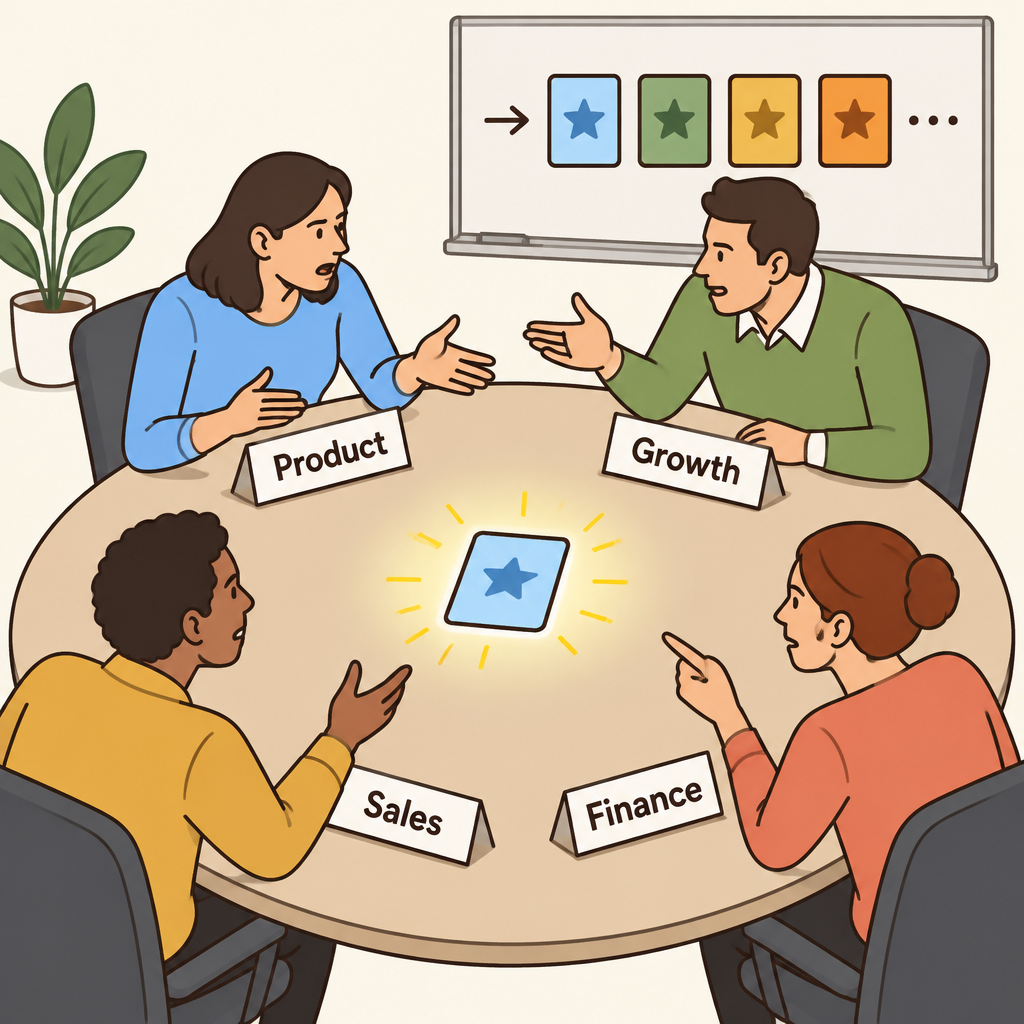
Notice that all four teams are pulling on the same single feature, and this scene repeats for the next one too.
Nobody is wrong to care. Each team has a real stake in how the feature is priced.
The trouble is that this debate happens again for every single feature. Without a written pricing philosophy, each decision is ad-hoc.
Four Ways to Package a Feature
Every pricing debate lands on the same short list of choices.
Free means every customer gets it. Paid means customers buy it.
Usage-gated means access depends on how much someone uses. Enterprise-only reserves it for the biggest plan.
- New feature: Every release faces the same choice.
- Free: Every customer gets it.
- Paid: Customers buy it.
- Usage-gated: Access depends on how much someone uses.
- Enterprise-only: Reserved for the biggest plan.
The options rarely change. What changes is the feature on the table.
So teams keep answering a familiar question from scratch, as if they had never answered it before.
Why the Debate Restarts Every Time
An ad-hoc decision solves one case. It does not leave behind a rule.
When no pricing philosophy is documented, there is nothing to point to next time. The reasoning stays in people's heads or old meeting notes.
So the next feature triggers the same debate. Same four departments, same arguments, same time spent.
- Feature ships: A new feature needs a pricing decision.
- Teams argue: Product, Growth, Sales, and Finance debate from scratch.
- Ad-hoc decision: One case gets solved, but no rule is created.
- Reasoning forgotten: It stays in heads or old meeting notes.
This is the cycle: ship, argue, decide, forget, repeat.
Shipping Faster Makes It Worse
This problem grows with output.
AI-assisted development lets teams build features faster. More teams can ship at the same time.
Every new feature is another pricing question. If each question needs its own meeting, the number of debates grows with the number of releases.
- Slower shipping
- Faster shipping
A company that once argued about pricing now and then can end up arguing about it constantly.
The Fix: One Source of Truth
The answer is a single source-of-truth document for your pricing philosophy.
It writes down how the company decides what is free, paid, usage-gated, or Enterprise-only.
When a new feature arrives, teams check the document first. If the feature fits an existing principle, the decision is fast.
If it does not fit, teams debate once, then update the document so the next similar feature is already settled.
- New feature arrives
- Check the document
- Fits a principle?
- Debate once: Only for genuinely new cases.
- Update the document: The next similar feature is settled.
- Apply the rule: A fast decision.
- Yes
- No
- Recheck
The Tension Does Not Go Away
A document fixes the repetition. It does not erase the disagreement.
Product, Growth, Sales, and Finance still want different things. Those goals can still pull against each other.
What changes is where the conflict happens. Teams argue about principles once, in one place, instead of reopening them feature by feature.
That alone saves a lot of repeated effort.
Spotting It in Your Own Work
Watch for a few telltale signs.
The same departments meet to price each new feature. Each decision starts from scratch. Nobody can point to a written rule.
When you see this, suggest writing the pricing philosophy down in one shared document.
Expect the tension to remain. The goal is to stop paying for the same debate over and over.
Check yourself
Once a company writes a single pricing philosophy document, Product, Growth, Sales, and Finance will stop disagreeing about pricing goals.
- True
- False
Answer: False
False. The document fixes the repetition, not the disagreement. The teams still want different things; what changes is that they argue about principles once, in one place, instead of feature by feature.
A _____ feature grants access based on how much someone uses it, while an _____ feature is reserved for the biggest plan.
Answer: A usage-gated feature grants access based on how much someone uses it, while an Enterprise-only feature is reserved for the biggest plan.
Usage-gated ties access to consumption; Enterprise-only reserves the feature for the top plan. Together with free (everyone gets it) and paid (customers buy it), these are the four packaging options every debate lands on.
A company prices each new feature in a meeting and reaches a sound decision every time. Yet the same debate keeps recurring with each release. What best explains why?
- Each decision resolves one case without leaving a reusable written rule
- The four packaging options change with every new feature
- The departments involved have no real stake in pricing
- Previous decisions were wrong and must be reversed each time
Answer: Each decision resolves one case without leaving a reusable written rule
An ad-hoc decision solves one case but leaves behind no rule. With reasoning stuck in people's heads or old meeting notes, there is nothing to point to next time, so the cycle repeats: ship, argue, decide, forget, repeat.
Keep going
This is lesson 1 of 9 in Pricing Constitutions: Writing Down Your Monetization Philosophy. Next up:
- What a Pricing Constitution Actually Is
- Principle 1: Charge for Value, Not Manufactured Friction
- Principle 2: Monetize Outcomes, Not Inputs
- Principle 3: Deliberately Choose What NOT to Monetize
- Principle 4: Minimize Pricing Dimensions and Plan Count
Wondering turns any topic into short lessons you can read, watch, or listen to, with practice questions and an AI tutor.