Free sample lesson · Good Inside
Good Inside
What if challenging behavior isn't a sign of a 'bad' child, but a signal that they're struggling?
Lesson 1 of the Wondering course Good Inside
A New Way to See Behavior
What if challenging behavior is a signal that a child is struggling, rather than proof of a 'bad' child?
This is the core of Dr. Becky's approach: everyone is good inside.
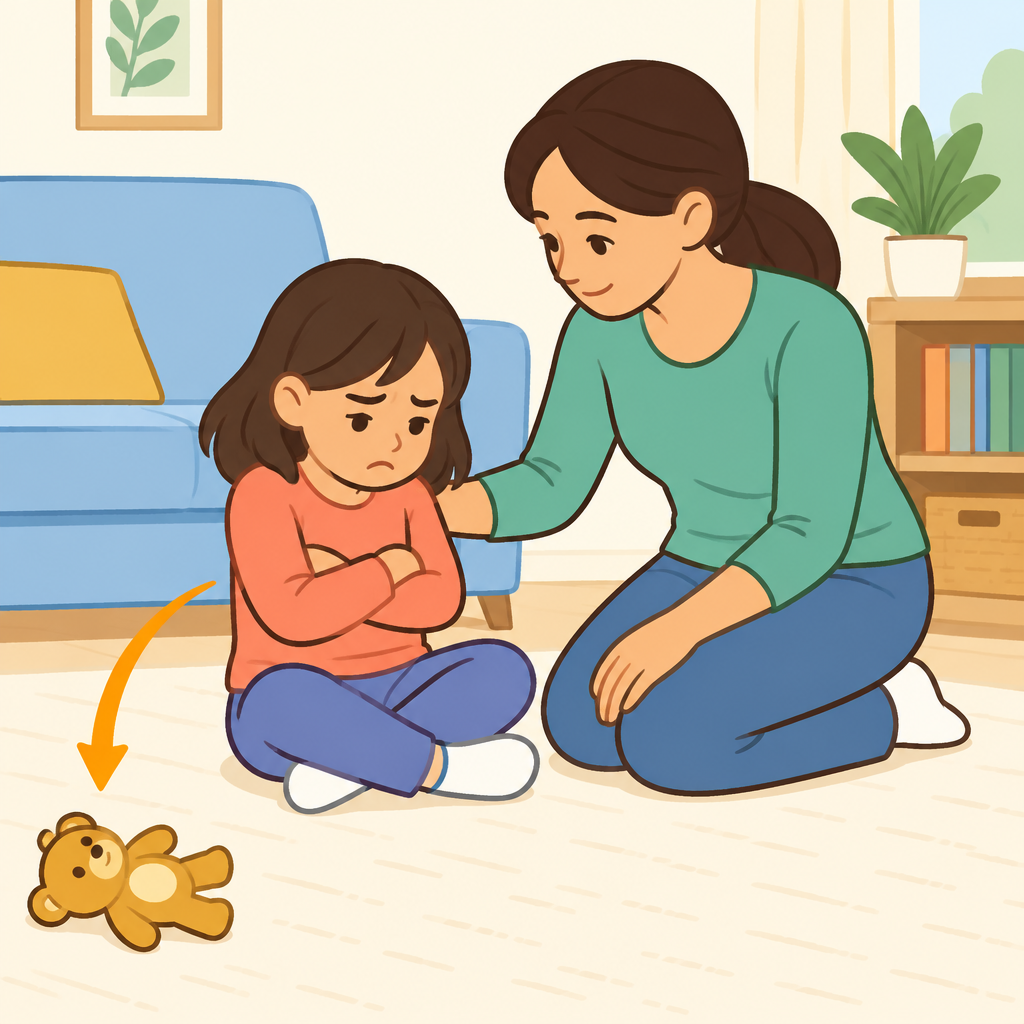
Notice how the parent stays close and calm, treating the outburst as a signal of struggle instead of a verdict on who the child is.
Being good inside means a person's inherent worth stays the same no matter what they do. Their actions can change. Their worth does not.
This one belief changes how we read behavior and how we respond to it.
Who They Are vs. What They Do
The framework separates two things we often blend together: a child's identity and their behavior.
A child who yells, grabs, or refuses is still a good kid. They are a good kid having a hard time.
Behavior is something a child does in a moment.
Identity is who they are at their core, and it stays good.
- Identity
- Behavior
Behavior Is a Signal
When a person is good inside, difficult behavior points to something else: an internal struggle.
Think of it as a signal. The behavior tells you something is hard for this person right now.
It does not tell you who they are.
So we stop asking "What is wrong with this kid?" and start asking "What is hard for this kid?" The response shifts from judgment and punishment toward curiosity and compassion.
- Judgment view
- Good Inside view
Curiosity Opens the Door
Believing someone is good inside makes it possible to be curious about not-so-good behavior.
If you think a child is bad, there is nothing to wonder about. You just punish.
If you trust they are good, you want to understand what is going on.
Curiosity creates space for genuine connection, and connection is where real change starts.
- Notice: See the not-so-good behavior.
- Remember: Recall that this person is good inside.
- Get curious: Wonder what is hard for them right now.
- Connect: Use that understanding to build genuine connection.
Good Inside Is Not "Anything Goes"
A common misunderstanding: if everyone is good inside, are all behaviors okay?
No. The framework does not say all behaviors are acceptable.
It says a person's worth is separate from their actions. You can still name a behavior as not okay.
What changes is the message underneath: you are good, and this behavior needs to change.
Parents Are Good Inside Too
This belief is not only for children. It applies to parents too.
You will lose your patience. You will say things you wish you had not.
Those moments are mistakes. They are not proof that you are a bad parent.
You are good inside even when you make mistakes. Seeing yourself this way makes it easier to be curious about your own hard moments.
Safety Makes Growth Possible
Why does this matter so much? The good inside framework creates psychological safety.
Psychological safety means feeling secure that your worth is not on the line when you struggle.
When people feel safe, they can connect and grow.
- Growth and change: People can change when they feel safe.
- Connection: Curiosity opens space to connect.
- Psychological safety: Worth is not on the line during a struggle.
- Good inside belief: Worth is separate from actions.
Each level rests on the one below
Key takeaway: see the struggle behind the behavior, stay curious, and remember that everyone, including you, is good inside.
Check yourself
Believing a child is "good inside" means that all of the child's behaviors are acceptable.
- True
- False
Answer: False
False. Being good inside is about a person's inherent worth, not about approving every action. Behavior can still be unacceptable while the child remains good at their core.
In the Good Inside view, a person's _____ stays constant, while their _____ can be good or bad. Bad behavior signals _____, not a bad person.
Answer: In the Good Inside view, a person's worth stays constant, while their behavior can be good or bad. Bad behavior signals struggle, not a bad person.
Inherent worth is fixed and separate from actions. Actions vary, and difficult actions are read as a sign that someone is struggling—"a good kid having a hard time."
A 6-year-old hits his sister after she takes his toy. Which response best reflects the Good Inside approach?
- Stop the hitting, then get curious about what he's struggling with
- Tell him hitting shows he's being a bad boy today
- Ignore the hitting since he is good inside anyway
- Send him away without discussion to teach a lesson
Answer: Stop the hitting, then get curious about what he's struggling with
The Good Inside approach treats hitting as a sign of struggle. The parent still stops the hitting but stays curious about what the child is going through. Labeling him "bad" or simply punishing confuses the behavior with who he is, and ignoring the hitting wrongly treats it as acceptable.
Keep going
This is lesson 1 of 21 in Good Inside. Next up:
- Identity Matters
- Two Truths
- Role Clarity
- Sturdy Boundaries
- Behavior Speaks
Wondering turns any topic into short lessons you can read, watch, or listen to, with practice questions and an AI tutor.