Free sample lesson · Design for How People Learn
Diagnosis
Why do so many training programs fail to change behavior?
Lesson 1 of the Wondering course Design for How People Learn
The Gap Before the Fix
Why do so many training programs fail to change behavior? Often, training was the wrong answer from the start.
The learning gap is the space between where a learner is now and where they need to be to show competence.
Not every performance problem is a training problem. Gaps come in five types: knowledge, skills, motivation, habit, and environment.
- Performance gap: Where learners are now versus where they need to be.
- Knowledge gap: Missing information.
- Skills gap: Needs practice and feedback.
- Motivation gap: Knows how, chooses not to.
- Habit and environment: Not yet automatic, or the system is broken.
- Habit gap
- Environment gap
Each type needs a different solution. Diagnose first, then design.
Knowledge Versus Skills Gaps
A knowledge gap means learners simply need information they do not have. Content delivery can close it, like sharing a new policy.
A skills gap is different. Learners need practice and feedback over time, with tasks that grow in complexity.
- Knowledge gap
- Skills gap
That is why a single training session is not enough for a skill.
Mixing these two up is a common reason training does not change behavior.
When They Know but Do Not Act
A motivation gap exists when learners know what to do but choose not to do it.
Picture a team that can explain a safety checklist perfectly, yet skips it on busy days.
More training will not fix this. They already have the knowledge and the skill.
Sending them to another course wastes time and resources, and the gap stays open.
Habits Need Practice in Context
A habit gap occurs when the right behavior has not become automatic yet.
The learner knows the step and can do it. But under everyday pressure, the old routine wins.
Closing this gap takes repeated practice in context, in the real setting where the behavior must happen.
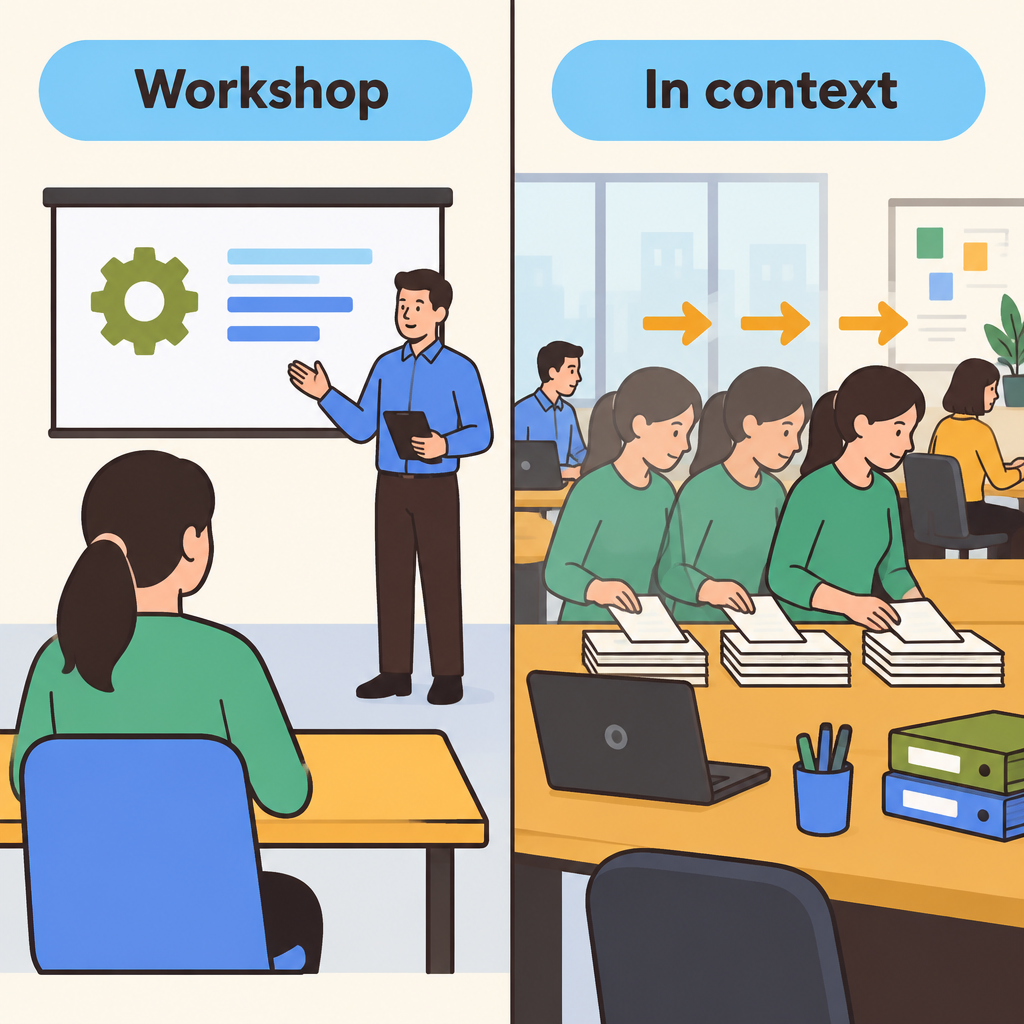
Notice that the habit forms on the right, where the same step is repeated in the real work setting rather than once in a separate room.
A single workshop held away from the job does not make a behavior automatic.
Fix the System, Not the Person
An environment gap means the system or resources are broken.
Think of staff who know the process and want to follow it, but the software crashes or the tools are missing.
Training these people changes nothing. The rule is simple: fix the environment, not the user.
- Fix the user
- Fix the environment
Repair the system and supply the resources, then check whether any gap remains.
Diagnose Before You Design
Before building any solution, ask questions that point to the root cause.
Is the system or a resource broken? Fix the environment. Are learners missing information? Deliver content.
Do they know what to do but choose not to? That is motivation, and training will not fix it.
If none apply, they need practice: built over time for skills, or repeated in context for habits.
- Performance problem
- System or resource broken?
- Fix the environment
- Missing information?
- Deliver content
- Know but choose not?
- Motivation: not training
- Build practice: Over time for skills, repeated in context for habits.
Your Diagnosis Cheat Sheet
Here is the whole diagnosis on one screen.
When you see a performance problem, name the gap type before you name a solution.
Then you can explain to a colleague why a course is, or is not, the right move.
Misdiagnosis leads to wasted time and resources. Good diagnosis points your effort where it will actually change behavior.
Check yourself
An employee knows the correct procedure and is able to do it, but chooses not to follow it. More training is _____ to close this gap.
- unlikely
- likely
Answer: unlikely
This is a motivation gap: the learner knows what to do but chooses not to do it. Training addresses missing knowledge or skill, so it won't fix a motivation problem.
A _____ gap can be closed by delivering information, while a _____ gap needs practice and feedback with increasing complexity over time.
Answer: A knowledge gap can be closed by delivering information, while a skills gap needs practice and feedback with increasing complexity over time.
Knowledge gaps are about missing information, so content delivery works. Skills gaps require repeated practice and feedback, so a single session is not enough.
Staff know how to log customer calls and can do it well, but under pressure they keep forgetting to do it because it isn't automatic yet. What type of gap is this?
- Habit gap
- Knowledge gap
- Motivation gap
- Environment gap
Answer: Habit gap
When the right behavior hasn't become automatic, it's a habit gap. The fix is repeated practice in the real work context, not more information.
Keep going
This is lesson 1 of 34 in Design for How People Learn. Next up:
- When Not to Train
- Know Your Learners
- Multiple Learner Types
- Performance Goals
- Essential Content
Wondering turns any topic into short lessons you can read, watch, or listen to, with practice questions and an AI tutor.