Free sample lesson · Atomic Habits
Compound Effect
If you improve by 1% daily for a year, you'll be 37 times better—not 365% better.
Lesson 1 of the Wondering course Atomic Habits
Small Changes, Big Results
Imagine getting just 1% better every day for one year.
Most people guess the result is 365% better. The real answer is far bigger: you end up about 37 times better.
- Daily improvement: Small enough to feel like nothing.
- Days of repetition: One full year of showing up.
- Final result: Far more than the 365% most people guess.
Gains that build on earlier gains grow far faster than simple addition.
That gap is the compound effect. Each day's gain builds on all the gains that came before it.
Small habits feel meaningless on any single day. Over months and years, their impact becomes enormous.
Habits Work Like Compound Interest
With compound interest, your money earns interest, and then that interest earns interest too.
Habits follow the same rule. The effects of your habits multiply as you repeat them.
- Repeat the habit: You do the small action again today.
- Gain 1%: You improve by a tiny amount.
- New starting point: Tomorrow's 1% is measured from this better you.
Adding 1% a day for 365 days gives 365% better. Multiplying instead gives $$1.01^{365} \approx 37$$.
Today's improved you becomes the new starting point for tomorrow's 1%.
Why Early Progress Feels Invisible
The compound curve starts flat. That is why small habits seem not to matter at first.
With 1% daily growth, after about 90 days you are roughly 2.4 times better. After 180 days, about 6 times. After 270 days, about 15 times.
- 1% daily
By day 365, you reach about 37 times better.
Most of the growth arrives late. People who quit early never see the steep part of the curve.
Marginal Gains: Many Small Wins
A marginal gain is a tiny improvement, often around 1%. An atomic habit is exactly this kind of small change that compounds over time.
The aggregation of marginal gains means searching for small improvements in everything you do.
One 1% gain is barely noticeable.
- One big change
- Many 1% gains
Stack many of them across different areas, and together they add up to a real advantage. Success comes from the total, not from one dramatic change.
The British Cycling Story
Dave Brailsford brought the aggregation of marginal gains to British Cycling.
His approach was to look for tiny 1% improvements in everything connected to the team.
No single change transformed the team.
Just five years later, British cyclists dominated the 2008 Olympics. Many small gains, compounded over time, produced a dramatic result.
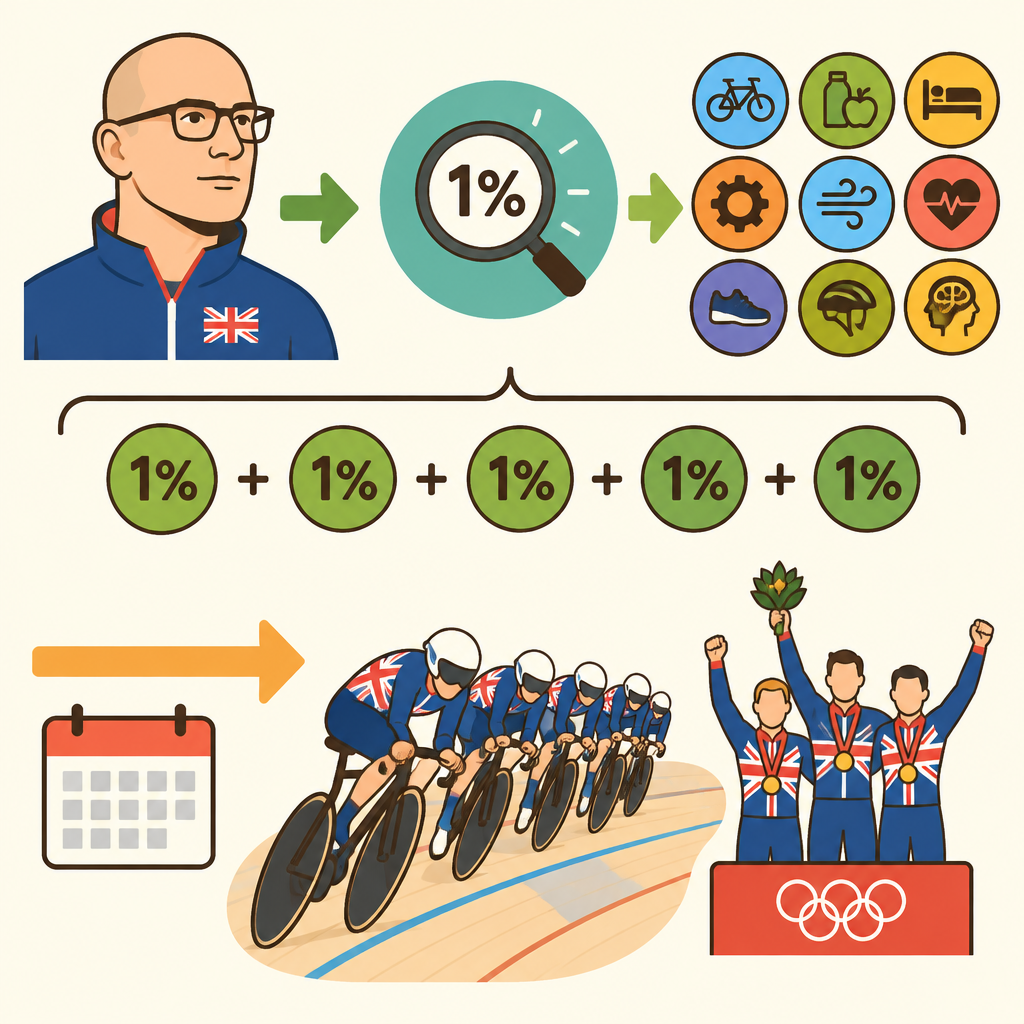
British cyclists at the 2008 Olympics, the payoff of many tiny gains
Staying the Course
The compound effect has a catch. On any given day, your habit seems to make almost no difference.
A 1% gain today is hard to notice.
Yet a year of those quiet days leads to about 37 times better.
So the real skill is keeping going while the results are still invisible.
Putting It to Work
You can use both ideas starting today.
To spot it in your own work, look for a habit that feels too small to matter. That is often where compounding hides.
Then search for 1% gains in several areas instead of waiting for one big breakthrough.
- Pick tiny: Choose a habit small enough to feel almost trivial.
- Repeat daily: Let each day's gain become tomorrow's starting point.
- Widen the search: Look for 1% gains in several areas, not one.
- Give it time: Keep going through the flat early part of the curve.
To explain it to a colleague: small improvements multiply over time, and many of them together win.
Check yourself
An 'atomic habit' is best described as a _____ that compounds over time.
- tiny change
- dramatic overhaul
Answer: tiny change
An atomic habit is a tiny change or marginal gain. Its power comes from repetition and compounding, not from being large or dramatic.
Daily progress compounds: improving _____ each day for one year leaves you about _____ better.
Answer: Daily progress compounds: improving 1% each day for one year leaves you about 37 times better.
Because each day's small gain builds on the previous day's, 1% daily improvement multiplies to about 37 times better after a year—far more than simply adding up 365 small gains.
Why are habits often called 'the compound interest of self-improvement'?
- Their effects multiply as they are repeated over time
- They deliver large results immediately on the first day
- They require spending money to see any benefit
- Their effects stay the same no matter how often repeated
Answer: Their effects multiply as they are repeated over time
Just as compound interest makes money multiply by building on previous growth, habits multiply their effects as they are repeated. The results are small at first and large over time.
Keep going
This is lesson 1 of 25 in Atomic Habits. Next up:
- Trajectory Over Position
- Breakthrough Through Patience
- Systems Over Goals
- Identity-Based Habits
- Habit Loop
Wondering turns any topic into short lessons you can read, watch, or listen to, with practice questions and an AI tutor.