Free sample lesson · Atomic Habits
Compound Effect
If you improve by 1% daily for a year, you'll be 37 times better—not 365% better.
Lesson 1 of the Wondering course Atomic Habits
Small Gains Become Powerful
Imagine improving by 1% each day. After one year, that steady progress can make you 37 times better, rather than 365% better.
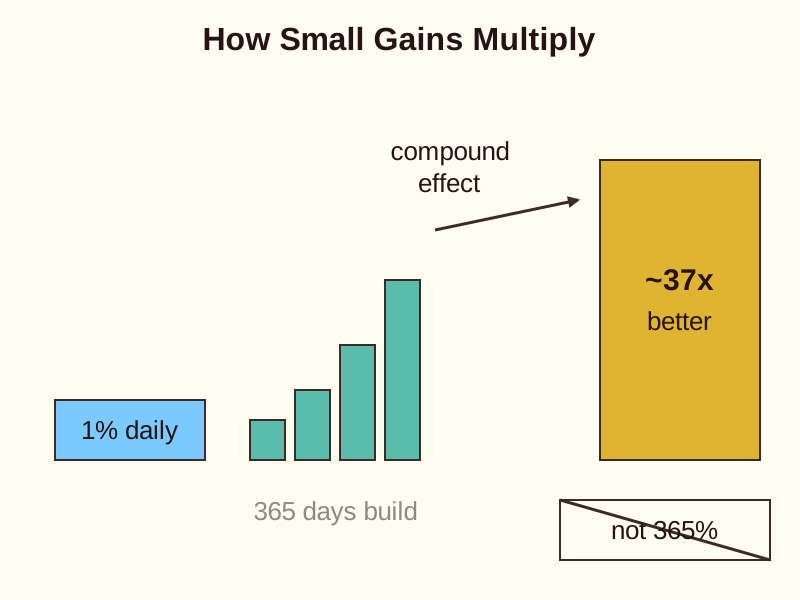
The compound effect explains why.
Small habits may feel invisible today. Repeated over months and years, however, their results build upon earlier results and become enormous.
Success often grows quietly before anyone notices.
How Compounding Works
A single 1% improvement looks almost too small to matter. You may not notice a major difference after one day, or even one week.
Compounding changes the picture. Each improvement becomes part of the starting point for the next improvement, so progress multiplies instead of simply adding.
That is why 1% daily for 365 days does not equal 365% improvement. The repeated process leads to roughly 37 times the result.
- Improve: Begin with one improvement of 1%.
- Build: Each improvement becomes part of the starting point for the next one.
- Multiply: After 1% daily for 365 days, the repeated process leads to roughly 37 times the result rather than 365% improvement.
Habits Build Over Time
Habits work like compound interest. Money can multiply when interest repeatedly earns more interest; personal gains can multiply when useful habits repeat.
- Compound interest
- Personal gains
An atomic habit is a tiny change that is easy to repeat. Its daily effect may seem modest, yet repetition gives it power.
Missing one dramatic breakthrough is not the main risk. Stopping the small process prevents future gains from building.
The Cycling Example
Dave Brailsford applied this idea to British Cycling through the aggregation of marginal gains.
His team searched for tiny 1% improvements in everything, rather than waiting for one dramatic change.
Five years later, British cyclists dominated the 2008 Olympics. The timeline shows how many small gains can become a visible result.
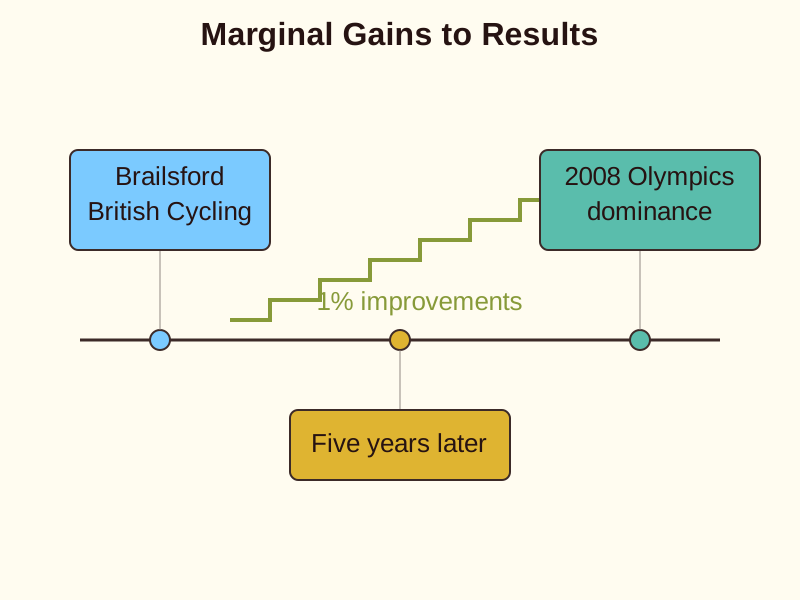
The lesson applies beyond sport: examine each part of a goal and look for a small improvement.
Add Gains Across Areas
Marginal gains become powerful when they add up across multiple areas. One small improvement may help practice, while another improves preparation or consistency.
Each area contributes a little. Together, these gains can create a much larger change than one isolated adjustment.
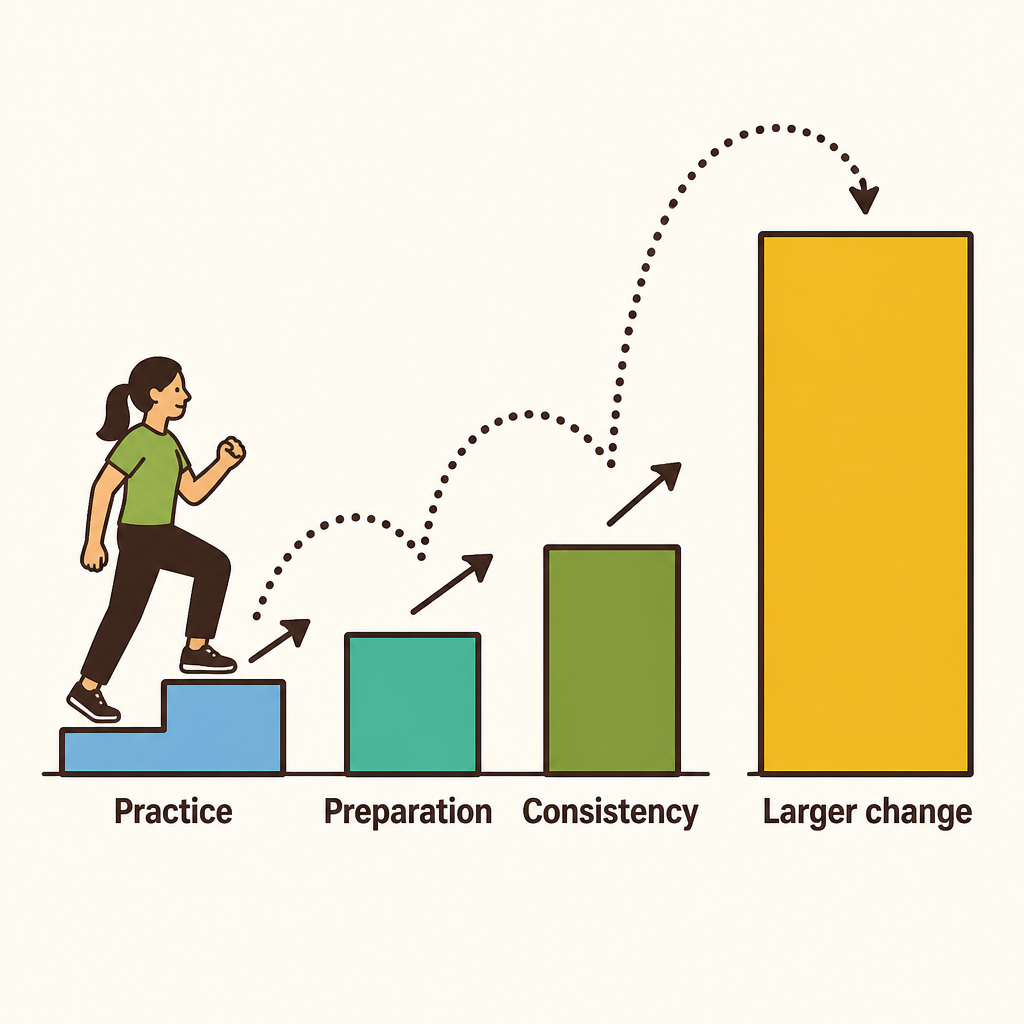
See how small contributions from different parts of a process combine into a larger change.
Ask, Where can I improve by 1%? Then repeat the question across the process, instead of searching for a perfect solution.
Apply The Compound Effect
Start with one atomic habit that you can repeat daily. Make the action small enough to complete even when motivation is low.
Focus on consistency before intensity. A tiny action repeated for months has more compounding potential than a dramatic action performed once.
Remember the core numbers: 1% each day, 365 days, and about 37 times better. Small gains become powerful when you keep adding them.
- Choose: Start with one atomic habit that is small enough to complete even when motivation is low.
- Repeat: Perform the tiny action daily and prioritize consistency before intensity.
- Compound: Keep adding the small gains for 1% each day across 365 days, aiming for about 37 times better.
Check yourself
Success can come from _____ across several areas rather than waiting for one _____.
Answer: Success can come from marginal gains across several areas rather than waiting for one dramatic change.
Marginal gains are small improvements made across different parts of a process. Together, they can produce a much larger result than waiting for one dramatic change.
What does the compound effect describe?
- Small repeated gains become much larger over time
- One dramatic action creates nearly all improvement
- Daily progress stays exactly the same size
- Results appear immediately after one attempt
Answer: Small repeated gains become much larger over time
The compound effect means repeated small improvements build on earlier improvements. Their long-term impact can become much larger than the daily change suggests.
If improvement compounds at 1% each day for 365 days, what result is described in the example?
- 365% better
- About 37 times better
- About 3.65 times better
- 1% better
Answer: About 37 times better
A 1% improvement repeated daily compounds rather than simply adding 1% each day. After 365 days, the result is roughly 37 times better.
Keep going
This is lesson 1 of 25 in Atomic Habits. Next up:
- Trajectory Over Position
- Breakthrough Through Patience
- Systems Over Goals
- Identity-Based Habits
- Habit Loop
Wondering turns any topic into short lessons you can read, watch, or listen to, with practice questions and an AI tutor.