Free sample lesson · Atomic Habits
Compound Effect
If you improve by 1% daily for a year, you'll be 37 times better—not 365% better.
Lesson 1 of the Wondering course Atomic Habits
The 1% Math Surprise
Get 1% better every day for a year. How much better are you at the end?
Most people guess around 365%. The real answer is 37 times better.
- Daily improvement: The size of the change you repeat each day.
- Common guess: What most people expect if the gains simply add up.
- Real result: What you reach when the gains multiply instead.
The gap between the guess and the result is the compound effect.
That gap between the guess and the reality is the whole lesson. Small gains do not add. They multiply.
What an Atomic Habit Is
An atomic habit is a tiny change or marginal gain that compounds over time.
The word tiny matters. The habit must be small enough that you keep repeating it.
- Tiny change: Small enough that you keep repeating it.
- Marginal gain: A small improvement rather than a dramatic one.
- Repetition: The habit is repeated rather than made bigger.
- Compounding: The change compounds over time.
Size is not the point. Repetition is.
Habits as Compound Interest
Habits are the compound interest of self-improvement.
Money multiplies through compound interest. Each gain sits on top of the last one and earns more.
- Compound interest
- Habits
Your habits work the same way. The effects multiply as you repeat them.
Why Today Feels Pointless
Small habits do not seem to make much difference on any given day.
One workout does not change your body. One page does not write a book.
This is the trap. The daily signal is too weak to notice, yet the impact delivered over months and years can be enormous.
Aggregating Marginal Gains
Dave Brailsford introduced the aggregation of marginal gains to British Cycling.
The idea: search for tiny 1% improvements in everything, rather than hunting for one dramatic change.
- Pick an area: Choose one part of the system to examine.
- Find 1%: Search for a tiny improvement rather than a dramatic change.
- Apply it: Make the small change part of normal practice.
- Move on: Take the search to the next area and begin again.
No single 1% wins a race. Stacked across many areas, they add up to a different team.
British Cycling's Result
Brailsford's method was not theory for long.
Just five years later, British cyclists dominated the 2008 Olympics.
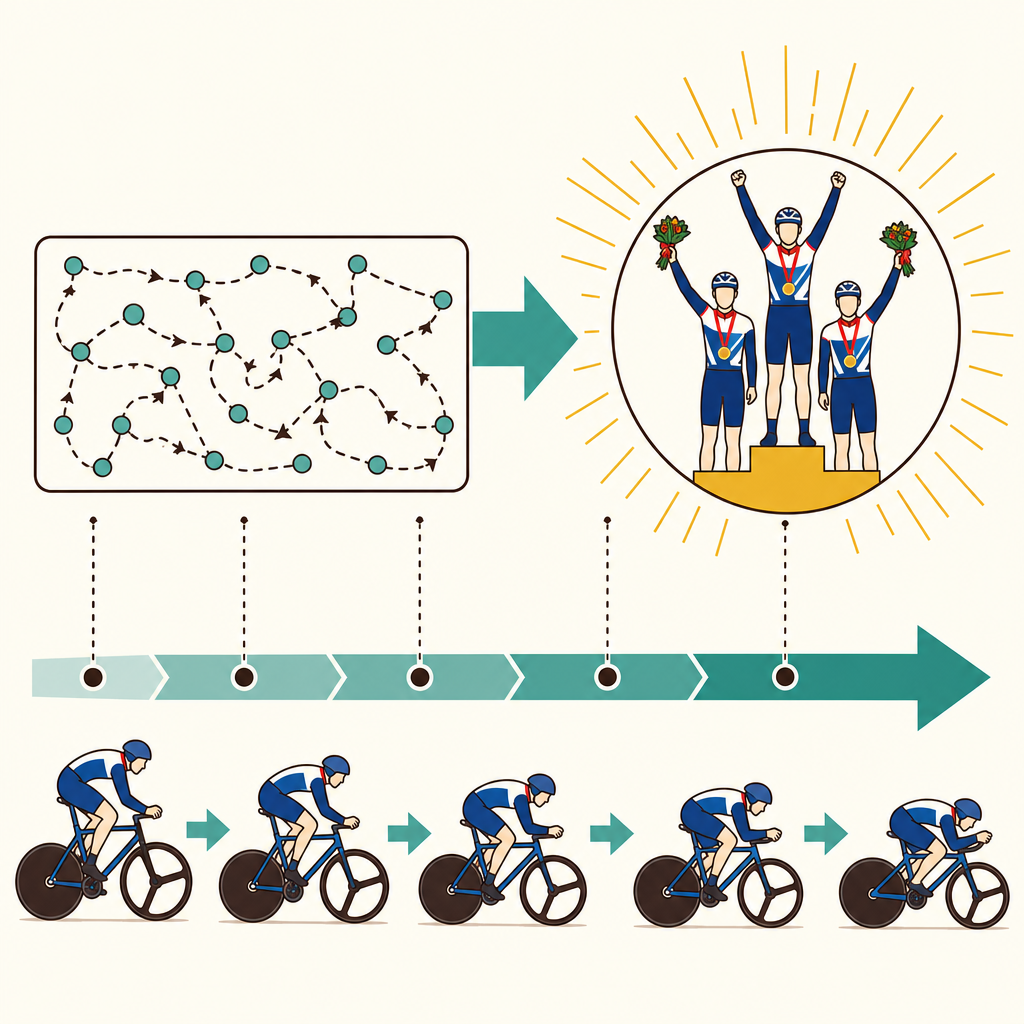
The visible end of an invisible process
Five years of small searches produced a result that looked sudden from the outside.
Small Change, Big Change
Most people wait for the dramatic transformation.
The marginal gains approach does the opposite. It looks for 1% in everything and repeats.
- One dramatic change
- Marginal gains
One of these strategies is easy to start today. The other is easy to postpone forever.
Compounding Runs Both Ways
Compounding does not care about direction.
A habit repeated is a habit multiplied, whether it helps you or costs you.
- 1% daily gains
- 37 times better
- Repeated without thinking
- Quietly multiplies
The same math that turns 1% daily gains into 37 times better also quietly multiplies the small things you repeat without thinking.
Putting It To Work
Start with one area and find a 1% improvement you can repeat.
Judge the habit by whether you repeated it, not by today's result.
- Choose small: Pick a 1% improvement you can repeat every day.
- Repeat: Score yourself on repetition rather than on today's result.
- Widen: Search the next area for another 1% improvement.
- Wait: Give the multiplication months and years to show up.
Then widen the search. Aggregation is what turned 1% into 37 times better, and British Cycling into 2008 Olympic champions.
Check yourself
After improving by 1% every day for one year, would a person be approximately 37 times better rather than 365% better?
- Yes
- No
Answer: Yes
Yes. Daily 1% improvements multiply, so the result is approximately 1.01³⁶⁵, or 37 times better. Adding 1% for each day would incorrectly produce about 365%.
A tiny change that is easy to repeat is an _____. Improvements gathered across many areas illustrate _____. Repeated effects multiplying over time show the _____.
Answer: A tiny change that is easy to repeat is an atomic habit. Improvements gathered across many areas illustrate marginal gains. Repeated effects multiplying over time show the compound effect.
An atomic habit is the small repeatable behavior. Marginal gains are the collection of small improvements across areas. The compound effect is the multiplication of repeated effects over time.
A student reads one page every night but sees no immediate change in the size of a book. Which idea best explains why continuing may still matter?
- Daily actions matter only when they produce visible results
- Repeated small actions can multiply into a large long-term result
- One dramatic action is required before progress can begin
- Small actions cancel out unless they are performed in different areas
Answer: Repeated small actions can multiply into a large long-term result
The compound effect can make repeated small actions produce a large result over months or years, even when one day's progress is hard to notice.
Keep going
This is lesson 1 of 25 in Atomic Habits. Next up:
- Trajectory Over Position
- Breakthrough Through Patience
- Systems Over Goals
- Identity-Based Habits
- Habit Loop
Wondering turns any topic into short lessons you can read, watch, or listen to, with practice questions and an AI tutor.