Free sample lesson · Applied Behavioral Insights
Two Mental Systems
Why does 2 + 2 feel effortless while 17 × 24 requires concentration?
Lesson 1 of the Wondering course Applied Behavioral Insights
Two Ways of Thinking
Why does $$2 + 2$$ feel effortless while $$17 × 24$$ demands concentration? Your mind handles these tasks through two mental systems.
System 1 works quickly and automatically. System 2 uses deliberate attention for demanding tasks.
- System 1
- System 2
Both systems shape judgments, choices, and reactions. Recognizing which system is active helps you spot when a decision deserves closer inspection.
System 1 Acts Automatically
System 1 operates quickly, with little effort and no sense of voluntary control.
It generates impressions and feelings continuously. You usually do not choose to begin this process or notice every step.
For example, $$2 + 2$$ feels immediately solvable. The answer appears without deliberate calculation, allowing your attention to remain available for other activities.
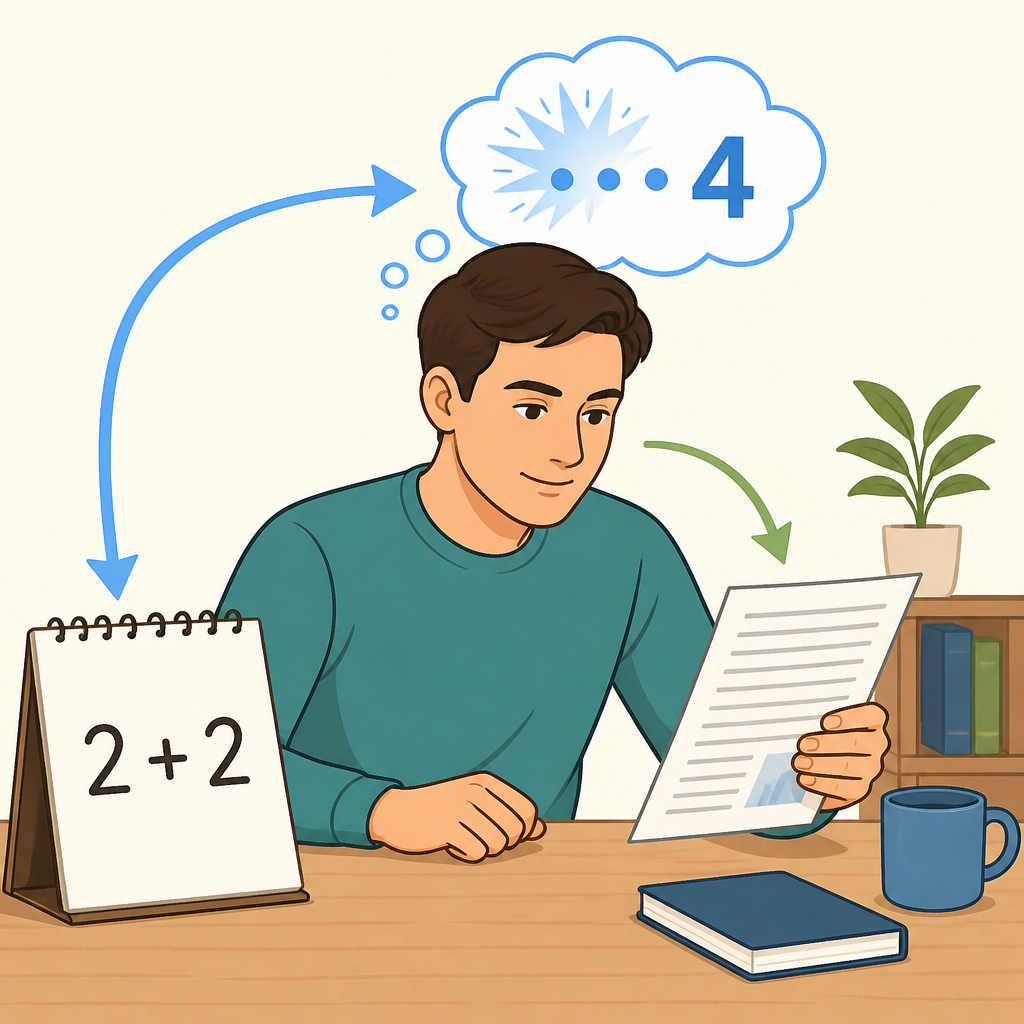
Notice how the simple answer appears immediately while the person’s attention remains free for another activity.
System 1 Creates Impressions
System 1 does more than answer simple calculations. It rapidly produces impressions about situations, choices, and likely meanings.
These impressions can feel clear because they arrive effortlessly. A product feature may seem appealing, or a business proposal may feel convincing, before careful analysis begins.
The feeling itself is real. However, it does not guarantee that the judgment is accurate.
System 2 Requires Effort
System 2 allocates attention to mental activities that demand effort.
It handles complex computations and conscious decision-making. Solving $$17 × 24$$ requires you to hold steps in mind and work through them deliberately.
System 2 can check an intuitive answer, compare alternatives, or follow a careful process. Because this work consumes attention, people often avoid using it unless a task clearly requires it.
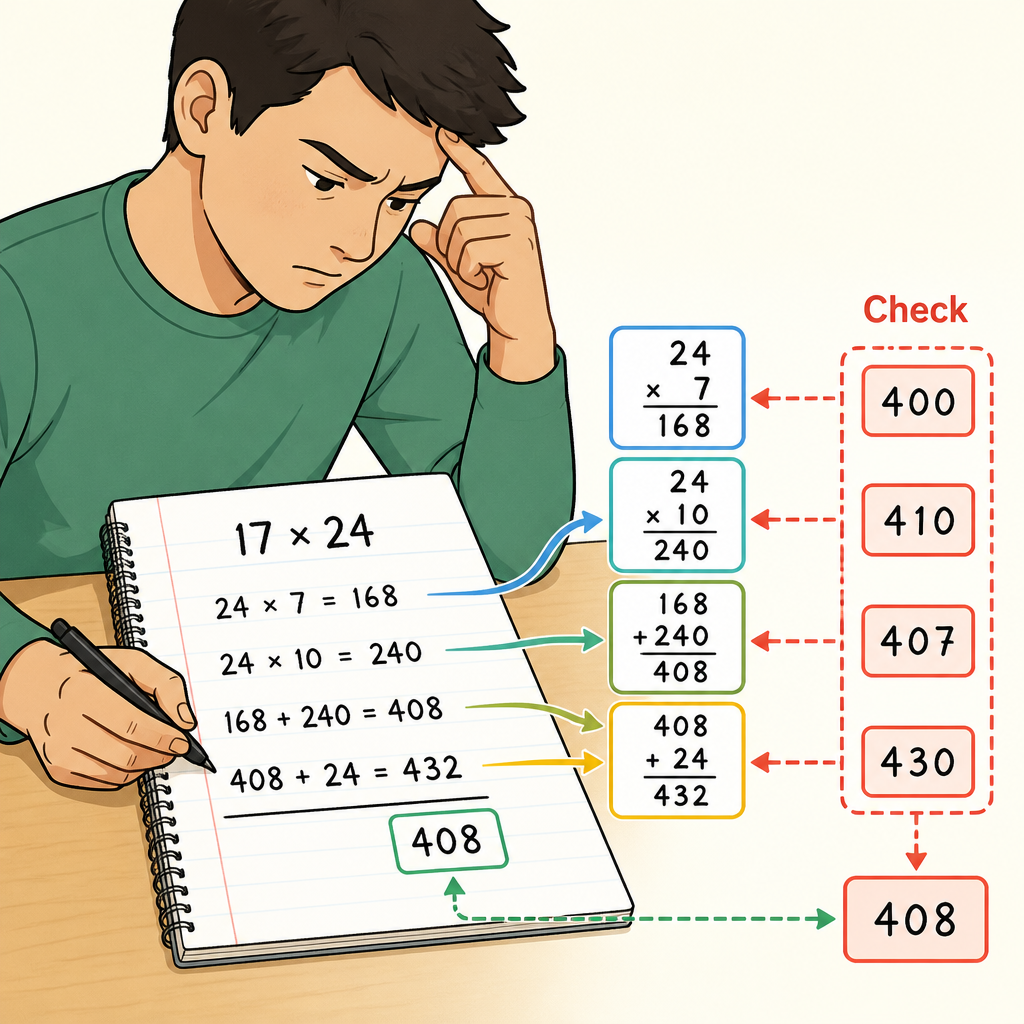
Notice the visible effort of holding steps in mind, working through a complex calculation, and checking an intuitive answer.
The Bat And Ball Problem
Consider this question: a bat and ball cost $1.10 together. The bat costs $1.00 more than the ball. How much does the ball cost?
System 1 immediately suggests $0.10. That answer feels right because $1.00 plus $0.10 equals $1.10.
Pause and use System 2. The correct answer is $0.05: the bat costs $1.05, making the total $1.10.
- Hear the total: The bat and ball together cost $1.10.
- Test the intuition: The quick answer of $0.10 for the ball leaves $1.00 for the bat, which does not make the bat $1.00 more than the ball.
- Solve deliberately: The ball costs $0.05 and the bat costs $1.05, totaling $1.10.
Why Intuition Can Mislead
The bat and ball problem reveals a common misconception: a fast answer is not automatically a correct answer.
System 1 offers a plausible response before System 2 checks the relationship between the prices. The error survives when the answer feels familiar or simple.
A useful signal is effort. When a question involves several connected steps, slow down and verify the impression produced by intuition.
- Notice effort: Recognize when a question involves several connected steps.
- Slow down: Do not treat a plausible or familiar first answer as automatically correct.
- Verify relationships: Check whether the answer fits all parts of the question.
Decisions At Work
Managers often receive immediate impressions about proposals, priorities, or risks. Product designers also notice quick reactions to an interface or feature.
Those reactions can guide attention, but they should not always settle the decision. Ask whether the choice involves complex comparisons or consequences.
If it does, deliberately engage System 2. Write down the steps, inspect the assumptions, and check whether the first answer truly fits.
- First impression: Notice the reaction to a proposal, priority, risk, interface, or feature.
- Assess the choice: Consider its comparisons and consequences.
- Engage System 2: Write steps, inspect assumptions, and check the first answer.
- Act on judgment: Proceed after the choice has been examined.
- Complex or consequential
- Straightforward
- Verified
Use Both Systems Wisely
System 1 keeps thinking fast and efficient, producing impressions and feelings without voluntary control. System 2 handles effortful analysis and conscious decisions.
System 2 is capable of checking System 1, yet it is often lazy and defers to the first answer. This makes deliberate pauses valuable.
When a judgment matters, treat intuition as a starting signal. Then calculate, compare, or verify before acting.
- Notice intuition: Treat the first impression or feeling as a starting signal.
- Analyze deliberately: Use System 2 to calculate or compare when the judgment matters.
- Verify the fit: Check whether the analysis supports the initial impression.
- Act carefully: Make the decision after the verification step.
Check yourself
System 1 operates automatically and quickly, without requiring deliberate attention.
- True
- False
Answer: True
This is true. System 1 works quickly with little effort and no sense of voluntary control.
Choose from: impressions; complex computations. System 1 continuously generates _____, while System 2 handles _____.
Answer: Choose from: impressions; complex computations. System 1 continuously generates impressions, while System 2 handles complex computations.
System 1 quickly produces impressions and feelings. System 2 uses deliberate attention for demanding mental work.
A bat and ball cost USD 1.10 together. The bat costs USD 1.00 more than the ball. How much does the ball cost?
- USD 0.05
- USD 0.10
- USD 0.15
- USD 1.00
Answer: USD 0.05
The ball costs USD 0.05. The bat then costs USD 1.05, and USD 1.05 + USD 0.05 equals USD 1.10. The tempting USD 0.10 answer does not satisfy the price difference.
Keep going
This is lesson 1 of 32 in Applied Behavioral Insights. Next up:
- System 2 Laziness
- Mental Effort Limits
- Cognitive Ease
- Priming Effects
- Anchoring Effect
Wondering turns any topic into short lessons you can read, watch, or listen to, with practice questions and an AI tutor.