Free sample lesson · AI Biology Frontiers
Why Structure Matters
Why did a 50-year folding problem bottleneck biology?
Lesson 1 of the Wondering course AI Biology Frontiers
A 50-Year Bottleneck
The AlphaFold 2 Nature paper frames one question as an open problem for more than 50 years: how does a protein's amino acid sequence become its three-dimensional shape?
Reading the sequence is easy. Predicting the fold was not.
That gap slowed biology, because the folded shape carries much of what scientists actually want to know.
One Dimension Versus Three
A sequence is a one-dimensional description: a chain of amino acid letters in order.
Function usually depends on three-dimensional features. Folding creates contacts, pockets, surfaces, and motions.
- Sequence
- Structure
Those features are what other molecules touch. The letters alone do not show them.
The Kinase Pocket
A kinase sequence tells you the protein may transfer phosphates. Useful, but vague.
The folded structure shows where ATP and substrates could bind.
An active site only makes sense once amino acids that sit far apart in the chain fold together into one pocket.
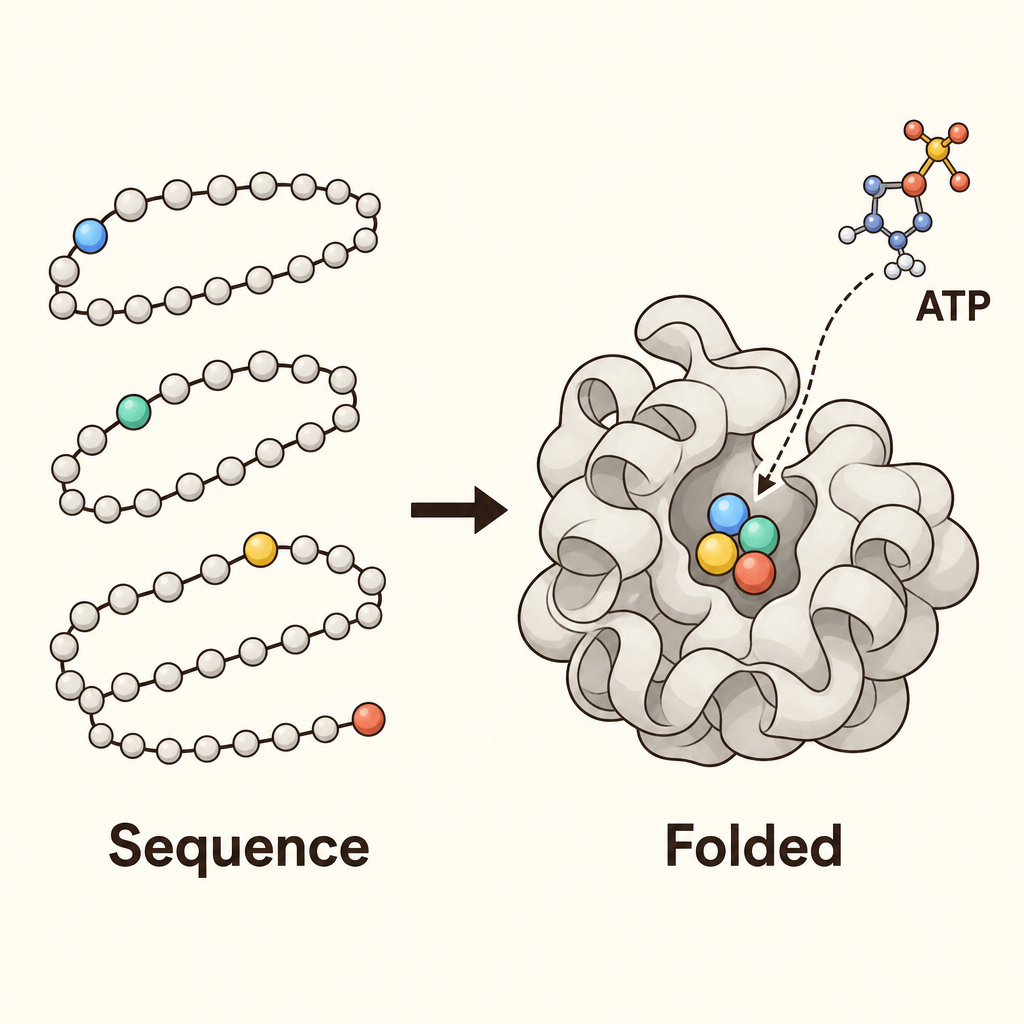
Notice that the residues lining the pocket sit far apart along the chain, which is why the sequence alone never shows the active site.
Reading A Mutation
The same disease mutation can mean different things depending on where it lands in the fold.
Buried in the core, it may destabilize the protein. On a protein-protein interface, it may break a partnership.
In a flexible tail, the interpretation changes again.
Why AI Broke Through
Structures are normally measured with X-ray crystallography, cryo-EM, or NMR. These methods are powerful, but slow and unevenly available.
AI learned a mapping from many known sequences and structures to new ones.
That reduced the need to solve every target experimentally before forming a hypothesis.
- Measure: X-ray crystallography, cryo-EM, or NMR solve structures slowly and unevenly.
- Accumulate: Many known sequences and structures build up over decades.
- Learn mapping: AI learns to map sequence to structure from those known pairs.
- Predict first: Hypotheses form without solving every target experimentally.
What A Prediction Is Not
A predicted structure is not a complete explanation of dynamics, binding strength, or cellular behavior.
It is a hypothesis-generating map, not the whole experiment.
A common misconception is that biology only needed prettier molecular pictures. The practical win is faster mechanistic reasoning across targets that lacked structures.
- Map for hypotheses
- Needs experiment
Sequence, Structure, Function
Hold the chain together: sequence gives letters, folding gives shape, shape enables function.
Name one decision a predicted structure can change. Where to target a drug pocket. Which mutation to prioritize. Which mechanism to test first.
That is the real payoff of solving the fold.
- Sequence: A one-dimensional chain of amino acid letters.
- Function: Binding, catalysis, and stability depend on shape.
- Drug pocket: Structure shows where a drug could bind.
- Disease mutation: Location in the fold changes the interpretation.
- AI prediction: Learned mapping from known sequences and structures.
Check yourself
Does an amino acid sequence alone usually reveal the exact three-dimensional binding pocket of a protein?
- Yes
- No
Answer: No
No. A sequence gives the order of amino acids, but folding reveals the contacts and pocket where molecules can bind.
In an AI structure-prediction workflow, researchers first _____ structures experimentally, then _____ known sequence–structure pairs, next AI _____, and finally researchers _____ for new targets.
Answer: In an AI structure-prediction workflow, researchers first measure structures experimentally, then accumulate known sequence–structure pairs, next AI learns the mapping, and finally researchers predict first for new targets.
Experimental measurements provide known examples. AI learns from those sequence–structure pairs, allowing researchers to form predictions before solving every new structure experimentally.
Why does a kinase’s folded structure reveal more about its active site than its amino acid sequence alone?
- It shows how distant amino acids form one binding pocket
- It changes the amino acid letters into different letters
- It proves exactly how the kinase behaves inside every cell
- It makes experimental structure measurements unnecessary in all cases
Answer: It shows how distant amino acids form one binding pocket
Folding can bring amino acids that are far apart in the sequence together into one pocket. That pocket shows where ATP and substrates could bind.
Keep going
This is lesson 1 of 12 in AI Biology Frontiers. Next up:
- How AlphaFold Learns Folds
- Trust, Confidence, Limits
- AlphaFold 3 Interactions
- Language Models for Proteins
- Open Models After AF3
Wondering turns any topic into short lessons you can read, watch, or listen to, with practice questions and an AI tutor.