An introduction to psychology: its history, major schools of thought, and how to understand it
Psychology is the scientific study of the mind and behavior. It grew out of philosophy and physiology and became its own science in 1879, when Wilhelm Wundt opened a psychology lab in Leipzig. Since then, rival schools have shaped it: structuralism, functionalism, psychoanalysis, behaviorism, Gestalt, humanistic psychology, and the cognitive approach that dominates today. Modern psychology splits into fields such as cognitive, developmental, social, clinical, biological, and personality psychology, and it relies on experiments and careful statistics. To understand it, start with a free textbook like OpenStax Psychology 2e, read a few original studies, and stay skeptical of pop-psychology claims. Wondering can turn any psychology topic into 3-minute lessons with practice after each one and spaced review, and it is free to start.
| School | Big idea | Key thinkers | Era |
|---|---|---|---|
| Structuralism | Break conscious experience into basic elements | Wilhelm Wundt, Edward Titchener | 1879 to 1920s |
| Functionalism | Ask what the mind is for and how it helps us adapt | William James, John Dewey | 1890s to 1920s |
| Psychoanalysis | Hidden, unconscious conflicts drive behavior | Sigmund Freud, Carl Jung | 1890s onward |
| Behaviorism | Study only observable behavior and how it is learned | Ivan Pavlov, John B. Watson, B. F. Skinner | 1913 to 1950s |
| Gestalt | We perceive whole patterns, not separate pieces | Max Wertheimer, Wolfgang Köhler, Kurt Koffka | 1910s to 1940s |
| Humanistic | People strive to grow and reach their potential | Abraham Maslow, Carl Rogers | 1950s to 1970s |
| Cognitive | The mind processes information: memory, attention, reasoning | George Miller, Ulric Neisser, Daniel Kahneman | 1950s to today |
| Evolutionary | Many mental traits were shaped by natural selection | Leda Cosmides, John Tooby, David Buss | 1990s to today |
What psychology is
Psychology is the scientific study of the mind and behavior. It asks how we perceive, remember, think, feel, learn, decide, and relate to other people, and why those things sometimes go wrong. The word comes from the Greek psyche, meaning soul or mind, and logia, meaning study.
What makes psychology a science, rather than a set of opinions about people, is its method. Psychologists turn questions into testable predictions, gather data, and check whether the data fit. A claim like "sleep helps memory" is not accepted because it sounds right. It is accepted because many experiments, run by different teams, keep finding it.
Psychology is also broad. The same department might hold someone studying how single neurons fire, someone studying how toddlers learn words, and someone running therapy trials for depression. That range is part of what makes the field confusing at first, and part of what makes it interesting.
A long past, a short history
The German psychologist Hermann Ebbinghaus wrote that psychology has a long past but only a short history. The long past is philosophy. Aristotle wrote On the Soul, one of the first works on memory, perception, and the mind. In the 1600s, René Descartes argued that mind and body are different kinds of things, a view called dualism. John Locke argued that the mind starts out like a blank slate, filled in by experience.
The short history begins in the 1800s, when physiologists started measuring the mind. Hermann von Helmholtz measured the speed of nerve signals. Gustav Fechner, in his Elements of Psychophysics (1860), showed how to relate the strength of a stimulus, like the weight of an object, to how strong it feels. Charles Darwin then gave psychology a new question: how did the mind evolve, and what is it for?
Turning points in psychology
- 1879: Wundt opens lab: Wilhelm Wundt opens a psychology laboratory at the University of Leipzig.
- 1890: James writes Principles: William James publishes The Principles of Psychology, the founding text of American psychology.
- 1899: Freud on dreams: Sigmund Freud publishes The Interpretation of Dreams, dated 1900 on its title page.
- 1913: Behaviorism launched: John B. Watson argues psychology should study only observable behavior.
- 1950s: Cognitive revolution: George Miller, Noam Chomsky, and others bring the inner mind back into the lab.
- 1998: Positive psychology: Martin Seligman uses his term as president of the American Psychological Association to promote the study of well-being.
- 2015: Replication project: The Open Science Collaboration repeats 100 published studies and finds that many results do not hold up.
1879: Wundt, the first lab, and structuralism
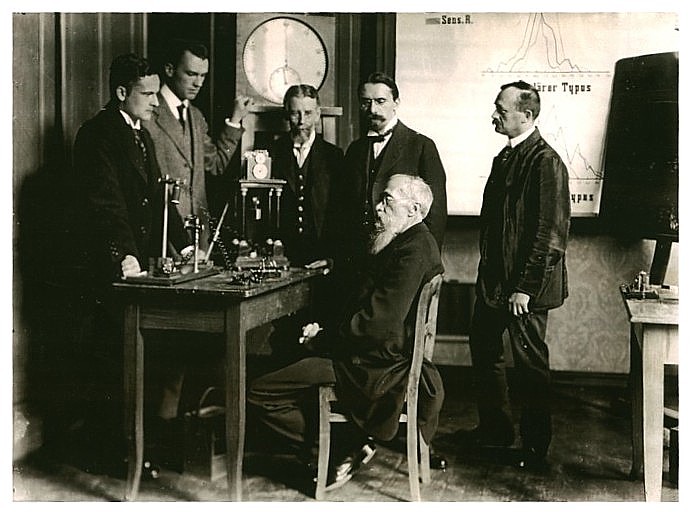
Most histories date modern psychology to 1879, when Wilhelm Wundt set up a laboratory for psychological research at the University of Leipzig. Wundt timed how fast people reacted to sounds and lights, and trained observers to report their sensations under controlled conditions. Students came from across Europe and North America to train with him, then went home and built labs of their own.
One of them, Edward Titchener, took a strict version of this approach to Cornell University and called it structuralism. The goal was to break conscious experience into its basic elements, the way chemists break matter into elements. The method was trained introspection: looking inward and reporting exactly what you sense.
Structuralism faded after Titchener died in 1927. Introspection turned out to be hard to check. If two trained observers reported different experiences, there was no way to tell who was right. But the idea that the mind could be studied with careful measurement in a lab has lasted.

Functionalism and William James
In the United States, William James at Harvard asked a different question. Instead of what the mind is made of, he asked what it is for. Influenced by Darwin, he saw habits, attention, and emotions as tools that help living things adapt. This approach became known as functionalism, and John Dewey and James Angell developed it further at the University of Chicago.
James's two-volume The Principles of Psychology (1890) took him about twelve years to write and is still read today. It described consciousness as a continuous stream rather than a set of parts, which is where the phrase "stream of consciousness" comes from. Functionalism never became a tight school, but its focus on usefulness fed into educational psychology, applied psychology, and later evolutionary psychology.
Freud and psychoanalysis
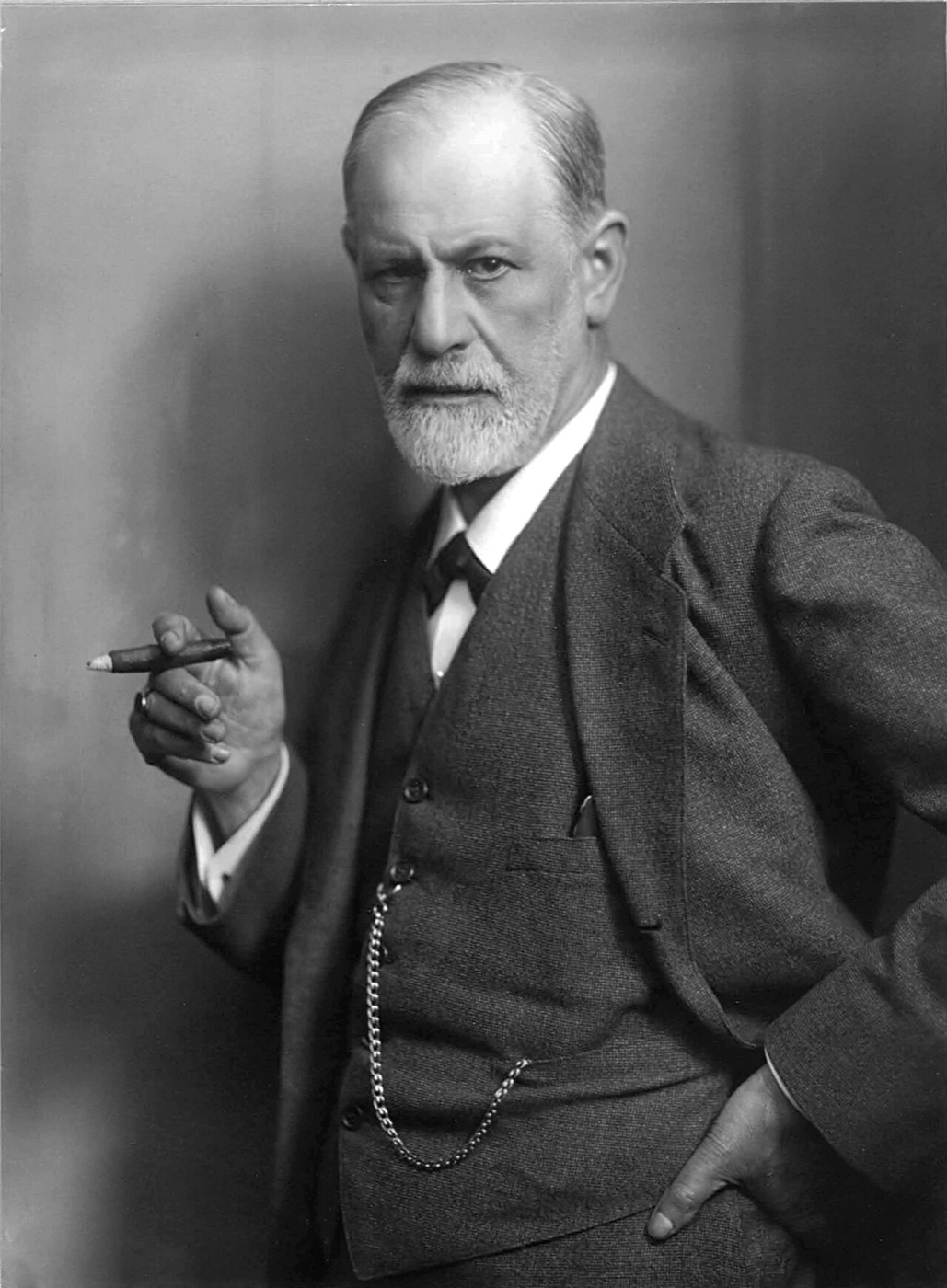
Sigmund Freud, a Viennese doctor, came to psychology through patients rather than labs. He argued that much of what drives us is unconscious: wishes, fears, and memories we push out of awareness. In The Interpretation of Dreams he treated dreams as disguised wishes. Later he described the mind as three parts in conflict, the id, the ego, and the superego.
His method, psychoanalysis, was a "talking cure" in which patients said whatever came to mind while the analyst looked for hidden patterns. Followers and rivals such as Carl Jung, Alfred Adler, and later Karen Horney built their own versions.
Freud's influence on culture is enormous: words like repression, denial, and the unconscious come from him. His standing in science is weaker. The philosopher Karl Popper argued that psychoanalysis could explain any outcome, so no observation could ever prove it wrong. Many of Freud's specific claims have not held up. Still, the broad ideas that much mental activity happens outside awareness and that early relationships matter are now well supported by other research, and modern psychodynamic therapy has been tested in clinical trials.

Behaviorism: Pavlov, Watson, and Skinner
Behaviorism rejected both introspection and the unconscious. If you cannot observe it, the argument went, you cannot study it scientifically, so psychology should study behavior. John B. Watson made the case in a 1913 paper, "Psychology as the Behaviorist Views It."
The Russian physiologist Ivan Pavlov had already shown classical conditioning. Dogs that heard a sound just before food began to salivate at the sound alone. Edward Thorndike showed that cats in puzzle boxes repeated actions that led to escape, which he called the law of effect. B. F. Skinner extended this into operant conditioning: behavior followed by a reward becomes more likely, and behavior followed by nothing or by punishment becomes less likely.
Behaviorism ruled American psychology from roughly the 1920s to the 1950s. It gave the field rigor and practical tools that are still used, from animal training to behavior therapy for phobias. Its weakness was leaving out thought itself. It struggled to explain how children learn language or how people solve problems in their heads.
Gestalt and humanistic psychology
In Germany, Max Wertheimer, Wolfgang Köhler, and Kurt Koffka argued that perception works on wholes. Wertheimer studied apparent motion: two lights flashing one after the other look like a single light moving, even though nothing moves. You see a melody, a face, or a shape as a whole, not as a list of parts. Gestalt ideas about grouping and pattern still shape design and the study of perception.
In the 1950s and 1960s, humanistic psychology pushed back against both Freud and the behaviorists, and was sometimes called the "third force." Abraham Maslow proposed a hierarchy of needs, from food and safety up to self-actualization. Carl Rogers developed client-centered therapy, where the therapist listens with warmth and without judgment. Many of the stage details, like Maslow's strict ordering of needs, have weak evidence, but Rogers's focus on the therapy relationship influenced nearly every kind of counseling that came after.
The cognitive revolution and what came after
In the 1950s, psychologists brought the mind back. In 1956, George Miller published "The Magical Number Seven, Plus or Minus Two," about limits on how much we can hold in mind at once. In 1959, the linguist Noam Chomsky published a sharp review of Skinner's book on language, arguing that reinforcement alone could not explain how children learn grammar. In 1967, Ulric Neisser's book Cognitive Psychology gave the new field its name.
The cognitive approach treats the mind as an information processor, with ideas borrowed from early computers: input, storage, retrieval. It now underlies most research on memory, attention, language, and decision-making. Daniel Kahneman and Amos Tversky, for example, showed how people rely on mental shortcuts that lead to predictable errors.
Two newer movements build on it. Evolutionary psychology, laid out in The Adapted Mind (1992), asks how natural selection shaped mental traits such as fear of snakes or how we choose partners. Critics warn that it is easy to invent evolutionary stories that cannot be tested. Positive psychology, launched by Martin Seligman in 1998, studies well-being, strengths, and what makes life go well, not only what goes wrong.
Three big schools compared
| Psychoanalysis | Behaviorism | Cognitive | |
|---|---|---|---|
| Studies | The unconscious mind | Observable behavior | Mental processes |
| Explains behavior by | Hidden conflicts and early life | Conditioning and reinforcement | How we process information |
| Main method | Case studies, talk therapy | Lab experiments, often on animals | Experiments with people, brain imaging |
| Lasting legacy | Talk therapy, unconscious processes | Rigor, behavior therapy | Memory, attention, decision research |
The main fields of psychology today
Today few psychologists belong to a single school. Instead, they work in fields defined by their questions, and borrow from whichever approach fits.
Cognitive psychology studies memory, attention, perception, language, and reasoning. Hermann Ebbinghaus started it early, testing his own memory of nonsense syllables and charting how fast he forgot them. Developmental psychology studies how people change across life. Jean Piaget described stages in how children think, and John Bowlby and Mary Ainsworth showed how early attachment to caregivers shapes later relationships.
Social psychology studies how other people affect us. Solomon Asch found that many people would give an obviously wrong answer to match a group, and Stanley Milgram found that most participants obeyed orders to give what they believed were painful shocks. Clinical psychology studies and treats mental disorders such as depression and anxiety, using tools like cognitive behavioral therapy, developed by Aaron Beck and Albert Ellis.
Biological psychology and neuroscience connect the mind to the brain, hormones, and genes, using methods like brain imaging. Personality psychology studies stable differences between people. Its best-supported model is the Big Five: openness, conscientiousness, extraversion, agreeableness, and neuroticism. These five traits show up across many cultures and predict real outcomes such as job performance and health.
How psychologists study the mind
Psychology uses several methods, and each answers a different kind of question. Case studies look closely at one person, like Phineas Gage, a railroad worker whose personality changed after an iron rod went through his brain in 1848. Surveys and correlational studies measure how two things move together across many people. Experiments change one thing on purpose and measure what happens.
Only experiments can show cause and effect. If people who sleep more also get better grades, that is a correlation. Maybe sleep helps grades, maybe good students have calmer lives, or maybe something else drives both. To test cause, researchers randomly assign people to conditions, for example more or less sleep, so the groups differ only in the thing being tested.
Every good study follows the same loop: start from a theory, make a specific prediction, collect data, analyze it, and update the theory. Then other teams repeat the study to see if the result holds.
The scientific method in psychology
- Theory: A general idea about how the mind works, such as "sleep strengthens memory."
- Hypothesis: A specific, testable prediction, such as "people who sleep after studying recall more words the next day."
- Run the study: Design an experiment, randomly assign people to conditions, and measure the outcome.
- Analyze the data: Use statistics to check whether the difference is larger than chance would produce.
- Replicate: Other teams repeat the study, often with larger and more varied samples.
- Revise the theory: Keep, adjust, or drop the theory based on all the evidence.
Who gets studied: samples and WEIRD people
A study is only as good as the people in it. Many classic findings come from small groups of college students, because they are easy to recruit. A 2008 review by Jeffrey Arnett found that about 96 percent of participants in top psychology journals came from Western industrialized countries that hold about 12 percent of the world's population.
In 2010, Joseph Henrich, Steven Heine, and Ara Norenzayan called these participants WEIRD: Western, Educated, Industrialized, Rich, and Democratic. They showed that WEIRD people are often outliers on things psychologists once assumed were universal, from some visual illusions to ideas about fairness. When you read a finding, ask who was studied and whether the result is likely to hold for other people.
The replication crisis and where psychology is now
Around 2011, psychology faced a reckoning. A respected journal published a paper claiming evidence for precognition, the ability to sense future events. The same year, Joseph Simmons, Leif Nelson, and Uri Simonsohn showed how common, flexible analysis choices could make almost any result look statistically significant. A prominent social psychologist, Diederik Stapel, was also found to have faked data.
In 2015, the Open Science Collaboration, a team of 270 researchers, repeated 100 studies published in three major psychology journals. In the originals, 97 percent reported significant results. In the repeats, only 36 percent did, and the average effect was about half as large. Some famous findings, like ego depletion and some forms of social priming, have since looked much weaker than first reported.
The field responded with reforms. Researchers now often preregister their plans before collecting data, share data and code, use larger samples, and run studies across many labs at once. Journals offer Registered Reports, which accept a paper based on its methods before the results are known. Psychology today is more cautious and more open than it was 15 years ago, which makes its newer findings more trustworthy.
Studies with a significant result
| Share of studies | |
|---|---|
| Original | 97% |
| Replication | 36% |
How to learn psychology, step by step
First, read one good introductory textbook from start to finish. OpenStax Psychology 2e is free online, written by experienced instructors, and covers every field in this article. A textbook gives you the map, so later reading has somewhere to fit.
Second, learn the methods early. Make sure you can explain the difference between correlation and causation, what random assignment does, and what a p-value does and does not mean. These ideas let you judge any claim you meet later, which is worth more than memorizing names.
Third, read a few original studies. Classic papers like Miller on the number seven or Watson on behaviorism are short and readable. For newer work, read the abstract, then the methods: who was studied, how many people, and what exactly was measured.
Fourth, test yourself instead of rereading. After each chapter, close the book and explain the main ideas out loud, then check. Come back to the material after a few days and again after a week. Psychology itself shows that self-testing and spaced review beat rereading for long-term memory.
Myths to drop, and where to start
Be skeptical of pop psychology, especially claims that are surprising, simple, and flattering. Two common myths: that we only use 10 percent of our brain, and that people learn best in their preferred learning style. Brain imaging shows activity across the whole brain, with no large region sitting unused. A 2008 review by Harold Pashler and colleagues found no solid evidence that teaching to a person's learning style improves learning.
Other ideas to question include "left-brained" and "right-brained" personalities, and the claim that one famous study settled a question. Ask whether a finding has been replicated, how large the samples were, and who was studied.
If you want a structured start, Wondering can turn any topic into a course of 3-minute lessons you can read, listen to, or watch, with practice questions after each lesson and spaced review that brings ideas back before you forget them. You can also talk through a topic with the voice tutor. Try the free sample lesson from our course based on Psychology 2e, which covers the foundations, the brain, and cognition.
That course is one of our polished courses, with polished lessons that are ready to start. Wondering is one place to learn psychology, your other interests, and the skills that make you better at your work, like understanding how people decide.
Try a free lesson on the foundations of psychology
Questions
What is psychology in simple words?
Psychology is the scientific study of the mind and behavior. It studies how people think, feel, learn, remember, and act, using experiments and other research methods.
Who is the father of psychology?
Wilhelm Wundt is usually called the father of modern psychology because he opened the first laboratory for psychological research in Leipzig in 1879. William James is often called the father of American psychology.
What are the main schools of thought in psychology?
The main historical schools are structuralism, functionalism, psychoanalysis, behaviorism, Gestalt psychology, humanistic psychology, and cognitive psychology. Evolutionary and positive psychology are newer approaches. Most psychologists today combine ideas from several of them.
What are the main branches of psychology?
Major branches include cognitive, developmental, social, clinical, biological, and personality psychology. Others include educational, industrial-organizational, and health psychology.
What is the replication crisis in psychology?
It is the discovery, starting around 2011, that many published findings do not hold up when repeated. In a 2015 project, only 36 percent of 100 repeated studies found a significant result, compared with 97 percent of the originals. The field has since adopted reforms such as preregistration and larger samples.
What is the best way to start learning psychology?
Read a free introductory textbook such as OpenStax Psychology 2e, learn basic research methods early, and read a few original studies. Test yourself and review over spaced intervals rather than rereading.
References
- James, W. (1890). The Principles of Psychology, Volume 1. Henry Holt and Company.
- Watson, J. B. (1913). Psychology as the behaviorist views it. Psychological Review, 20(2), 158-177.
- Miller, G. A. (1956). The magical number seven, plus or minus two: Some limits on our capacity for processing information. Psychological Review, 63(2), 81-97.
- Seligman, M. E. P., and Csikszentmihalyi, M. (2000). Positive psychology: An introduction. American Psychologist, 55(1), 5-14.
- Arnett, J. J. (2008). The neglected 95%: Why American psychology needs to become less American. American Psychologist, 63(7), 602-614.
- Henrich, J., Heine, S. J., and Norenzayan, A. (2010). The weirdest people in the world? Behavioral and Brain Sciences, 33(2-3), 61-83.
- Simmons, J. P., Nelson, L. D., and Simonsohn, U. (2011). False-positive psychology: Undisclosed flexibility in data collection and analysis allows presenting anything as significant. Psychological Science, 22(11), 1359-1366.
- Open Science Collaboration. (2015). Estimating the reproducibility of psychological science. Science, 349(6251), aac4716.
- Pashler, H., McDaniel, M., Rohrer, D., and Bjork, R. (2008). Learning styles: Concepts and evidence. Psychological Science in the Public Interest, 9(3), 105-119.
- Spielman, R. M., Jenkins, W. J., and Lovett, M. D. (2020). Psychology 2e. OpenStax.