An introduction to physics: its history, big theories, and how to understand it
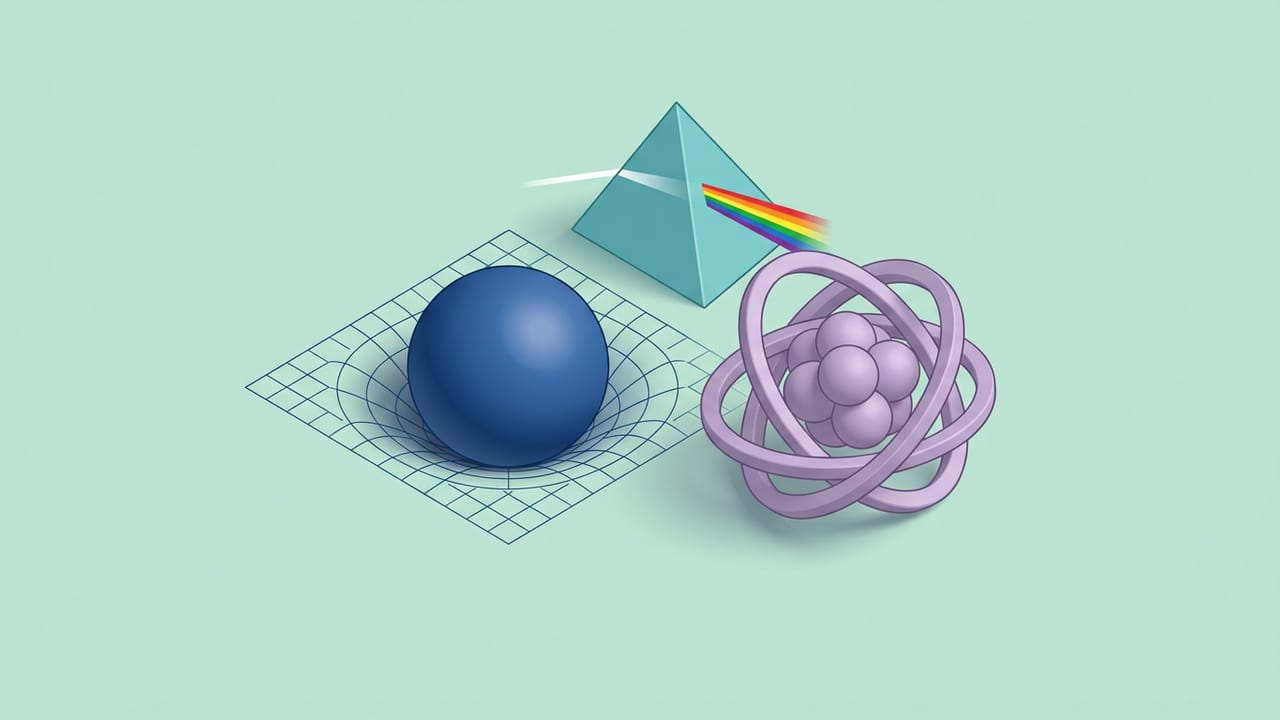
Physics is the study of matter, energy, space, and time, and the rules that connect them. It began with Greek thinkers like Aristotle and Archimedes, became a modern science with Galileo and Newton, and was rebuilt in the 20th century by relativity and quantum mechanics. Today its main frameworks are classical mechanics, thermodynamics, electromagnetism, relativity, and quantum mechanics, with the Standard Model describing every known particle. To understand it, learn basic algebra and calculus, work through problems by hand, check your units, estimate before you calculate, and test your intuition against simple experiments. Wondering turns physics into 3-minute lessons with practice after each one, spaced review, and a voice tutor. It is free to start.
| Framework | Big idea | Key figures | Era |
|---|---|---|---|
| Classical mechanics | Forces change motion, and the same laws rule the sky and the ground | Galileo, Kepler, Newton | 1600s to 1700s |
| Thermodynamics and statistical mechanics | Energy is conserved, and entropy tends to grow | Carnot, Joule, Clausius, Boltzmann | 1820s to 1900 |
| Electromagnetism | Electricity, magnetism, and light are one field | Faraday, Maxwell, Hertz | 1830s to 1880s |
| Relativity | Space and time are linked, and gravity is curved spacetime | Einstein | 1905 to 1915 |
| Quantum mechanics | At small scales, energy comes in lumps and outcomes are probabilities | Planck, Bohr, Heisenberg, Schrödinger | 1900 to 1930 |
| Standard Model | All known matter is built from a few particles and three forces | Glashow, Weinberg, Salam, Higgs | 1960s to today |
What physics is
Physics is the study of how the natural world behaves at its most basic level. It asks what things are made of, how they move, and what makes them change. Its questions run from the size of a proton to the age of the universe.
What makes physics different from other sciences is that it looks for a small number of rules that apply everywhere. The same law of gravity that drops an apple also holds the Moon in orbit. The same theory of light explains rainbows, radio, and X-rays.
Physics is also the base layer for other sciences. Chemistry rests on how electrons behave in atoms. Biology depends on chemistry. Engineering turns physics into bridges, phones, and power plants.
Physicists write their rules in mathematics because math lets you make exact predictions. A good physical law does not just describe what you saw. It tells you what you will see next time, with a number you can check.
A short history of physics at a glance
The story of physics has a few big turning points. Each one replaced an older picture with a wider one, and each kept the old picture as a special case that still works in its own range.
Newton showed that one set of laws covers both Earth and the heavens. Maxwell showed that light is an electromagnetic wave. Einstein reshaped space and time. Quantum mechanics rewrote the rules for atoms. Recent decades have confirmed predictions that took nearly a century to test.
Turning points in physics
- 1687: Principia: Newton publishes his laws of motion and universal gravitation.
- 1865: Light as a wave: Maxwell shows that light is an electromagnetic wave.
- 1905: Special relativity: Einstein publishes special relativity and the light quantum.
- 1915: General relativity: Einstein describes gravity as the curving of spacetime.
- 1925-1927: Quantum mechanics: Heisenberg, Schrödinger, and others build quantum mechanics.
- 2012: Higgs boson: CERN's ATLAS and CMS experiments announce the Higgs boson.
- 2015: Gravitational waves: LIGO detects ripples in spacetime from two merging black holes.
Ancient and medieval physics
Aristotle, in the 4th century BC, wrote a book called Physics, which is where the word comes from. He taught that heavy things fall faster than light things and that a moving object needs a constant push to keep going. Both ideas feel right from daily life, and both turned out to be wrong. Still, his system shaped thinking for nearly 2,000 years.
Archimedes, working in Syracuse in the 3rd century BC, took a more mathematical path. He worked out the law of the lever and the principle of buoyancy: an object in water is pushed up by a force equal to the weight of the water it moves aside. Engineers still use both.
Ibn al-Haytham, working in Cairo in the early 11th century, wrote the Book of Optics. He argued that we see because light travels from objects into the eye, not because the eye sends out rays, as many earlier thinkers believed. Just as important, he tested his ideas with careful, repeatable experiments using lenses, mirrors, and dark rooms. That habit of checking claims against experiment is at the heart of physics.
The Scientific Revolution: from Copernicus to Newton
In 1543 Nicolaus Copernicus published a model that put the Sun, not Earth, at the center of the planets. It was a bold idea with little direct proof at first. The proof came from the people who followed him.
Galileo Galilei turned a telescope to the sky in 1609 and 1610 and saw moons circling Jupiter, which showed that not everything orbits Earth. On the ground, he rolled balls down ramps and measured their speed. He found that objects speed up at a steady rate as they fall, no matter how heavy they are. The famous story of him dropping balls from the Leaning Tower of Pisa is probably a legend, but his ramp experiments were real.
Johannes Kepler used years of careful observations by Tycho Brahe to show that planets move in ellipses, not perfect circles. He described their motion in three laws, published between 1609 and 1619.
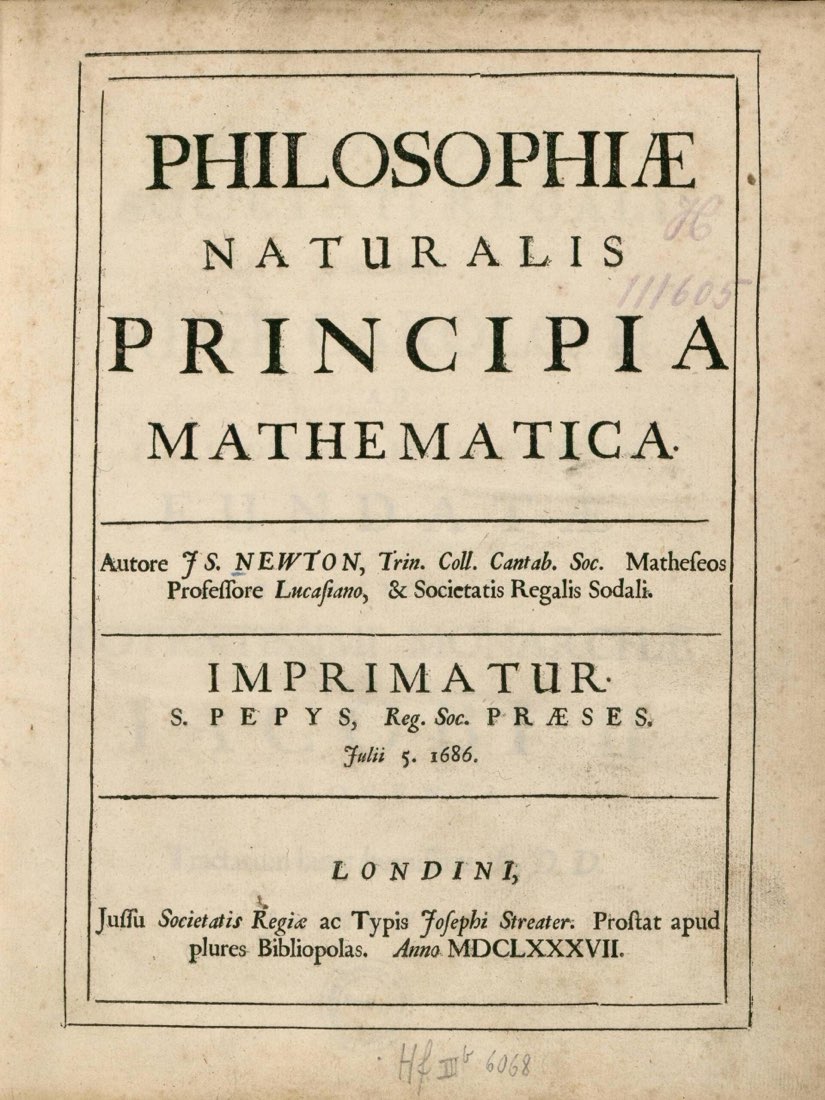
Isaac Newton tied it all together. In Philosophiae Naturalis Principia Mathematica, published in 1687, he set out three laws of motion and a law of universal gravitation. With them he could explain Kepler's ellipses, the tides, and the path of a cannonball with the same math. For the first time, the heavens and Earth obeyed one set of rules.

The 1800s: heat, energy, and light
Steam engines raised a practical question: how much work can you get out of heat? Sadi Carnot studied this in 1824. In the 1840s James Joule showed through experiments that mechanical work turns into a fixed amount of heat. This led to the first law of thermodynamics: energy is never created or destroyed, only changed from one form to another.
Rudolf Clausius and William Thomson (later Lord Kelvin) stated the second law: heat flows on its own from hot to cold, never the reverse. Clausius named the quantity behind this "entropy" in 1865. Later, Ludwig Boltzmann explained entropy by counting the ways atoms can be arranged. This gave rise to statistical mechanics, which explains the behavior of gases and heat from the motion of countless tiny particles.
At the same time, Michael Faraday discovered that a moving magnet creates an electric current, which is how generators still work. He pictured invisible lines of force filling space. James Clerk Maxwell turned that picture into equations. In 1865 he showed that electric and magnetic fields can travel together as a wave, at the speed of light. Light, he concluded, is an electromagnetic wave. Heinrich Hertz made such waves in his lab in the late 1880s, and radio followed.
Einstein and the quantum revolution
By 1900, physics looked nearly complete. Then two small puzzles broke it open. One was how hot objects glow. The other was how light behaves for observers moving at different speeds.
In 1900 Max Planck explained the glow of hot objects by assuming energy is given off in small lumps, which he called quanta. In 1905 Albert Einstein published several landmark papers. One argued that light itself comes in quanta, later called photons. Another introduced special relativity: the speed of light is the same for every observer, so time and space must stretch to keep it that way. A short follow-up gave the famous result E = mc², which says mass and energy are two forms of the same thing.
In 1915 Einstein finished general relativity. In it, gravity is not a pull but the curving of space and time by mass and energy. In 1919 an eclipse expedition led by Arthur Eddington measured starlight bending around the Sun, in line with his prediction, and made him world famous.
Meanwhile, Niels Bohr built a model of the atom in 1913 in which electrons sit in fixed energy levels. In 1925 and 1926, Werner Heisenberg and Erwin Schrödinger found two different-looking forms of a full quantum mechanics, which turned out to be equivalent. Max Born showed that the theory predicts probabilities, not certainties. In 1927 Heisenberg stated his uncertainty principle: you cannot know both the position and the momentum of a particle exactly at the same time.
The Standard Model, the Higgs boson, and gravitational waves
From the 1930s on, physicists combined quantum mechanics with special relativity into quantum field theory. In this picture, every particle is a ripple in a field that fills all of space. Paul Dirac's equation of 1928 predicted antimatter, and the positron, the antimatter twin of the electron, was found in 1932.
Through the 1960s and 1970s this work grew into the Standard Model. It describes all known matter with a short list of particles: six quarks, six leptons such as the electron, and the particles that carry forces. It explains three of the four fundamental forces with great precision.
One piece was missing for decades: the Higgs boson, predicted in 1964 to explain why some particles have mass. On July 4, 2012, the ATLAS and CMS experiments at CERN's Large Hadron Collider announced they had found it. Peter Higgs and François Englert shared the 2013 Nobel Prize in Physics.
General relativity predicted that violent events, like two black holes colliding, would send ripples through spacetime. On September 14, 2015, the LIGO detectors in the United States caught one, from two black holes merging over a billion light-years away. The result was announced in February 2016 and won the 2017 Nobel Prize.
The big frameworks: classical, relativity, and quantum
Modern physics is not one theory but a set of frameworks, each tuned to a range of sizes and speeds. Classical mechanics covers everyday objects. Thermodynamics and statistical mechanics cover heat and large collections of particles. Electromagnetism covers charges, magnets, and light. Relativity covers high speeds and strong gravity. Quantum mechanics covers atoms and smaller.
A key idea is that new theories contain the old ones. At low speeds, relativity's equations shrink back to Newton's. For large objects, quantum effects average out and classical physics returns. That is why engineers still use Newton to build bridges, while GPS satellites must correct for both special and general relativity to keep their clocks in step with ours.
Three pictures of nature
| Classical | Relativity | Quantum | |
|---|---|---|---|
| Where it works | Everyday sizes and speeds | High speed, strong gravity | Atoms and smaller |
| Core idea | Forces change motion: Objects keep moving unless a force acts on them, and the future follows exactly from the present. | Gravity is curved spacetime: The speed of light is the same for everyone, and mass tells spacetime how to curve. | Outcomes are probabilities: Energy comes in discrete lumps, and the theory gives the chance of each result, not a single certain answer. |
| Key figures | Galileo, Newton | Einstein | Planck, Bohr, Heisenberg, Schrödinger |
| Where it breaks | Near light speed, in atoms | Inside black holes, at the Big Bang | Has no theory of gravity yet |
Schools of thought: what quantum mechanics really means
Quantum mechanics is the most precisely tested theory in science. Yet physicists still disagree about what it says is actually happening. The math predicts the odds of each result of a measurement. The fight is over what reality is like between measurements.
The Copenhagen interpretation, shaped by Bohr and Heisenberg, says the wave function is a tool for predicting results, and that measurement turns many possibilities into one outcome. It asks you not to picture what the particle is "really" doing when no one looks. Many working physicists use a practical version of this view and focus on calculating.
The many-worlds interpretation, proposed by Hugh Everett in 1957, says the wave function never collapses. Every possible outcome happens, and the universe branches each time. It keeps the math simple but asks you to accept an enormous number of unseen worlds.
The pilot wave theory, first suggested by Louis de Broglie in 1927 and developed by David Bohm in 1952, says particles always have definite positions, guided by a wave. It brings back a clear picture of reality, but the guiding wave links distant particles instantly.
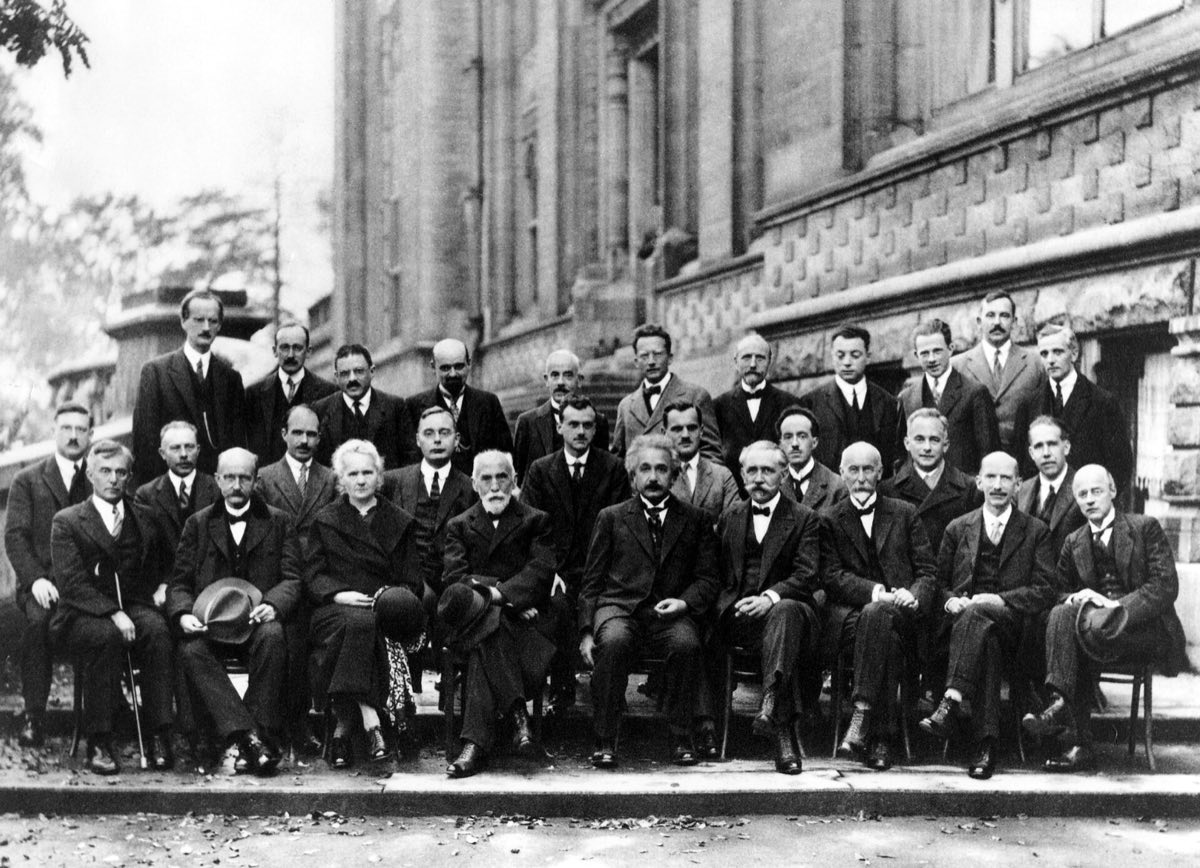
Einstein disliked the idea that nature is random at its core, and he argued with Bohr about it for years, starting at the 1927 Solvay Conference. In 1964 John Bell showed that the question could be tested. Experiments since then, honored by the 2022 Nobel Prize, show that no theory with only local hidden facts can match quantum results. All three interpretations above agree with those experiments, which is why the debate is still open.

Key concepts every beginner should know
Energy is the ability to cause change. It shows up as motion, heat, light, chemical bonds, and mass. The total amount in a closed system never changes, which makes energy one of the most useful ideas for solving problems.
Conservation laws say that some quantities stay the same no matter what happens: energy, momentum, angular momentum, and electric charge. A spinning skater pulls in her arms and spins faster because angular momentum is conserved.
A field is something that has a value at every point in space, like the temperature across a room. Gravity, electricity, and magnetism act through fields. In quantum field theory, even particles are ripples in fields.
Symmetry is the idea that the laws of physics do not change when you shift your point of view. In 1918 the mathematician Emmy Noether proved that each such symmetry gives a conservation law. Because the laws are the same today as tomorrow, energy is conserved. Because they are the same here as there, momentum is conserved.
Finally, all of nature runs on four fundamental forces: gravity, electromagnetism, the strong force, and the weak force. The first two reach across any distance. The last two only act inside atomic nuclei.
The four fundamental forces
- 4 Fundamental forces: Everything that happens comes down to these.
- 3 of 4 In the Standard Model: Gravity is still left out.
- ~10³⁶× Gravity is weaker: Than the electric push between two protons.
Gravity
- Range: Unlimited
- Does: Holds planets, stars, and galaxies together
- Theory: General relativity
Electromagnetism
- Range: Unlimited
- Does: Holds atoms together, makes light, runs chemistry
- Carrier: Photon
Strong force
- Range: About the size of a nucleus
- Does: Binds quarks into protons and neutrons
- Carrier: Gluon
Weak force
- Range: Smaller than a proton
- Does: Drives radioactive decay and helps power the Sun
- Carrier: W and Z bosons
Where physics stands now: the open problems
The two great theories of the 20th century do not fit together. General relativity treats spacetime as smooth and continuous. Quantum mechanics treats everything as lumpy and uncertain. Inside a black hole or at the Big Bang, both should matter, and combining them gives nonsense. Finding a theory of quantum gravity is the biggest open problem in physics. String theory and loop quantum gravity are two leading attempts, but neither has been confirmed by experiment.
Dark matter is another puzzle. In the 1930s Fritz Zwicky noticed galaxies in clusters moving too fast to be held by the matter we can see. In the 1970s Vera Rubin found the same thing in the way galaxies spin. Something we cannot see adds extra gravity, but no one has detected it directly.
Dark energy is stranger still. In 1998 two teams found that the expansion of the universe is speeding up, not slowing down. Taken together, ordinary matter, the stuff of stars and people, makes up only about 5 percent of the universe. The rest is dark matter and dark energy, and we do not know what either one is.
There are smaller open questions too: why neutrinos have mass, why the universe has more matter than antimatter, and why the forces have the strengths they do. Each is an active field of research today.
How to learn physics, step by step
Start with the math you need. Algebra and basic trigonometry carry you through most introductory mechanics. Calculus, which Newton developed partly to do physics, lets you handle changing speeds and forces. Later, vectors, differential equations, and linear algebra open up electromagnetism and quantum mechanics. You do not need all of it before you begin; learn each piece when a problem calls for it.
Solve problems, do not just read. Physics is a skill, like a language or an instrument. Reading a worked example feels like understanding, but you only find out what you know when you face a blank page. Draw a picture, list what you know and what you want, pick the law that connects them, and only then reach for equations.
Check your units. If you want a distance and your answer comes out in seconds, you made a mistake somewhere. Tracking units through every step catches more errors than any other habit.
Estimate before you calculate. Enrico Fermi was famous for rough guesses, like how many piano tuners work in Chicago, built from a few sensible numbers. A quick estimate tells you whether a final answer is reasonable.
Use thought experiments. Galileo imagined tying a heavy stone to a light one: if heavy things fall faster, should the pair fall faster, as one heavier object, or slower, held back by the light stone? The contradiction shows that all objects must fall at the same rate. Einstein said he started thinking about relativity by imagining chasing a beam of light.
For reading, a standard introductory textbook with worked problems is the best first step. The Feynman Lectures on Physics, from Richard Feynman's Caltech course in the early 1960s, are free to read online and are good for building intuition alongside a textbook.
Distance fallen in free fall
| Time (seconds) | Distance fallen |
|---|---|
| 0 s | 0m |
| 1 s | 4.9m |
| 2 s | 19.6m |
| 3 s | 44.1m |
| 4 s | 78.4m |
| 5 s | 122.5m |
Common misconceptions to watch for
Heavier objects fall faster. Without air resistance, they do not. On the Moon in 1971, Apollo 15 astronaut David Scott dropped a hammer and a feather together on live TV, and they landed at the same moment. On Earth, a feather falls slowly only because air pushes on it.
A moving object needs a force to keep moving. This was Aristotle's view, and it is how most people think. In fact, an object keeps moving at the same speed in a straight line unless a force acts on it. Things slow down on Earth because of friction and air resistance.
Astronauts float because there is no gravity in space. At the height of the International Space Station, gravity is still about 90 percent as strong as on the ground. Astronauts float because they and the station are falling together around Earth.
Seasons happen because Earth is closer to the Sun in summer. They happen because Earth's axis is tilted, so each hemisphere gets more direct sunlight for part of the year. Earth is actually closest to the Sun in early January, during northern winter.
Each of these is worth testing against your own intuition. Noticing where your gut is wrong is one of the fastest ways to learn physics.
Where to start with Wondering
If you want a gentle first step, start with big ideas before equations. Carlo Rovelli's short book Seven Brief Lessons on Physics covers relativity, quantum mechanics, and the structure of the cosmos in plain language.
Wondering turns books and topics like this into 3-minute lessons, with a few practice questions after each one and spaced review that brings ideas back before you forget them. You can also talk through a hard idea with the voice tutor. It is free to start, and you can try a sample lesson below.
Wondering also makes polished courses and polished lessons, ready-made in its library, so you can start without building anything. It is one place to learn physics, your other interests, and the skills that make you better at your work.
Read a free lesson from a course on Seven Brief Lessons on Physics
Questions
What are the main branches of physics?
The main branches are classical mechanics, thermodynamics and statistical mechanics, electromagnetism, relativity, and quantum mechanics. Applied fields include optics, nuclear and particle physics, condensed matter physics, and astrophysics.
What math do I need to learn physics?
Algebra and basic trigonometry are enough for introductory mechanics. Calculus is needed for most college physics, and vectors, differential equations, and linear algebra come next for electromagnetism and quantum mechanics.
Who is the father of physics?
There is no single answer. Galileo is often called the father of modern physics for his experiments, and Newton is credited with founding classical mechanics in his Principia of 1687.
What is the difference between classical and quantum physics?
Classical physics describes everyday objects, where the future follows exactly from the present. Quantum physics describes atoms and smaller, where energy comes in discrete amounts and the theory predicts probabilities of outcomes.
Do heavier objects fall faster?
No. Without air resistance, all objects fall with the same acceleration, about 9.8 meters per second squared near Earth. Apollo 15 showed this on the Moon in 1971 by dropping a hammer and a feather together.
What are the biggest unsolved problems in physics?
The biggest are combining general relativity and quantum mechanics into a theory of quantum gravity, and finding out what dark matter and dark energy are. Others include why there is more matter than antimatter and why neutrinos have mass.
References
- Newton, I. (1687). Philosophiae Naturalis Principia Mathematica. London: Royal Society. Project Gutenberg.
- Maxwell, J. C. (1865). A dynamical theory of the electromagnetic field. Philosophical Transactions of the Royal Society of London, 155, 459-512.
- Einstein, A. (1905). Zur Elektrodynamik bewegter Körper [On the electrodynamics of moving bodies]. Annalen der Physik, 17(10), 891-921.
- Einstein, A. (1916). Die Grundlage der allgemeinen Relativitätstheorie [The foundation of the general theory of relativity]. Annalen der Physik, 49(7), 769-822.
- ATLAS Collaboration. (2012). Observation of a new particle in the search for the Standard Model Higgs boson with the ATLAS detector at the LHC. Physics Letters B, 716(1), 1-29.
- Abbott, B. P., et al. (LIGO Scientific Collaboration and Virgo Collaboration). (2016). Observation of gravitational waves from a binary black hole merger. Physical Review Letters, 116(6), 061102.
- Faye, J. (2002, revised 2024). Copenhagen interpretation of quantum mechanics. Stanford Encyclopedia of Philosophy.
- Vaidman, L. (2002, revised 2026). Many-worlds interpretation of quantum mechanics. Stanford Encyclopedia of Philosophy.
- Goldstein, S. (2001, revised 2025). Bohmian mechanics. Stanford Encyclopedia of Philosophy.
- National Institute of Standards and Technology. CODATA internationally recommended values of the fundamental physical constants.