Free sample lesson · Seven Brief Lessons on Physics
The Creative Genius
What if the key to revolutionary discovery isn't working harder, but thinking differently?
Lesson 1 of the Wondering course Seven Brief Lessons on Physics
Rethinking What Genius Means
Most people picture genius as raw brainpower. Einstein challenges that picture.
His genius did not come from superior mathematical ability. Strong math helps, but it was not his edge.
What set him apart was his willingness to take seriously the contradictions between existing theories and pursue them relentlessly.
- Common myth
- Einstein's approach
The key to discovery may lie in thinking differently rather than simply working harder. Two habits explain how: combinatory play and productive unproductivity.
Combinatory Play: Connecting Ideas
Combinatory play means linking ideas that seemed to have nothing to do with each other.
Revolutionary insights rarely appear from nowhere. They often come from an unexpected connection between two areas that people kept in separate boxes.
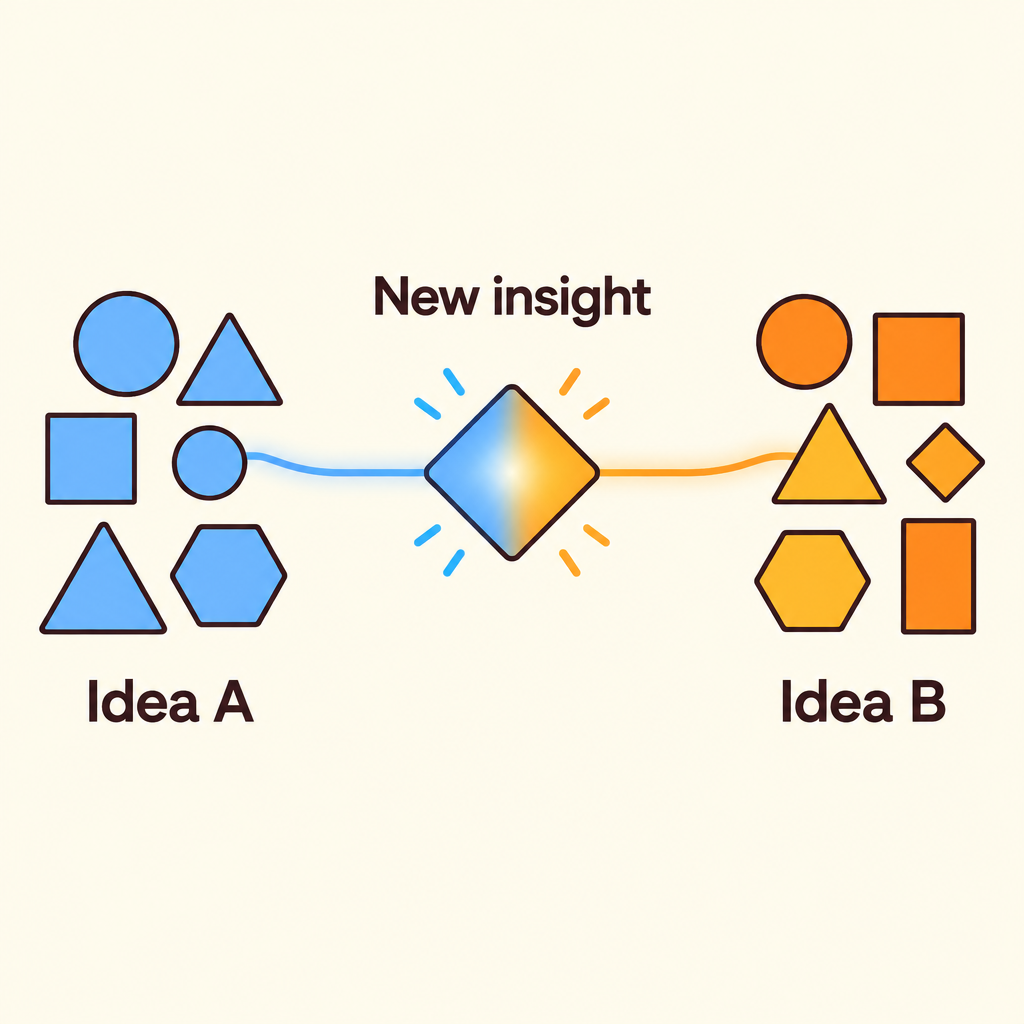
Notice that the bright new shape exists only where the two separate clusters connect, which is how combinatory play produces a breakthrough.
Think of it as play. You hold two unrelated ideas side by side and ask how they might fit.
The new link is the breakthrough. Neither idea alone would produce it.
Contradictions as a Starting Point
Einstein looked for places where existing theories clashed.
A contradiction is easy to ignore as an annoyance. Einstein treated it as a clue that two ideas needed a new connection.
He did not stop at noticing. He pursued the contradiction relentlessly until a deeper idea could hold both sides.
- Spot the clash: Notice where two existing theories contradict each other.
- Take it seriously: Treat the contradiction as a clue instead of an annoyance.
- Pursue it: Keep working on it relentlessly rather than looking away.
- Connect the ideas: Find a deeper idea that can hold both sides.
In your own work, a clash between two accepted ideas may be the best place to dig.
The Value of Loafing
In his youth, Einstein spent a year 'loafing aimlessly.'
That sounds like wasted time. Yet creative breakthroughs often need periods of unfocused exploration, when the mind wanders without a fixed goal.
This is productive unproductivity. Time that looks idle gives the mind room to make the odd connections that combinatory play depends on.
Rest is part of the process.
From Wandering to Breakthrough
Look at how Einstein's story unfolds over time.
First came his youthful year of loafing aimlessly. Then, at age 26, he published three papers that would fundamentally change physics.
Even after that, he did not rush. He took ten years of intense work to develop general relativity from special relativity.
- A year of loafing: He spent a year loafing aimlessly, exploring without focus.
- Three landmark papers: He published three papers that would fundamentally change physics.
- General relativity: Ten years of intense work took him from special to general relativity.
Wandering and hard work were both part of the path.
Genius Hesitates
A short phrase sums up his pace: 'genius hesitates.'
Hesitating does not mean doing nothing. His ten years on general relativity mixed patience with intense effort.
Breakthroughs tend to move in a rhythm: explore loosely, spot a connection, then work hard to test and build it.
When the work stalls, stepping back to explore again restarts the cycle.
- Explore loosely: Let the mind wander without a fixed goal.
- Spot a connection: Notice how two unrelated ideas might fit.
- Work intensely: Test and build the idea with patient effort.
- Step back: When work stalls, return to open exploration.
Using These Ideas Yourself
You can use both habits in your own work.
Combinatory play: when stuck, borrow an idea from an unrelated field or hobby and ask how it fits your problem.
Productive unproductivity: schedule unfocused time, like a walk, without guilt.
Contradictions: when two ideas clash, do not look away. Dig in, as Einstein did.
Check yourself
Einstein's genius lay mainly in _____
- pursuing contradictions between theories
- having superior mathematical ability
Answer: pursuing contradictions between theories
Einstein's edge was not superior mathematical ability. It was his willingness to take seriously the contradictions between existing theories and pursue them relentlessly.
In creativity, _____ means linking previously unrelated ideas, while _____ means exploring without a fixed focus.
Answer: In creativity, combinatory play means linking previously unrelated ideas, while productive unproductivity means exploring without a fixed focus.
Combinatory play is about connection: unexpected links between separate ideas. Productive unproductivity is about time: unfocused periods that seem wasteful but feed breakthroughs.
Which example best shows combinatory play?
- An architect designs a building inspired by how birds fly
- A pianist practices the same scale daily for an hour
- A student memorizes a list of chemistry formulas
- An engineer follows a manual to repair a machine
Answer: An architect designs a building inspired by how birds fly
Combinatory play means unexpectedly connecting ideas from previously unrelated areas. Linking bird flight to building design joins two separate fields. The other options involve practice, memorization, or step-by-step work within a single area.
Keep going
This is lesson 1 of 23 in Seven Brief Lessons on Physics. Next up:
- The Most Beautiful Theory
- Curved Spacetime
- Time Bends Too
- Energy in Packets
- The Measurement Problem
Wondering turns any topic into short lessons you can read, watch, or listen to, with practice questions and an AI tutor.