An introduction to philosophy: its history, big schools of thought, and how to start
Philosophy is the careful study of basic questions that no experiment can settle on its own: what is real, what we can know, how we should live, and what makes an argument good. Its main branches are metaphysics, epistemology, ethics, logic, political philosophy, aesthetics, and philosophy of mind. It began around the same time in Greece, India, and China, with thinkers like Socrates, the Buddha, and Confucius, and runs through Stoicism, Islamic and medieval thought, Descartes, Kant, Nietzsche, and the analytic and continental schools of today. To start, read a short primary text such as Plato's Apology, break each argument into premises and a conclusion, and write your own reply. Wondering can turn philosophy into 3-minute lessons with practice after each one, and it is free to start.
| School | Big idea | Key thinkers | Era |
|---|---|---|---|
| Platonism | Behind the changing world are perfect, unchanging Forms | Plato | 4th century BCE |
| Confucianism | A good society grows from good character, family duty, and ritual | Confucius, Mencius, Xunzi | From the 5th century BCE |
| Daoism | Live in step with the Dao, the natural way of things, without forcing | Laozi, Zhuangzi | From about the 4th century BCE |
| Buddhist philosophy | Suffering comes from craving; there is no fixed, lasting self | The Buddha, Nagarjuna | From the 5th century BCE |
| Stoicism | Focus on what is in your control and live by reason and virtue | Zeno, Seneca, Epictetus, Marcus Aurelius | About 300 BCE to 200 CE |
| Epicureanism | A good life is a calm one, free of pain and fear | Epicurus, Lucretius | About 300 BCE onward |
| Rationalism | Reason alone can give us real knowledge | Descartes, Spinoza, Leibniz | 17th century |
| Empiricism | All knowledge comes from experience | Locke, Berkeley, Hume | 17th and 18th centuries |
| Utilitarianism | The right act produces the most happiness overall | Bentham, Mill | 18th and 19th centuries |
| Existentialism | We are not born with a purpose; we make ourselves through our choices | Kierkegaard, Sartre, Beauvoir, Camus | 19th and 20th centuries |
| Pragmatism | Judge an idea by what difference it makes in practice | Peirce, William James, Dewey | Late 19th and 20th centuries |
| Analytic philosophy | Make problems clear through logic and careful use of language | Frege, Russell, Wittgenstein | 20th century to today |
What philosophy is
The word philosophy comes from the Greek for "love of wisdom." In practice it means thinking hard and carefully about questions that are too basic for any one science to answer. Is the mind the same thing as the brain? Can we ever be sure of anything? What do we owe strangers? Is there a good reason to obey the law?
Philosophy is not just having opinions about big questions. Its method is argument: you state a claim, give reasons for it, and test those reasons against objections. A philosopher who believes something should be able to say why, and should change their mind when the reasons fail.
Many sciences began as philosophy. Physics was once called natural philosophy, and psychology split off from philosophy in the late 1800s. What remains are the questions where data alone does not settle the matter, because the hard part is getting the concepts and the reasoning right.
Philosophy's history at a glance
Philosophy has no single starting point. Between about 600 and 400 BCE, people in Greece, India, and China began asking systematic questions about nature, knowledge, and how to live, mostly without knowing about one another. The German philosopher Karl Jaspers later called this period the Axial Age.
From there the story runs through the great Greek teachers, the Hellenistic schools that followed them, medieval Christian, Jewish, and Islamic thinkers, the early modern argument between reason and experience, and the many schools of the last two centuries. The sections below take each era in turn.
Six eras of philosophy
- c. 600-400 BCE: First thinkers: Thales and the Presocratics in Greece, the Upanishads and the Buddha in India, Confucius and Laozi in China.
- 469-322 BCE: Socrates to Aristotle: Socrates questions Athens, Plato founds the Academy, and Aristotle maps logic, science, and ethics.
- c. 300 BCE-200 CE: Hellenistic schools: Stoics, Epicureans, and Skeptics turn philosophy into a guide for living well.
- c. 400-1400: Medieval and Islamic: Augustine, Avicenna, Averroes, Maimonides, and Aquinas join Greek philosophy with faith.
- 1600s-1700s: Reason vs experience: Descartes and the rationalists against Locke, Hume, and the empiricists, until Kant tries to unite them.
- 1800s-today: Modern schools: Hegel, Marx, Nietzsche, existentialism, pragmatism, and the analytic and continental traditions.
Ancient Greece: from the Presocratics to Aristotle
The first Greek philosophers, now called the Presocratics, lived in the 500s and 400s BCE. Thales of Miletus is usually named first, because he looked for a natural explanation of everything instead of a story about the gods, and he guessed that all things come from water. Heraclitus said that everything is always changing. Parmenides argued the opposite, that change is an illusion. Democritus proposed that the world is made of tiny, uncuttable atoms moving in empty space.
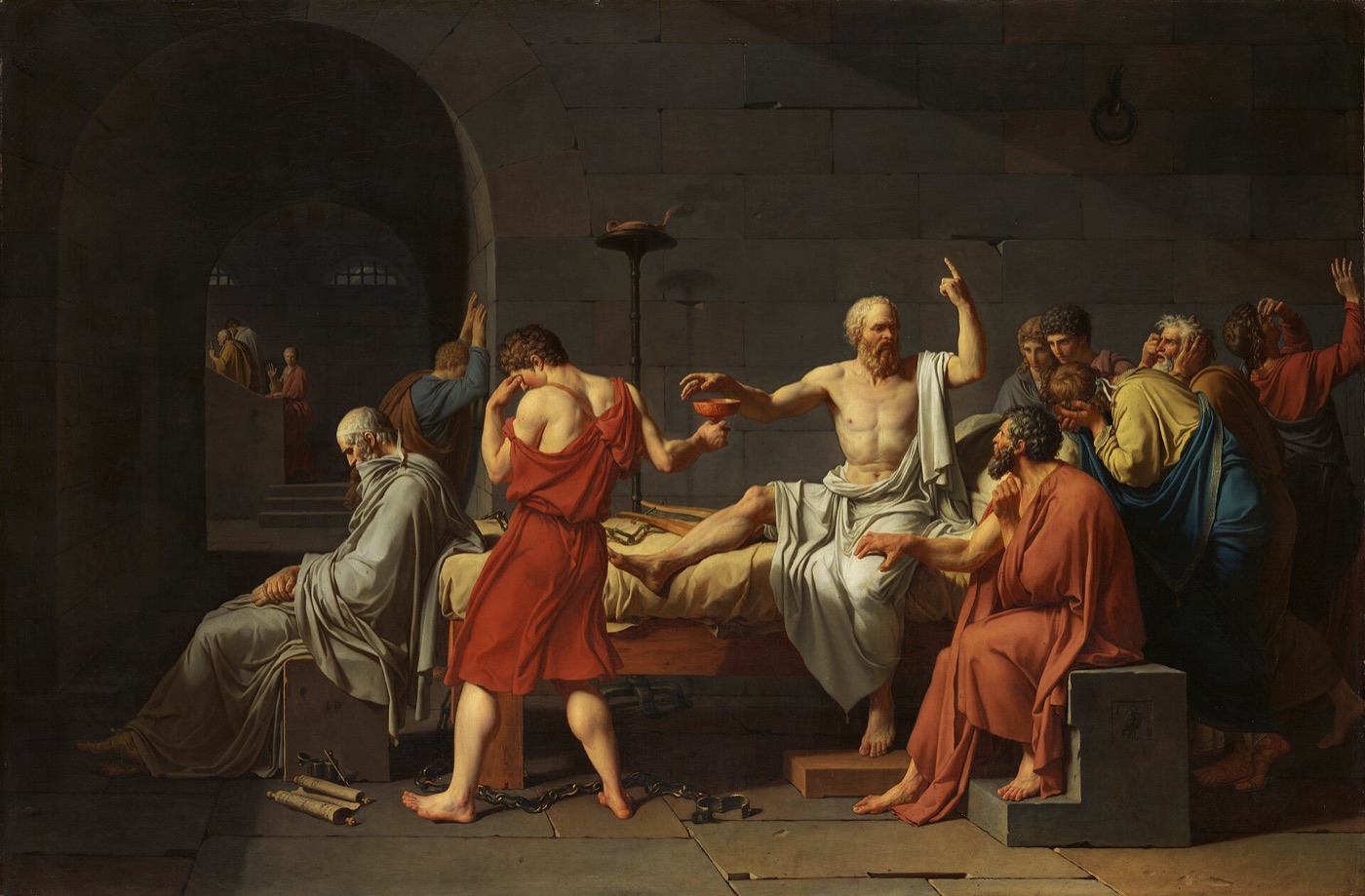
Socrates (469-399 BCE) wrote nothing, but he changed philosophy by turning it toward ethics. He walked around Athens asking people to define words like justice and courage, then showed that their definitions did not hold up. This back-and-forth questioning is still called the Socratic method. In 399 BCE Athens put him on trial for impiety and corrupting the young, and he was sentenced to death by drinking hemlock.
His student Plato (about 428-348 BCE) wrote dialogues starring Socrates and founded the Academy in Athens. Plato argued that the things we see are imperfect copies of perfect, unchanging Forms, an idea he illustrates with the allegory of the cave in the Republic. His student Aristotle (384-322 BCE) brought philosophy back down to earth. He studied animals, politics, and poetry, invented formal logic with the syllogism, and argued in the Nicomachean Ethics that the good life, eudaimonia, comes from practicing virtues like courage and honesty.

The Hellenistic schools: Stoics, Epicureans, and Skeptics
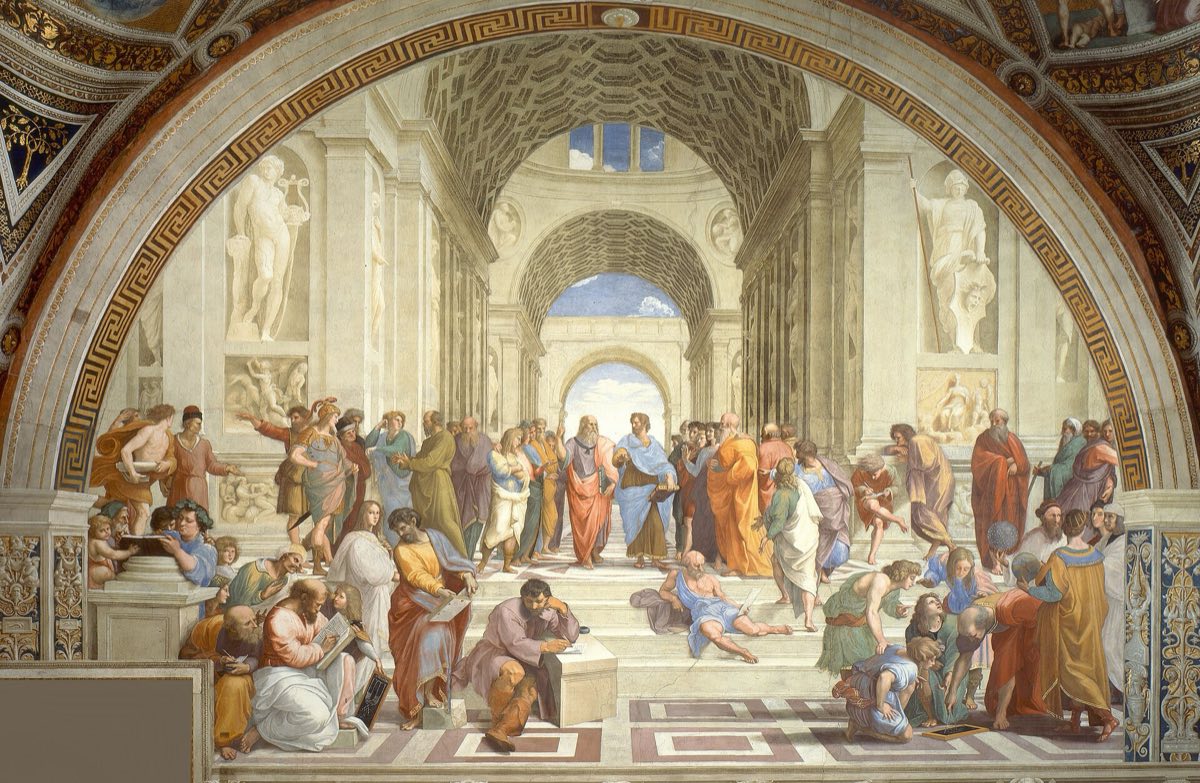
After Alexander the Great died in 323 BCE, Greek philosophy turned practical. The new schools asked one main question: how can a person live a calm, good life in an uncertain world? Each gave a different answer, and each was a full way of living, not just a theory.
Stoicism was founded by Zeno of Citium in Athens around 300 BCE and named after the painted porch, the Stoa, where he taught. The Stoics held that virtue is the only true good and that we should separate what is in our control, our judgments and actions, from what is not, like other people and fortune. Its best-known later voices are Seneca, the former slave Epictetus, and the Roman emperor Marcus Aurelius, whose private notes became the Meditations.
Epicurus (341-270 BCE) taught in a garden outside Athens. He said pleasure is the goal of life, but by pleasure he meant the absence of pain and fear, which comes from simple living, friendship, and clear thinking, not from feasts. He also argued that death is nothing to fear because when it comes, we are no longer there to experience it. The Skeptics, starting with Pyrrho, went further and advised suspending judgment on any claim we cannot prove, as a path to peace of mind.
China and India: Confucius, Laozi, the Buddha, and the Indian schools
Confucius (traditionally 551-479 BCE) taught in the Chinese state of Lu. His sayings, collected by his students in the Analects, focus on ren, often translated as humaneness, and li, the rituals and manners that hold families and societies together. His ideal is the junzi, the person of good character who leads by example. Later Confucians argued about human nature: Mencius said it is good at root, while Xunzi said it must be shaped by education.
Daoism, linked to the Daodejing and its traditional author Laozi, offers a contrast. The Dao is the natural way of things, and the wise person acts through wu wei, effortless action that does not force. The later Daoist Zhuangzi wrote playful stories, like the one where he dreams he is a butterfly and then wonders whether he is a butterfly dreaming he is a man.
In India, the Upanishads explored the link between Atman, the self, and Brahman, ultimate reality. Siddhartha Gautama, the Buddha, taught the Four Noble Truths: life involves suffering, suffering comes from craving, it can end, and there is a path to end it. Buddhist philosophers also argued that there is no fixed, lasting self, and Nagarjuna, around the 2nd century CE, developed the idea of emptiness. Classical Indian thought is often grouped into six orthodox schools, including Nyaya, known for its work on logic and knowledge, and Vedanta, plus schools that rejected the Vedas, such as Buddhism, Jainism, and the materialist Charvaka.

Medieval and Islamic philosophy: faith meets reason
For about a thousand years, the big project in Europe and the Middle East was fitting Greek philosophy together with religious faith. Augustine of Hippo (354-430) blended Plato's ideas with Christianity and wrote the Confessions, an early autobiography full of questions about time, memory, and the will. Boethius wrote The Consolation of Philosophy in prison around 524.
Much of Aristotle was kept alive and developed in the Islamic world. Avicenna, or Ibn Sina (980-1037), was a physician and philosopher who drew a famous distinction between what a thing is, its essence, and the fact that it exists. His "floating man" thought experiment imagines a person created in midair with no sensations, who still knows that he exists. Al-Ghazali attacked the philosophers in The Incoherence of the Philosophers, and Averroes, or Ibn Rushd (1126-1198), replied with The Incoherence of the Incoherence. Averroes wrote such detailed commentaries on Aristotle that Latin readers called him simply the Commentator.
When Arabic and Greek texts were translated into Latin in the 1100s and 1200s, they reshaped European thought. The Jewish philosopher Maimonides wrote The Guide for the Perplexed, and Thomas Aquinas (1225-1274) built a vast system in the Summa Theologiae that joined Aristotle with Christian theology, including his five arguments for the existence of God.
Reason or experience: Descartes, Locke, Hume, and Kant
Modern philosophy is often dated to René Descartes (1596-1650). He decided to doubt everything he could, even that he had a body, to find one thing that could not be doubted. In the Discourse on the Method (1637) he found it in the line "I think, therefore I am." Descartes and the other rationalists, Spinoza and Leibniz, held that reason alone can give us real knowledge about the world.
The empiricists disagreed. John Locke argued in An Essay Concerning Human Understanding (1689) that the mind starts as a blank slate and that all our ideas come from experience. David Hume (1711-1776) pushed this to an unsettling end. He argued that we never actually observe causes, only one event followed by another, and that our belief that the future will be like the past rests on habit, not proof. This is the problem of induction, and it is still debated.
Immanuel Kant (1724-1804) said Hume woke him from his "dogmatic slumber." In the Critique of Pure Reason (1781) he argued that both sides were half right: knowledge needs experience, but the mind brings its own structure, like space, time, and cause and effect, that shapes everything we can experience. Kant also wrote one of the most important works of ethics, discussed below.
From Hegel to today: the modern schools
G. W. F. Hegel (1770-1831) saw history as reason unfolding over time through conflict and resolution. Karl Marx (1818-1883) kept the idea of history moving through conflict but made it about economics and class. In his notes on Feuerbach he wrote that philosophers had only interpreted the world, and that the point is to change it. Friedrich Nietzsche (1844-1900) declared that "God is dead" in The Gay Science (1882), meaning that belief in God no longer anchored European values, and asked what would replace it.
In the 20th century, existentialists like Jean-Paul Sartre, Simone de Beauvoir, and Albert Camus argued that people have no fixed nature or given purpose. Sartre summed it up as "existence precedes essence": we first exist, then define ourselves through our choices. Beauvoir applied this to women in The Second Sex (1949). In the United States, the pragmatists Charles Sanders Peirce, William James, and John Dewey judged ideas by the practical difference they make.
Western philosophy then split into two styles. Analytic philosophy, from Gottlob Frege, Bertrand Russell, and Ludwig Wittgenstein, prizes logic, clarity, and small, precise problems, and dominates English-speaking universities. Continental philosophy, from Edmund Husserl and Martin Heidegger to Michel Foucault, deals more with lived experience, history, and power. Today both are active, and some of the busiest areas are philosophy of mind and artificial intelligence, the ethics of new technology, political philosophy after John Rawls, and experimental philosophy, which tests ideas with surveys and studies.
The main branches and the questions they ask
Philosophy divides into branches by the kind of question asked. Metaphysics asks what exists. Epistemology asks what knowledge is and how we get it. Logic studies what makes reasoning valid. Ethics asks how we should live and act. Political philosophy asks what makes power legitimate. Aesthetics asks what beauty and art are. Philosophy of mind asks how the mind relates to the body.
The branches overlap all the time. Whether we have free will is a question of metaphysics, but the answer matters for ethics, because blame seems to require that we could have done otherwise. There are also "philosophy of" fields for almost every subject, including science, mathematics, language, law, and religion.
Seven branches of philosophy
Metaphysics
- What is real?: Existence, time, causation, free will, God
Epistemology
- What can we know, and how?: Knowledge, belief, evidence, skepticism
Logic
- What makes an argument good?: Validity, proof, fallacies
Ethics
- How should we live?: Right and wrong, virtue, duty, well-being
Political philosophy
- What makes power legitimate?: Justice, rights, liberty, the state
Aesthetics
- What are beauty and art?: Taste, meaning in art, judgment
Philosophy of mind
- How does the mind relate to the body?: Consciousness, thought, personal identity
Key ideas every beginner needs
An argument is a set of premises that are meant to support a conclusion. The classic example: all humans are mortal, Socrates is a human, so Socrates is mortal. An argument is valid if the conclusion must be true whenever the premises are true. It is sound if it is valid and its premises really are true. A valid argument can still have a false conclusion if one of its premises is false.
A priori knowledge is known by reasoning alone, like "all bachelors are unmarried." A posteriori knowledge depends on experience, like "it is raining." Much of the fight between rationalists and empiricists is about how much of what we know is a priori.
Philosophers also lean on thought experiments, imagined cases that test an idea. In the trolley problem, first posed by Philippa Foot in 1967, you can steer a runaway trolley away from five people onto a track where it will kill one. Most people say you should, but many change their answer when the only way to save the five is to push someone in front of the trolley. Cases like this show where our principles conflict.
The three big ethical theories
Most moral philosophy today works within three families of theory. Virtue ethics, from Aristotle and also found in Confucius, asks what kind of person you should be, and says right action is what a person of good character would do. It was revived in the 20th century by Elizabeth Anscombe and Alasdair MacIntyre.
Deontology, from the Greek for duty, says some acts are right or wrong in themselves, whatever their results. Its central figure is Kant, whose categorical imperative tells us to act only on rules we could want everyone to follow, and to treat people never merely as tools. On this view, lying is wrong even when it would turn out well.
Consequentialism judges acts only by their results. Its best-known form, utilitarianism, came from Jeremy Bentham and John Stuart Mill, who held that the right act creates the greatest happiness for the greatest number. The modern philosopher Peter Singer uses this reasoning to argue that well-off people should give much more to the global poor. In the trolley problem, a strict consequentialist pulls the lever and may even push, while a deontologist worries about using a person as a means.
Virtue ethics vs deontology vs consequentialism
| Virtue ethics | Deontology | Consequentialism | |
|---|---|---|---|
| Core question | Who should I be? | What is my duty? | What turns out best? |
| What matters | Character | Rules and rights | Results |
| Key thinkers | Aristotle, Confucius | Kant | Bentham, Mill, Singer |
| Classic objection | Vague in hard cases | Rigid when duties clash | Can justify harming a few |
All aim to guide action · All are tested on hard cases
Common beginner mistakes
The first mistake is starting with the hardest books. Kant's Critique of Pure Reason and Hegel's Phenomenology of Spirit are difficult even for professionals. Starting there makes many people decide philosophy is not for them, when the real problem was the order.
The second is collecting names and isms instead of arguments. Knowing that Hume was an empiricist matters less than being able to explain his argument about cause and effect and say where you think it goes wrong. The third is reading only summaries, which strip out the reasoning that makes a view worth taking seriously.
Other common mistakes: treating philosophy as a matter of opinion where every view is equal, attacking a weak version of a view you dislike, pulling famous lines out of context, and ignoring everything outside Europe. "God is dead," for example, is a claim about culture, not a simple statement of atheism.
How to start studying philosophy, step by step
1. Read Plato's Apology first. It is Socrates' defense speech at his trial, short enough to finish in an afternoon, and free online. It shows philosophy as a way of life and contains his famous claim that the unexamined life is not worth living. Then try the Crito, Epictetus' Enchiridion, a few chapters of the Analects or the Daodejing, and the first two of Descartes' Meditations.
2. Pair the primary texts with one clear overview, such as Nigel Warburton's A Little History of Philosophy, which has 40 short chapters, or Thomas Nagel's What Does It All Mean? For any thinker, the free Stanford Encyclopedia of Philosophy is a reliable reference.
3. Break every argument into numbered premises and a conclusion. Then ask two questions: does the conclusion follow, and is each premise true? Most of philosophy is this skill.
4. Steelman before you criticize. Restate the view in its strongest form, one its defender would accept, before you look for problems. 5. Write a one-page response to each reading: the main claim, the best argument for it, your best objection, and how the author might reply. 6. Talk it through with someone. Socrates did all his philosophy out loud, and explaining a view to another person is the fastest way to find the gaps in your understanding.

Learn philosophy in short lessons with Wondering
If you want a steady way in, Wondering turns any topic, book, or set of notes into a course of 3-minute lessons that you can watch, listen to, or read. Each lesson ends with practice questions, and spaced review brings ideas back just before you would forget them, which helps when you are juggling dozens of names and arguments.
You can also talk through a lesson with the voice tutor, which is a good way to practice explaining an argument out loud, the Socratic way. Try a free sample lesson from a course on Nigel Warburton's A Little History of Philosophy, or browse the philosophy category on Explore. Wondering is free to start.
Courses like that one are polished courses with polished lessons, ready-made in the library. And Wondering is one place to learn philosophy, your other interests, and the clear thinking and writing that make you better at your work.
Try a free lesson from A Little History of Philosophy
Questions
What are the main branches of philosophy?
The main branches are metaphysics (what is real), epistemology (what we can know), logic (what makes reasoning good), ethics (how to live), political philosophy (what makes power legitimate), aesthetics (beauty and art), and philosophy of mind (how the mind relates to the body).
What should I read first in philosophy?
Start with Plato's Apology, a short and readable account of Socrates' trial. Pair it with a clear overview such as Nigel Warburton's A Little History of Philosophy, and use the free Stanford Encyclopedia of Philosophy as a reference.
Who is considered the first philosopher?
In the Western tradition, Thales of Miletus, in the 6th century BCE, is usually called the first philosopher because he sought natural explanations instead of myths. Philosophy also began independently in India and China at roughly the same time.
What is the difference between philosophy and religion?
Both can address meaning, ethics, and ultimate reality, but philosophy relies on argument and reason that anyone can examine, not on revelation or sacred authority. Many philosophers, like Augustine, Avicenna, and Aquinas, worked on both.
What is the difference between analytic and continental philosophy?
Analytic philosophy, dominant in English-speaking countries, focuses on logic, clarity, and narrow problems. Continental philosophy, rooted in Germany and France, focuses more on lived experience, history, culture, and power.
Is philosophy still useful today?
Yes. It trains you to make and test arguments, spot weak reasoning, and think clearly about hard choices. Current debates on AI, bioethics, and justice all draw directly on philosophical work.
References
- Plato. Apology. Translated by Benjamin Jowett. Project Gutenberg.
- Descartes, R. (1637). Discourse on the Method of Rightly Conducting One's Reason and of Seeking Truth in the Sciences. Project Gutenberg.
- Nails, D., and Monoson, S. S. Socrates. Stanford Encyclopedia of Philosophy.
- Csikszentmihalyi, M. Confucius. Stanford Encyclopedia of Philosophy.
- Chan, A. Laozi. Stanford Encyclopedia of Philosophy.
- Gutas, D. Ibn Sina [Avicenna]. Stanford Encyclopedia of Philosophy.
- Markie, P., and Folescu, M. Rationalism vs. Empiricism. Stanford Encyclopedia of Philosophy.
- Hursthouse, R., and Pettigrove, G. Virtue Ethics. Stanford Encyclopedia of Philosophy.
- Alexander, L., and Moore, M. Deontological Ethics. Stanford Encyclopedia of Philosophy.
- Sinnott-Armstrong, W. Consequentialism. Stanford Encyclopedia of Philosophy.