Free sample lesson · A Little History of Philosophy
Socratic Method
What if the wisest person is the one who admits they know nothing?
Lesson 1 of the Wondering course A Little History of Philosophy
The Man Who Changed Philosophy
Socrates lived in Athens from 469 to 399 BCE. He changed what philosophy was about.
Before him, thinkers mostly studied nature: what the world is made of and how it works.
Socrates turned the focus to human values and knowledge. What is justice? What is courage? What is goodness?
- Study of nature
- Human values
His main tool was a simple one: the question.
Questions in the Marketplace
Socrates did not hand out answers. He walked into the Athenian marketplace and asked people questions.
He sought out citizens with a reputation for wisdom: politicians, poets, and craftsmen.
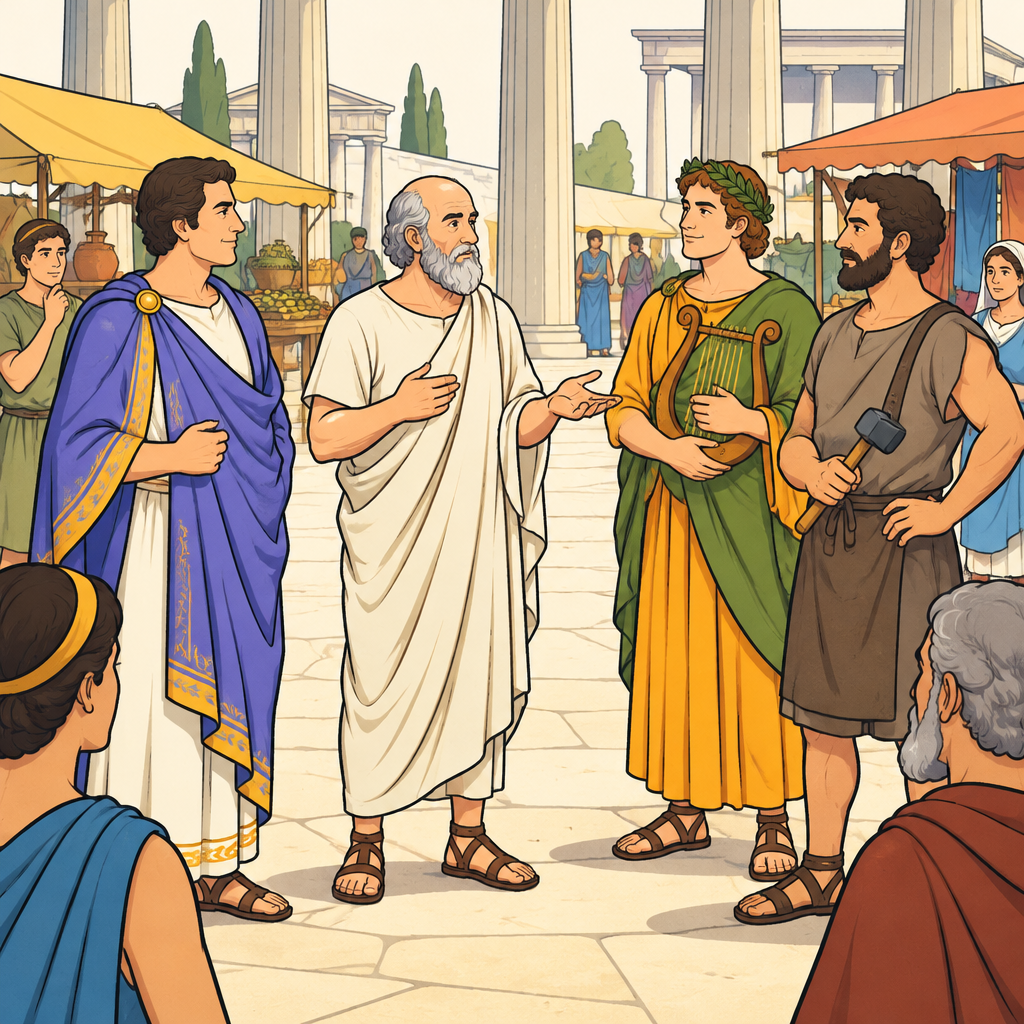
Notice that Socrates is the one asking while the respected citizens do the answering, which is how the method puts their beliefs to the test.
He asked them to define big ideas like justice or courage. Most answered with confidence.
Then the questions kept coming.
How the Method Works
The Socratic Method is a systematic way of testing beliefs through questions.
It starts with a confident definition. Socrates then asks follow-up questions that check whether the definition holds.
Often the definition contradicts itself or leads to an absurd conclusion.
- Ask for definition: Ask someone to define a big idea like justice or courage.
- Probe it: Ask follow-up questions that test whether the definition holds.
- Expose contradiction: Show where the definition contradicts itself or leads to an absurd conclusion.
- Recognize ignorance: Reach intellectual humility about what is truly known.
The goal is intellectual humility: the person sees the limits of what they really know.
Seeing It in Action
Imagine Socrates asks a soldier, "What is courage?" The soldier says: "Courage means never retreating."
Socrates asks: "Is a soldier who retreats to set a trap and win the battle a coward?"
The soldier says no. Now his definition contradicts his own belief.
He must revise, and the questioning starts again. A definition that survives every question can stand for now. Most do not.
- What is courage?
- Offer a definition: For example: courage means never retreating.
- Survives the questions?: Test it against a tricky case, like a retreat that wins the battle.
- Contradiction found: The definition clashes with what the speaker also believes.
- Stands for now
- No
- Revise
- Yes
I Know That I Know Nothing
Socrates summed up his stance in a famous line: "I know that I know nothing."
The people he questioned believed they understood justice and courage. Their answers showed they did not.
Socrates also lacked final answers. His advantage was that he knew he lacked them.
For Socrates, true wisdom begins with recognizing your own ignorance.
Humility Beats False Certainty
False certainty feels safe, but it stops learning. If you think you already know, you stop asking.
Intellectual humility keeps the door open.
Humility here means holding your beliefs loosely enough to test them.
In this view, wisdom builds in layers. Admitting ignorance is the foundation, honest questioning rests on it, and real understanding grows on top.
- Real understanding: Grows only after beliefs have been tested.
- Honest questioning: Testing definitions for contradictions.
- Admitting ignorance: The first step: knowing what you do not know.
Each level rests on the one below.
Using It Yourself
You can use the Socratic Method in everyday work and conversations.
When you feel very sure, ask yourself to define the key term. Then test it against a tricky case.
If you find a contradiction, treat it as progress. You just learned where your understanding ends.
That is the spirit of Socrates: question first, conclude carefully.
Check yourself
In the Socratic Method, Socrates mainly _____
- asked questions to expose contradictions
- gave lectures with correct answers
Answer: asked questions to expose contradictions
Socrates did not lecture or hand out answers. He asked careful questions to expose contradictions in people's own beliefs.
Socrates shifted philosophy away from the study of _____. He focused on human _____, such as justice, courage, and goodness.
Answer: Socrates shifted philosophy away from the study of nature. He focused on human values, such as justice, courage, and goodness.
Earlier thinkers studied the natural world. Socrates turned philosophy toward human values and what people actually know about them.
What is the intended outcome of Socratic questioning?
- Intellectual humility about what one truly knows
- Firm certainty in a single correct definition
- Winning a debate by embarrassing opponents
- Memorizing the views of respected citizens
Answer: Intellectual humility about what one truly knows
By revealing contradictions in confident beliefs, the method leads to intellectual humility. It aims to remove false certainty, not to replace it with a new fixed answer or to humiliate people.
Keep going
This is lesson 1 of 43 in A Little History of Philosophy. Next up:
- Examined Life
- Human Flourishing
- Golden Mean
- Skepticism
- Epicureanism
Wondering turns any topic into short lessons you can read, watch, or listen to, with practice questions and an AI tutor.