An introduction to economics: its history, schools of thought, and how to think like an economist
Economics is the study of how people, businesses, and governments make choices when resources are scarce. Because time, money, and materials are limited, every choice has a trade-off, and people respond to incentives. Microeconomics looks at single decisions and markets, such as why a price rises. Macroeconomics looks at the whole economy: growth, inflation, unemployment, and interest rates. The modern field began with Adam Smith in 1776 and grew through the classical, Marxian, neoclassical, Keynesian, monetarist, Austrian, and behavioral schools. To start, learn opportunity cost, supply and demand, and marginal thinking, then use them to read the news. Wondering can help with 3-minute lessons on economics, practice after each lesson, and spaced review. It is free to start.
| School | Big idea | Key thinkers | Era |
|---|---|---|---|
| Classical | Free markets and the division of labor create wealth | Adam Smith, David Ricardo, Thomas Malthus, John Stuart Mill | Late 1700s to mid 1800s |
| Marxian | Capitalism rests on exploiting labor and will be replaced | Karl Marx, Friedrich Engels | From the mid 1800s |
| Neoclassical | Value comes from choices at the margin; markets tend to equilibrium | William Stanley Jevons, Carl Menger, Léon Walras, Alfred Marshall | From the 1870s |
| Keynesian | Weak total demand can keep unemployment high; government can help | John Maynard Keynes, Paul Samuelson | From the 1930s |
| Austrian | Prices carry knowledge no planner has; cheap credit causes booms and busts | Carl Menger, Ludwig von Mises, Friedrich Hayek | From the 1870s |
| Monetarist (Chicago) | The money supply drives inflation; keep policy steady and rules-based | Milton Friedman, Anna Schwartz, George Stigler | From the 1950s |
| Behavioral | People are predictably less than rational, and that changes outcomes | Daniel Kahneman, Amos Tversky, Richard Thaler | From the 1970s |
| Institutional | Laws, customs, and organizations shape how economies work | Thorstein Veblen, Ronald Coase, Douglass North, Elinor Ostrom | From the late 1800s |
| Modern Monetary Theory | A government that issues its own currency is limited by inflation, not by running out of money | Stephanie Kelton, L. Randall Wray | From the 1990s |
What economics is
Economics is the study of choice under scarcity. You have 24 hours in a day and a limited budget. A city has a limited amount of land. A country has a limited number of workers. Because there is never enough of everything for everyone, people have to choose, and every choice means giving something up.
Four ideas sit at the center of the field. Scarcity means resources are limited. Choices follow from scarcity. Trade-offs are what you give up when you choose. Incentives are the rewards and costs that push people toward one choice or another. A tax on sugary drinks, a sale at a store, and a bonus at work are all incentives.
Economics is not only about money. Economists study why people marry, how schools affect earnings, why some countries grow rich, and how to cut pollution at the lowest cost. Money is just a convenient way to measure many of these trade-offs.
Microeconomics and macroeconomics
The field splits into two big parts. Microeconomics studies single decisions and single markets: how a household spends its income, how a firm sets prices, why rents rise in one city, or what a minimum wage does to jobs in one industry.
Macroeconomics studies the economy as a whole. It asks why total output grows in some years and shrinks in others, what causes inflation and unemployment, and how central banks and governments should respond. The two parts use many of the same tools, but macro adds up millions of micro decisions and looks at what happens in total.
The two halves of economics
Microeconomics
- Consumer choice: How people spend limited income
- Firms and costs: How businesses decide what and how much to make
- Markets and prices: Supply, demand, and competition
- Labor markets: Wages, hiring, and skills
- Market failures: Pollution, monopolies, and public goods
Macroeconomics
- Output and growth: GDP and why some countries get richer
- Inflation: Why the general price level rises
- Unemployment: Why people who want jobs cannot find them
- Money and interest rates: What central banks do and why
- Trade and exchange rates: How countries buy and sell with each other
Before Adam Smith: households, gold, and farms
The word economics comes from the Greek oikonomia, which meant managing a household. The Greek writer Xenophon wrote a dialogue on household management called the Oeconomicus in the 4th century BCE. Aristotle separated this kind of practical management from trade aimed only at piling up money, which he distrusted.
From the 1500s to the 1700s, European states followed ideas later called mercantilism. Mercantilists treated gold and silver as the measure of a nation's wealth. They wanted to export more than they imported, so they used tariffs, monopolies, and colonies to keep money flowing in.
In 18th-century France, a group called the physiocrats pushed back. Led by François Quesnay, they argued that wealth came from land and farming, not from piling up gold. Quesnay's Tableau économique (1758) drew the economy as a flow of spending between farmers, landowners, and artisans. That idea of an economy as a circular flow still appears in textbooks.
Adam Smith and the classical economists
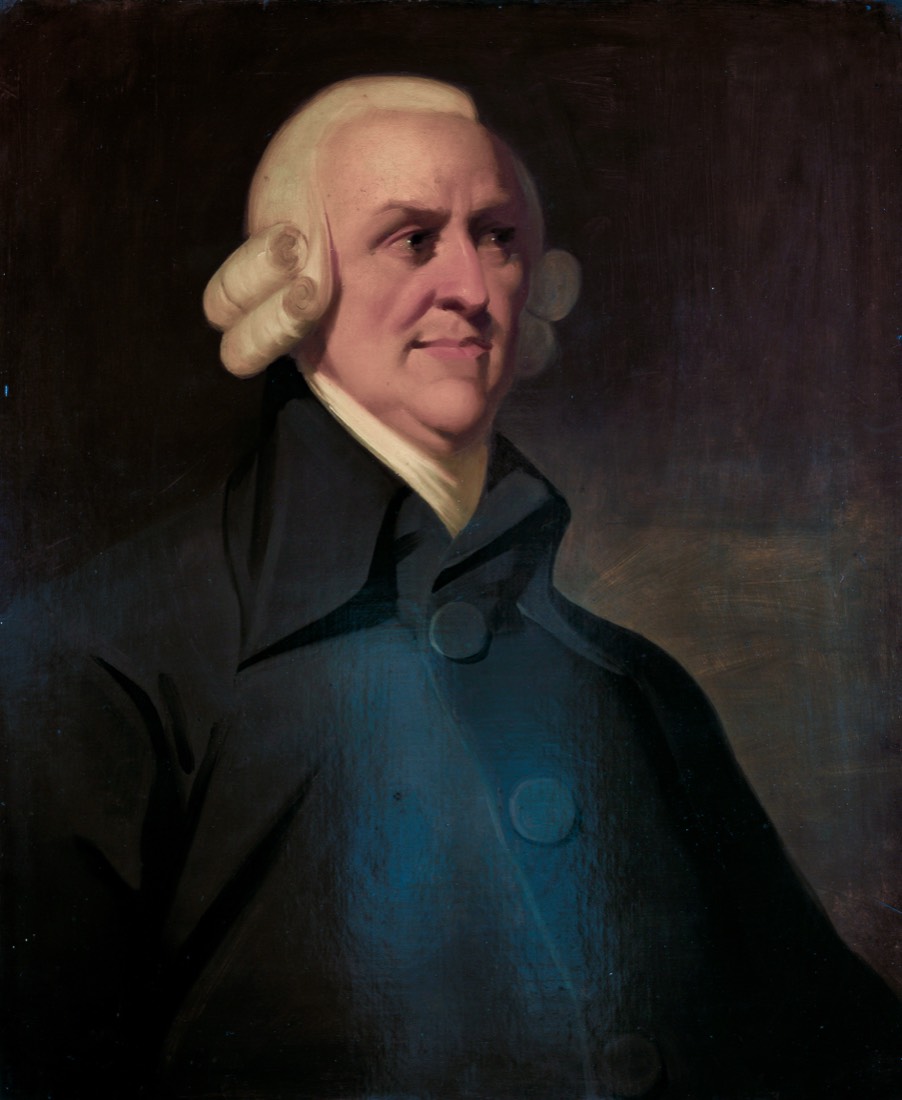
The Scottish philosopher Adam Smith published An Inquiry into the Nature and Causes of the Wealth of Nations in 1776. He argued that a nation's wealth is what its people can produce, not the gold it holds. His famous example was a pin factory, where splitting the work into small steps let a few workers make far more pins than each could alone. This is the division of labor.
Smith also explained why self-interest can serve others. In one of the most quoted lines in economics, he wrote: "It is not from the benevolence of the butcher, the brewer, or the baker, that we expect our dinner, but from their regard to their own interest." Competition, he argued, channels self-interest into goods people want, an idea later summed up by his phrase the invisible hand. Smith was not against all government; he wanted it to provide defense, justice, and some public works.
Thomas Malthus, in An Essay on the Principle of Population (1798), warned that population tends to grow faster than the food supply, which would keep most people near subsistence. David Ricardo, in On the Principles of Political Economy and Taxation (1817), explained comparative advantage: two countries both gain from trade if each specializes in what it gives up the least to make. His example was English cloth and Portuguese wine. John Stuart Mill pulled these ideas together in his Principles of Political Economy (1848), the main textbook for decades.

Marx and the marginal revolution: two answers to the classics
The classical economists mostly held that a good's value came from the labor needed to make it. Two very different movements grew out of that idea in the second half of the 1800s.
Karl Marx took the labor theory of value in a radical direction. In Capital, whose first volume appeared in 1867, he argued that workers create more value than they are paid, and that capitalists keep the difference as profit, which he called surplus value. He predicted that capitalism's crises would deepen until it was replaced. Marx's predictions are widely disputed, but his questions about class, power, and instability still shape debates.
At almost the same moment, three economists working separately changed how the field explains value. William Stanley Jevons in England and Carl Menger in Austria both published in 1871, and Léon Walras in Switzerland followed in 1874. They argued that value depends on the usefulness of one more unit, the marginal unit. This solved an old puzzle: water is vital but cheap, and diamonds are useless but costly, because water is plentiful and one more glass adds little.
Alfred Marshall built these ideas into his Principles of Economics (1890). He drew supply and demand as two curves that set price together, like the two blades of a pair of scissors, and he made elasticity a standard tool. His book helped replace the old name political economy with the word economics, and it shaped teaching for half a century.
The Great Depression and John Maynard Keynes
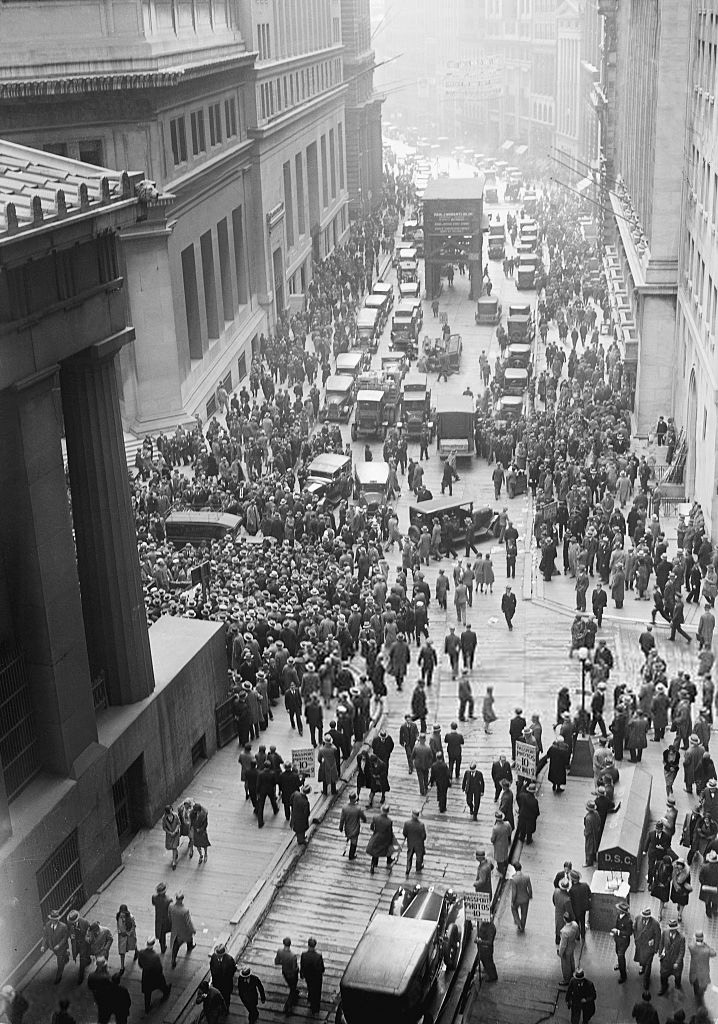
The stock market crash of October 1929 was followed by the Great Depression, the worst economic collapse of the industrial era. In the United States, about a quarter of workers were unemployed by 1933, banks failed by the thousands, and prices fell. Prevailing theory said markets would correct themselves, but for years they did not.
The British economist John Maynard Keynes offered an explanation in The General Theory of Employment, Interest and Money (1936). He argued that total spending in an economy, called aggregate demand, can fall short and stay short. When households and firms all cut back at once, one person's cut spending becomes another person's lost income. Keynes argued that governments could fill the gap by spending more or cutting taxes during a slump.
After World War II, Paul Samuelson and others combined Keynes's macroeconomics with Marshall's microeconomics. This mix, the neoclassical synthesis, became mainstream economics. Samuelson's textbook Economics (1948) taught it to generations of students.

Friedman, stagflation, and rational expectations
Milton Friedman of the University of Chicago led the main challenge to Keynesian thinking. In A Monetary History of the United States (1963), he and Anna Schwartz argued that the Federal Reserve made the Depression far worse by letting the money supply shrink. Friedman's school, monetarism, held that steady growth in the money supply matters more than government spending. He summed it up in a widely quoted line: "Inflation is always and everywhere a monetary phenomenon." He won the Nobel memorial prize in 1976.
The 1970s gave his view a boost. After oil price shocks in 1973 and 1979, many rich countries suffered high inflation and high unemployment at the same time, a mix called stagflation. Simple Keynesian models said those two should move in opposite directions. In the United States, inflation reached double digits, and it fell only after the Federal Reserve under Paul Volcker raised interest rates sharply around 1980, at the cost of a deep recession.
Economists such as John Muth and Robert Lucas added the idea of rational expectations: people use all the information they have to forecast the future, including what policymakers are likely to do. If everyone expects a policy to cause inflation, they raise prices and wages in advance, which can cancel the policy's intended effect. This pushed macroeconomics toward models built on individual decisions.
Behavioral economics, 2008, and economics today
Most models assumed people are rational and consistent. The psychologists Daniel Kahneman and Amos Tversky showed in careful experiments that they are not, and that the errors follow patterns. Their prospect theory (1979) found that losses hurt more than equal gains feel good, a pattern called loss aversion. Richard Thaler carried these findings into economics, studying why people undersave for retirement and how default options change behavior. Kahneman won the Nobel memorial prize in 2002 and Thaler in 2017.
The financial crisis of 2008 shook the field again. A US housing bubble built on risky mortgages burst, the investment bank Lehman Brothers failed in September 2008, and the world fell into the Great Recession. Few mainstream models had paid much attention to banks and debt. Central banks cut interest rates close to zero and bought bonds on a large scale, and interest in Keynes and in financial instability returned.
Economics today leans heavily on data. Economists use natural experiments and randomized trials to test what policies actually do, from cash transfers in poor villages to minimum wage changes. Research on inequality, climate, and the surge in inflation after the COVID-19 pandemic keeps the old debates about markets, money, and government very much alive.
Turning points in economics
- 1776: Wealth of Nations: Adam Smith argues that the division of labor and free exchange create wealth.
- 1867: Marx's Capital: Marx argues that profit comes from unpaid labor and that capitalism is unstable.
- 1871: Marginal revolution: Jevons and Menger, then Walras in 1874, explain value through the next unit.
- 1936: General Theory: Keynes explains how weak demand can keep unemployment high for years.
- 1970s: Stagflation: High inflation and high unemployment together boost monetarism and rational expectations.
- 1979: Prospect theory: Kahneman and Tversky show that people weigh losses more than gains.
- 2008: Financial crisis: A housing and banking crash brings finance and debt back to the center.
The main schools of thought
Economists share most of their basic tools, but they disagree about how well markets work on their own and what government should do. The table at the top of this article lists the main schools. Here is what sets each apart.
Classical economists trusted markets and free trade. Marxian economists see capitalism as built on conflict between owners and workers. Neoclassical economics, the core of most university courses today, models people and firms making choices at the margin and markets moving toward equilibrium. Keynesians stress that total demand can fall short and that government spending can help in a slump.
The Austrian school, from Carl Menger to Ludwig von Mises and Friedrich Hayek, argues that prices carry knowledge spread across millions of people, which no central planner can gather. Monetarists and the wider Chicago school favor markets and steady, rules-based monetary policy. Behavioral economists bring psychology in. Institutional economists, from Thorstein Veblen to Douglass North and Elinor Ostrom, study how laws, customs, and organizations shape economic life. Ostrom was the first woman to win the Nobel memorial prize in economics, in 2009.
Modern Monetary Theory, or MMT, is a newer and contested view. Its supporters, such as Stephanie Kelton, argue that a government that issues its own currency cannot run out of that currency, so the real limit on its spending is inflation. Most mainstream economists dispute its policy conclusions, while supporters say it describes how government finance actually works.
The big macro debate: Keynesian, monetarist, and Austrian
The sharpest disagreements are about recessions. What causes them, and should governments try to fix them? Three schools give clearly different answers.
Keynesians blame a drop in spending and want governments to step in with spending or tax cuts. Monetarists blame mistakes with the money supply and want a central bank that follows steady rules. Austrians blame booms built on artificially cheap credit and think the bust, painful as it is, clears out bad investments. Most working economists today borrow from more than one of these views.
How three schools explain recessions
| Keynesian | Monetarist | Austrian | |
|---|---|---|---|
| Main cause | Too little spending: When households and firms cut back together, lost spending becomes lost income, and unemployment can stay high. | Money supply errors: Friedman and Schwartz argued that the Federal Reserve let the money supply shrink in the early 1930s, deepening the Depression. | Cheap credit booms: Interest rates held too low lead firms into projects that savings cannot support, which later fail. |
| Best response | Spend more, cut taxes | Steady money growth | Let the bust clear |
| Role of government | Active in slumps | Follow fixed rules | Mostly stay out |
| Key thinker | John Maynard Keynes | Milton Friedman | Friedrich Hayek |
Key concepts every beginner needs
Opportunity cost is the value of the best thing you give up when you choose. The cost of college is not just tuition; it is also the wages you could have earned. The saying "there is no such thing as a free lunch" is a short way to remember it.
Marginal thinking means deciding based on the next unit, not the total. A cafe deciding whether to stay open one more hour compares the extra sales from that hour with the extra cost of that hour. What it already spent on rent does not matter for that choice.
Comparative advantage, from Ricardo, says people and countries gain by specializing in what they give up the least to do, even if someone else is better at everything. A lawyer who types faster than her assistant still gains by letting the assistant type while she does legal work.
Three numbers run the macro news. GDP, or gross domestic product, is the total value of goods and services a country produces in a year; Simon Kuznets helped build the US national accounts in the 1930s. Inflation is the rise in the general price level, often measured by a consumer price index, and many central banks aim for about 2% a year. Interest rates are the price of borrowing money, and central banks raise or lower their key rate to cool or support the economy.
Supply, demand, and elasticity
Supply and demand is the most used tool in economics. Demand describes how much buyers want at each price: as the price rises, they usually want less. Supply describes how much sellers offer at each price: as the price rises, they usually offer more. The price where the two amounts match is the equilibrium price.
If the price is above equilibrium, sellers have unsold goods, a surplus, and the price tends to fall. If it is below, buyers cannot get what they want, a shortage, and the price tends to rise. When something shifts a whole curve, such as a frost that ruins orange crops, the equilibrium moves.
Elasticity measures how strongly quantity responds to price. Demand for gasoline is inelastic in the short run, because people still need to drive to work when prices rise. Demand for one brand of cereal is elastic, because shoppers can easily switch to another brand. Elasticity tells you who really pays a tax and whether a price cut will raise a firm's revenue.
Supply and demand for a made-up good
| Price | Demand (wanted by buyers) | Supply (offered by sellers) |
|---|---|---|
| $1 | 90 | 30 |
| $2 | 80 | 40 |
| $3 | 70 | 50 |
| $4 | 60 | 60 |
| $5 | 50 | 70 |
| $6 | 40 | 80 |
| $7 | 30 | 90 |
How to think like an economist
Thinking like an economist is mostly a habit of asking a few questions. What is being given up? What are the incentives, and how will people change their behavior in response? What happens at the margin? And then what: what are the effects beyond the first one?
That last question is the core of a famous essay by the 19th-century French writer Frédéric Bastiat about what is seen and what is not seen. A broken window gives work to the glazier, which is seen. The shopkeeper's money would otherwise have bought something else, which is not seen. Good economic reasoning tracks both.
Watch for common mistakes. The fixed-pie fallacy treats the economy as a fixed amount of wealth, so one person's gain must be another's loss. In fact, trade and new ideas can grow the pie, which is why both sides of a voluntary trade usually gain. A related error, the lump of labor fallacy, assumes there is a fixed amount of work, so machines or immigrants must take jobs away. Also be careful not to confuse correlation with cause, or to judge a policy by its intentions instead of its results.
How to learn economics, step by step
Start with a short overview of the history, so the schools and their arguments have a place to hang. Then work through one introductory principles textbook from start to finish, covering both micro and macro. Mankiw's Principles of Economics is a common choice, and free options include the CORE Econ project's The Economy and OpenStax's Principles of Economics.
Practice the graphs by hand. Draw supply and demand, shift one curve, and say out loud what happens to price and quantity. Do the end-of-chapter problems instead of only reading, because economics is learned by working through examples. Short daily practice beats a long weekend session, and testing yourself later helps the ideas stick.
Then read the news with your new tools. When you see a story about rent control, tariffs, or an interest rate change, ask what the incentives are, who gains, who pays, and what is not seen. Once that feels natural, read one primary source, such as a few chapters of The Wealth of Nations, and one modern book from a school you disagree with.
If you want a lighter start, Wondering turns economics into 3-minute lessons you can read, listen to, or watch, with practice questions after each lesson, spaced review to bring ideas back before you forget them, and a voice tutor you can talk through an idea with. It is free to start. Try a free sample lesson from the course below, or browse more economics courses in Explore.
Those ready-made courses are polished courses with polished lessons, written to be clear and visual. And Wondering is one place to learn economics, your other interests, and the skills that make you better at your work, such as reading a market or a budget.
Try a free lesson: A Little History of Economics
Questions
What is economics in simple terms?
Economics is the study of how people, businesses, and governments make choices when resources like time, money, and materials are limited. It looks at the trade-offs those choices involve and how incentives shape them.
What is the difference between microeconomics and macroeconomics?
Microeconomics studies single decisions and markets, such as how a firm sets prices or how a household spends its income. Macroeconomics studies the whole economy, including growth, inflation, unemployment, and interest rates.
Who is the father of economics?
Adam Smith is usually called the father of modern economics because of The Wealth of Nations, published in 1776. Earlier thinkers, from Aristotle to the French physiocrats, wrote about economic questions before him.
What are the main schools of economic thought?
The main schools are classical, Marxian, neoclassical, Keynesian, Austrian, monetarist (Chicago), behavioral, and institutional economics. Modern Monetary Theory is a newer, more contested view.
Is economics hard to learn?
The core ideas, like opportunity cost and supply and demand, are easy to grasp with everyday examples. The harder part is applying them carefully, which comes from practicing graphs and problems and using the ideas to read the news.
What should I read first to learn economics?
Start with a short history of economic ideas, then one introductory principles textbook such as Mankiw's Principles of Economics or the free CORE Econ book The Economy. Do the practice problems as you go.
References
- Smith, A. (1776). An Inquiry into the Nature and Causes of the Wealth of Nations. Project Gutenberg.
- Ricardo, D. (1817). On the Principles of Political Economy and Taxation. Project Gutenberg.
- Marx, K. (1867). Capital: A Critique of Political Economy, Volume I. Marxists Internet Archive.
- Marshall, A. (1890). Principles of Economics. Library of Economics and Liberty.
- Keynes, J. M. (1936). The General Theory of Employment, Interest and Money. Reissued by Palgrave Macmillan (2018).
- Muth, J. F. (1961). Rational expectations and the theory of price movements. Econometrica, 29(3), 315-335.
- Kahneman, D., and Tversky, A. (1979). Prospect theory: An analysis of decision under risk. Econometrica, 47(2), 263-291.
- The Nobel Prize. Milton Friedman, Prize in Economic Sciences 1976.
- The Nobel Prize. Richard H. Thaler, Prize in Economic Sciences 2017.