Free sample lesson · A Little History of Economics
Greek Philosophy
How did ancient philosophers think about wealth and the good life?
Lesson 1 of the Wondering course A Little History of Economics
The First Economic Thinkers
Long before economics had a name, ancient Greek philosophers were already asking its core questions.
How should a society organize its economic life? Who should own things? When is a trade fair?
Two thinkers led the way: Plato and his student Aristotle. Raphael's famous painting The School of Athens shows them walking side by side at its center.
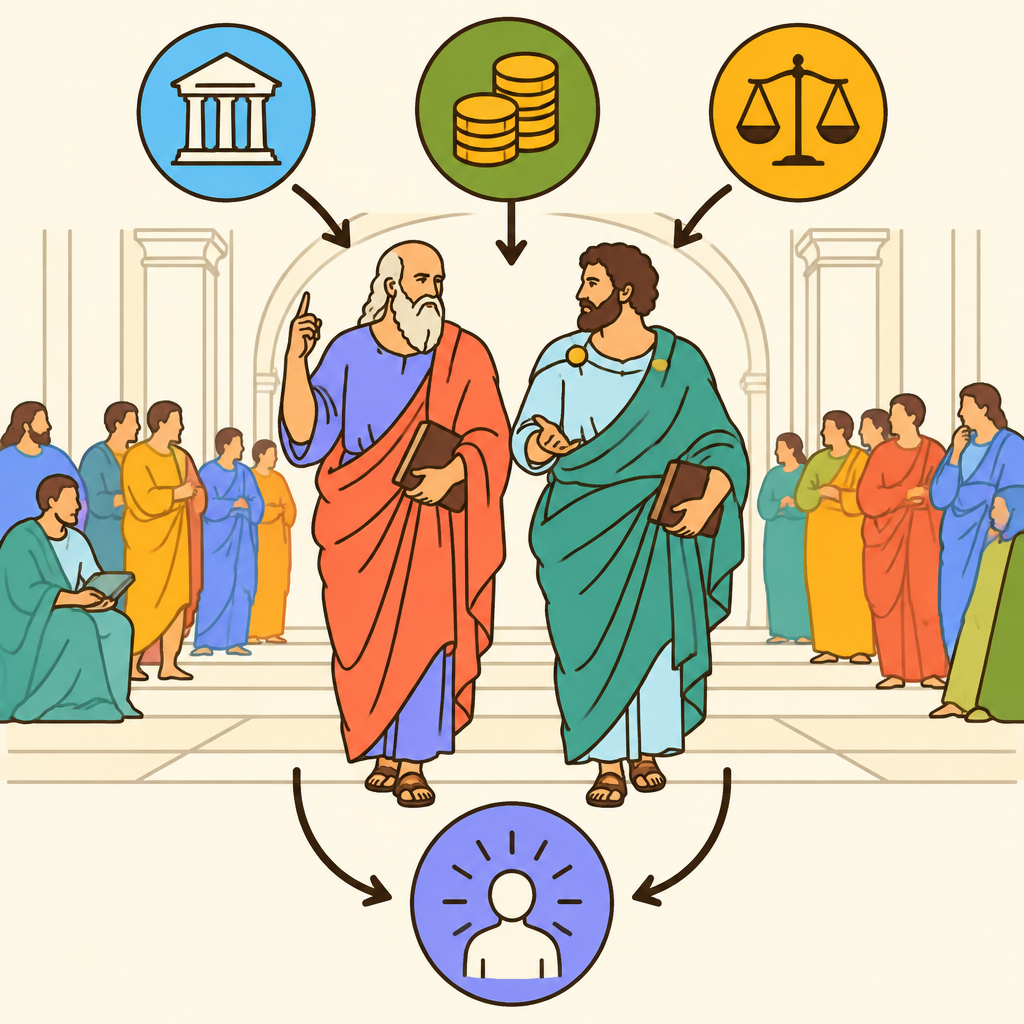
Plato and Aristotle at the heart of Greek thought
For both men, wealth was always tied to a bigger question: how can people live a good life?
Plato: Property Corrupts
Plato imagined an ideal society with no private property.
In his vision, people would not chase wealth. He saw the love of money as a danger to the whole community.
His worry was simple. When people focus on what they own, they stop focusing on virtue and the common good.
- Own things: People hold private property.
- Chase wealth: The love of money takes hold.
- Neglect virtue: Attention shifts away from virtue and the common good.
- Remove the cause: Plato's ideal society has no private property.
So for Plato, the cure was to remove private property and the pursuit of wealth altogether.
Aristotle: Property Can Help
Aristotle studied under Plato, but he disagreed about property.
He thought private property could enable good living. Owning things gives people the means to care for their households and live well.
- Plato
- Aristotle
Still, he shared Plato's warning against the love of money.
Their debate turned economics into a question of ethics: what kind of society is a good one?
Natural Exchange: Meeting Needs
Aristotle did not reject trade completely. He split exchange into two kinds.
Natural exchange happens when people trade to meet real needs.
Picture a farmer with extra grain and a shoemaker with extra shoes. They swap, and each household gets what it lacks.
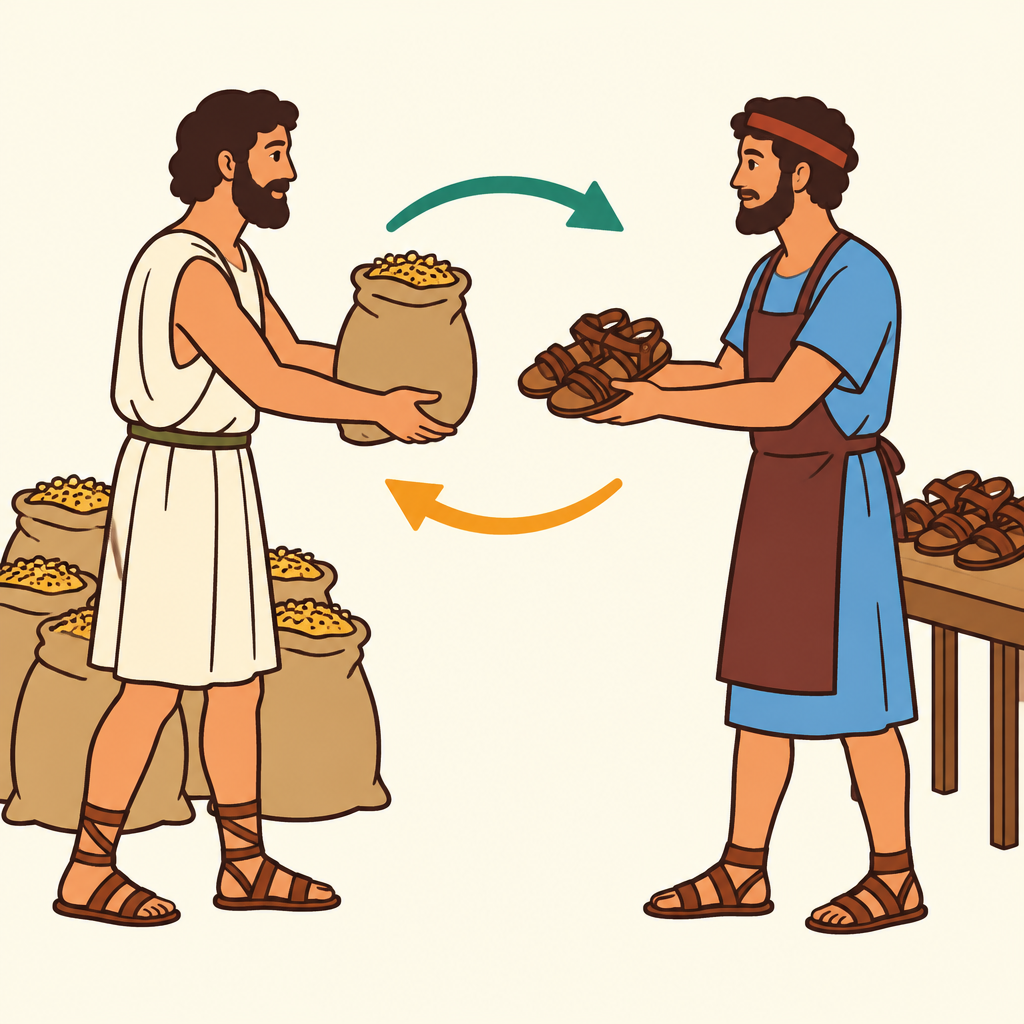
Each person gives up a surplus and gets something their household needs, which is what makes this exchange natural.
The goal of this kind of trade is simple: having enough to live well.
Unnatural Exchange: Profit as the Goal
The second kind of exchange troubled Aristotle. He called commerce for profit 'wholly unnatural.'
Here, the goal is no longer to meet a need. The goal is to make more money.
A trader who buys goods only to resell them at a higher price fits this picture.
- Exchange
- Natural: Trade to meet real needs.
- Grain for shoes: Each household gets what it lacks.
- Unnatural: Commerce for profit.
- Buy to resell: The goal is more money.
Aristotle was questioning the morality of money-making itself. Needs have a limit. The desire for more money may have none.
Wealth and the Good Life
Both philosophers warned against the love of money.
For them, wealth was a means. The real goal was a good life, one of virtue and fairness.
This challenges a common modern habit. We often measure success by how much someone earns.
Plato and Aristotle would ask what that money is for.
Why It Still Matters
The Greeks raised questions we still argue about today.
Debates over private versus shared ownership echo Plato and Aristotle on property and virtue.
Arguments about whether profit is fair echo Aristotle's split between natural and unnatural exchange.
When you hear a debate about markets and justice, ask: is this about meeting needs, or about making money?
Check yourself
Plato's ideal society _____ private property and the pursuit of wealth.
- did without
- was built on
Answer: did without
Plato envisioned an ideal society without private property or the pursuit of wealth, fearing that wealth-seeking would corrupt people and society.
Aristotle called exchange to meet household needs _____, but called commerce aimed at _____ unnatural.
Answer: Aristotle called exchange to meet household needs natural, but called commerce aimed at profit unnatural.
Aristotle judged exchange by its purpose. Trading to get what you need is natural; trading to make money is unnatural.
Which exchange would Aristotle most likely call natural?
- A farmer trades extra grain for shoes she needs
- A merchant buys oil cheaply to resell at a higher price
- A trader hoards coins to grow his fortune
- A dealer buys cloth only to sell it for profit
Answer: A farmer trades extra grain for shoes she needs
Natural exchange meets real needs. The farmer swaps surplus grain for shoes she needs. The other options aim at gaining more money, which Aristotle saw as unnatural.
Keep going
This is lesson 1 of 24 in A Little History of Economics. Next up:
- Medieval Just Price
- Mercantilism
- Physiocracy
- Invisible Hand
- Comparative Advantage
Wondering turns any topic into short lessons you can read, watch, or listen to, with practice questions and an AI tutor.