Free sample lesson · Year 6 Norwegian Naturfag Prep
Making Hypotheses
How do scientists turn wild guesses into testable ideas?
Lesson 1 of the Wondering course Year 6 Norwegian Naturfag Prep
More than a wild guess
A hypothesis is a sensible prediction that you can check.
A wild guess comes from nowhere, and there is no clear way to check whether it is right.
A hypothesis grows from what you already know or have noticed, and a test can check it.
- Wild guess
- Hypothesis
Scientists use hypotheses to decide what they want to investigate next.
Start with something you notice
Good hypotheses usually start with a small observation.
Maybe you notice that seedlings on a windowsill lean towards the light.
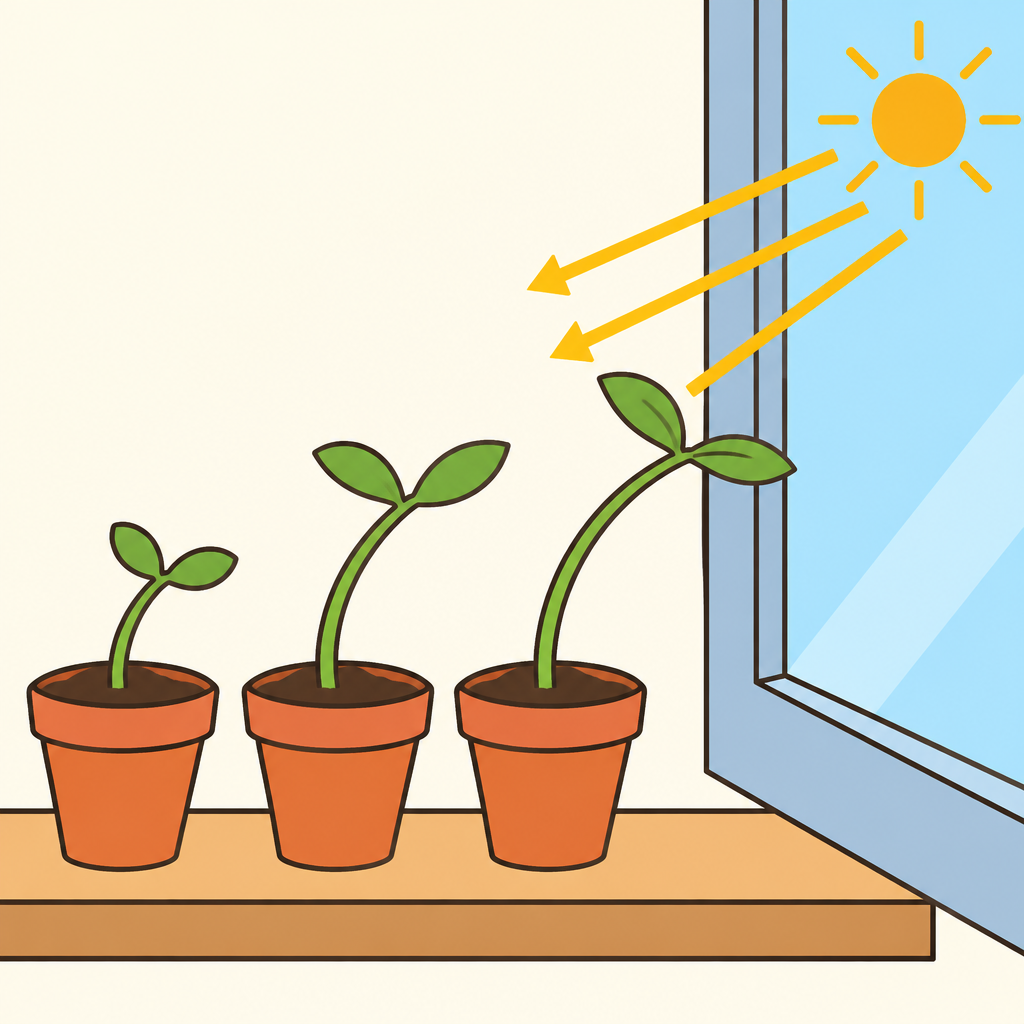
An observation worth predicting about
That noticing gives you something to predict. You are using what you have already seen.
Observations are the seeds of investigations.
Testable means checkable
A hypothesis is testable when an investigation can give you evidence about it.
Here is an example. A plant placed near a window will grow taller than a plant kept in a dark cupboard.
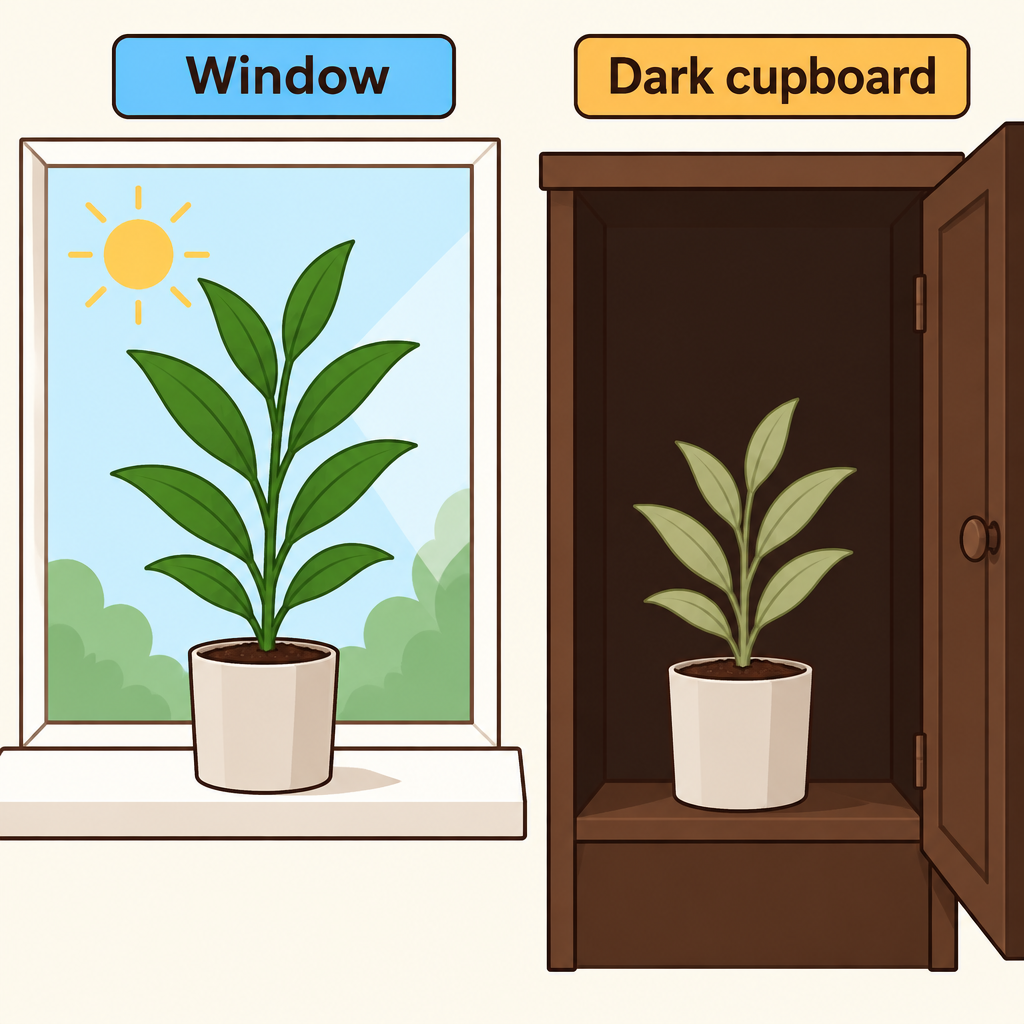
Notice that only the light differs between the two plants, which is why comparing their heights gives useful evidence.
You can then measure both plants and compare their heights.
Those measurements are your evidence.
Making the test fair
A prediction is only useful if your test is fair.
In a fair test you change one thing and keep everything else the same.
Same pot, same soil, same amount of water. Only the light is different.
- Plan your test
- Only one thing different?: Look at pot, soil, water and light.
- Make the rest same: Give both plants the same pot, soil and water.
- Run the test
- Compare the heights
- check again
Then any difference in height has one likely cause.
Ideas you cannot test
Some ideas cannot be tested at all.
"Plants are pretty" is an opinion, so no measurement can settle it.
"Plants like sunshine" sounds scientific, but liking cannot be measured.
"A plant near a window grows taller than one in a dark cupboard" can be tested, because height is measurable.
Wording it clearly
Clear wording makes a hypothesis much easier to test.
Say what you will change, what you will measure, and what you expect to happen.
- One change: Name the one thing you will change, such as the light.
- One measure: Name what you will measure, such as the height.
- Your expectation: Say clearly what you expect to happen.
- Check wording: Make sure a test could also show that you are wrong.
For example: if I keep one plant near a window, it will grow taller than the plant in the dark cupboard.
Hypotheses can be improved
A hypothesis is rarely finished the first time you write it.
You test it, look at your evidence, and then keep the idea or change it.
A changed hypothesis often leads straight into a new test.
- Make hypothesis: Write a prediction you can check.
- Plan fair test: Change one thing and keep the rest the same.
- Collect evidence: Measure and record what happens.
- Keep or change: Decide whether the idea still fits your evidence.
Being wrong is useful
Evidence can support your hypothesis, or it can show that the hypothesis needs changing.
Neither result is a mistake. Both give you real information.
Scientists change hypotheses often. Changing one shows that you have been paying attention to your evidence.
What a strong hypothesis needs
A strong hypothesis does three things at once.
It comes from what you already know, it says what you expect, and it can be checked by a fair test.
- Strong hypothesis: It does three things at once.
- Based on what you know: It comes from what you already know or noticed.
- Says what you expect: It states clearly what you expect to happen.
- Checked by fair test: A fair test can give evidence about it.
In Naturfag tasks, writing it this way shows the examiner how you think.
Check yourself
A hypothesis is a sensible prediction that can be checked by an observation, investigation, or fair test.
- True
- False
Answer: True
This is true. A hypothesis is more than a guess because it can be checked using evidence.
A _____ is a sensible prediction that can be checked. A _____ comes from nowhere and has no clear way to be checked.
Answer: A hypothesis is a sensible prediction that can be checked. A wild guess comes from nowhere and has no clear way to be checked.
A hypothesis uses what you know or have noticed and can be tested. A wild guess has no clear evidence-based starting point or checking method.
A student notices that seedlings on a windowsill lean toward the light. Which is the best hypothesis to investigate?
- Seedlings near a light will lean toward it.
- Seedlings are pretty.
- Plants like everything about sunshine.
- Seedlings will become the biggest plants in the world.
Answer: Seedlings near a light will lean toward it.
The prediction about light direction is based on an observation and can be checked by observing or testing seedlings. The other choices are opinions, vague statements, or unrelated guesses.
Keep going
This is lesson 1 of 21 in Year 6 Norwegian Naturfag Prep. Next up:
- Tracking Variables
- Lab Safety
- Analyzing Evidence
- Particle Model
- State Changes
Wondering turns any topic into short lessons you can read, watch, or listen to, with practice questions and an AI tutor.