Free sample lesson · YC guide to business models
Copy a Proven Model
Why do billion-dollar startups rarely invent how they make money?
Lesson 1 of the Wondering course YC guide to business models
Overview: Copy a Proven Model
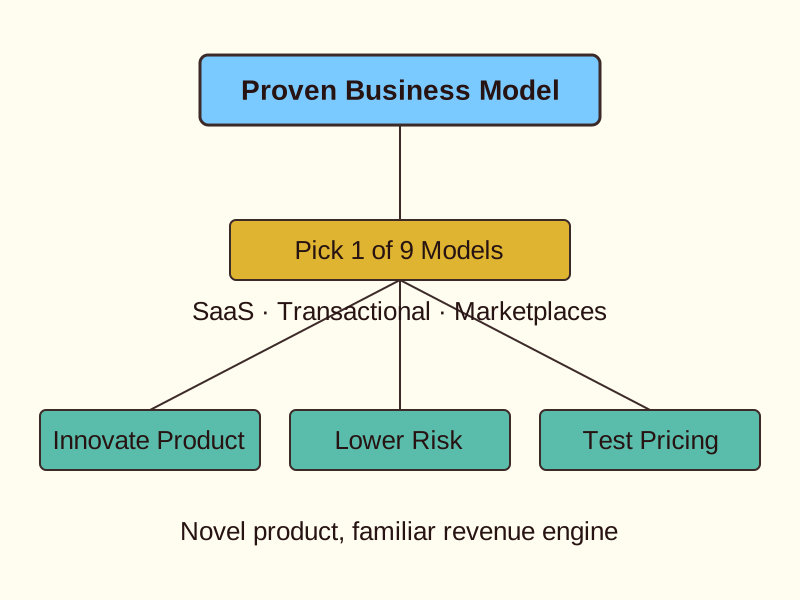
A novel product can still use a familiar revenue engine, reducing avoidable financing and growth risk.
The Power of Proven Models
A business model is simply how your company makes money. Many founders believe they must invent a brand new revenue engine to be successful.
Aaron Epstein argues the opposite. He suggests that you should copy a proven model while focusing your innovation on the product itself.
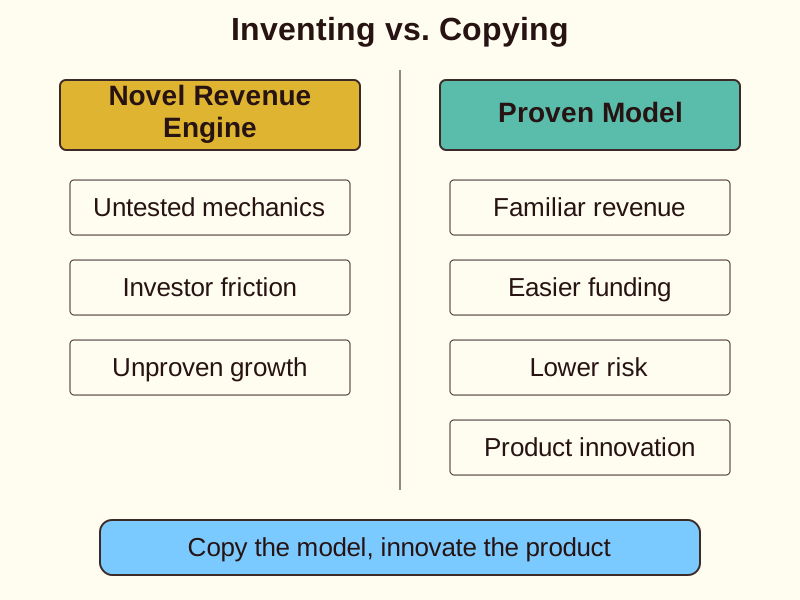
Using a familiar model reduces risk. It makes it easier for investors to fund you and for your business to grow.
The Nine Recurring Models
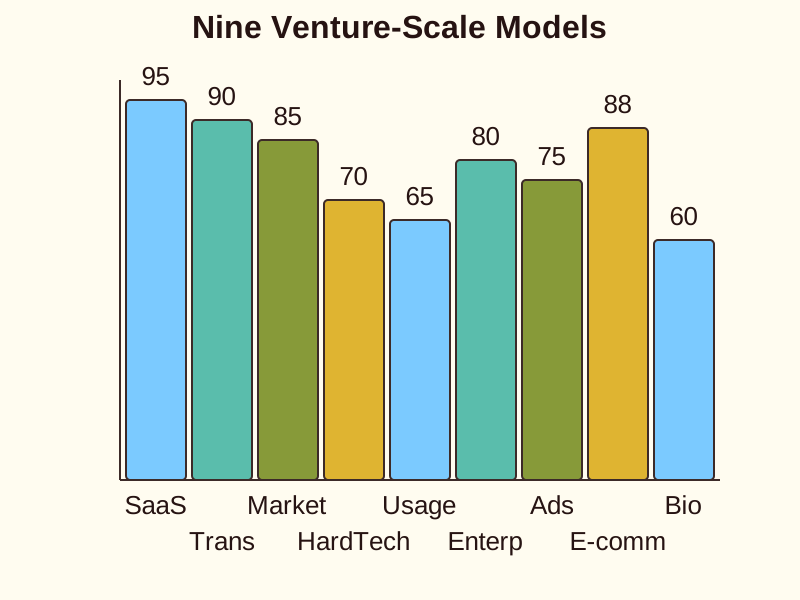
Nearly every billion-dollar company follows one of nine established paths. These patterns have already scaled to massive heights.
Common models include SaaS, which charges monthly for software, and Transactional, which takes a cut of money movement.
Other successful paths are Marketplaces, Hard Tech, Usage-based, Enterprise, Advertising, E-commerce, and Bio. These categories represent the vast majority of venture-scale success.
Product Novelty vs Model Novelty
It is important to distinguish between what you build and how you charge for it. Your product should be new and unique.
However, your business model does not need to be unprecedented. Inventing a new way to charge customers often creates avoidable friction.
Investors may hesitate if they cannot recognize your revenue pattern. Stick to a model with known metrics and growth levers.
- Product (New)
- Business Model (Proven)
Choosing Your Path
Copying a model does not mean copying a competitor. You are borrowing a revenue structure, not a brand or a customer segment.
Each of the nine models has specific requirements. For example, SaaS requires high retention, while Marketplaces need both buyers and sellers.
Identify which of the nine models fits your vision. Use that foundation to run early pricing experiments and prove your concept.
- 1. Borrow Structure: Select one of the nine proven revenue models for your venture.
- 2. Match Requirements: Ensure your business meets model-specific needs like retention or two-sided liquidity.
- 3. Run Experiments: Test early pricing models against your chosen foundation to prove the concept.
How to Apply It in Real Life
- Select Model: Choose a proven revenue engine that fits your core offering without reinventing how customers pay.
- Align Requirements: Identify the specific metrics and operational drivers required to make the chosen model succeed.
- Run Pricing Experiments: Test early pricing structures and tiers with your target market to validate willingness to pay.
Check yourself
To reduce risk and attract investors, a startup should focus its innovation on the _____.
- product
- business model
Answer: product
Innovation should focus on the product. The business model should ideally be a proven, recognizable structure to reduce friction and risk.
In venture-scale business, _____ models charge a recurring monthly fee, while _____ models take a percentage of money movement.
Answer: In venture-scale business, SaaS models charge a recurring monthly fee, while Transactional models take a percentage of money movement.
SaaS (Software as a Service) provides predictable recurring revenue, whereas Transactional models rely on the volume of individual payments or trades.
What is the primary benefit of copying a proven business model rather than inventing a new one?
- It eliminates the need for product innovation
- It reduces financing risk and customer payment friction
- It ensures you have no competitors in your market
- It allows you to skip pricing experiments entirely
Answer: It reduces financing risk and customer payment friction
Using a proven model makes it easier for investors to understand your growth levers and reduces the friction customers feel when trying to pay you.
Keep going
This is lesson 1 of 11 in YC guide to business models. Next up:
- Read the YC Top 100
- Marketplaces Compound Demand
- Money Flow Creates Leverage
- Recurring Revenue Needs Retention
- Avoid Non-Scale Traps
Wondering turns any topic into short lessons you can read, watch, or listen to, with practice questions and an AI tutor.