Free sample lesson · World Models: How AI Simulates Worlds
A Small Model of the World in Your Head
How can you know a bridge will hold a train before building it?
Lesson 1 of the Wondering course World Models: How AI Simulates Worlds
The Bridge in Your Head
How can you know a bridge will hold a train before building it?
In 1943, psychologist Kenneth Craik gave an answer. We can design a bridge in our minds and know it will bear a train, without running full-scale experiments.[[1]](https://cpcontacts.markhuckvale.com/research/hp/Craik_NOE_Chapter_5.pdf)
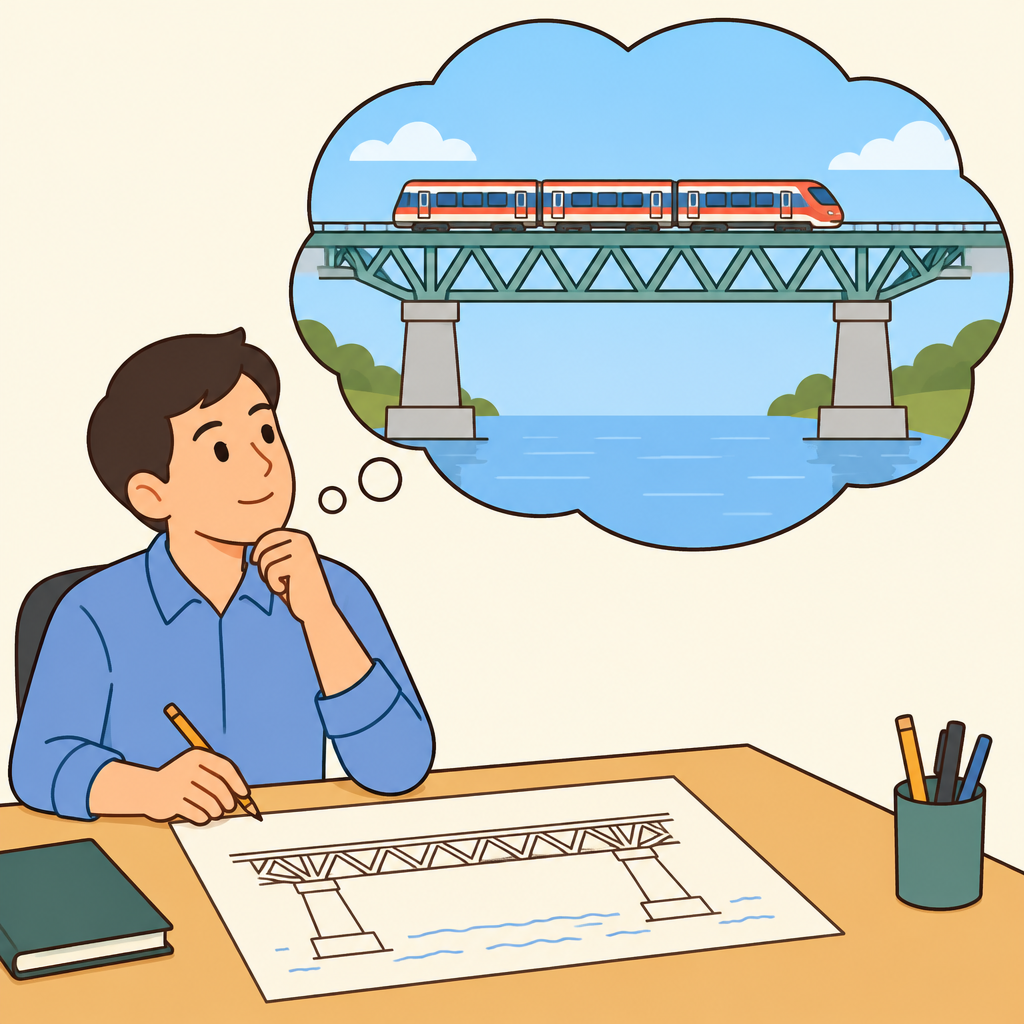
Notice that the test happens inside the engineer's head, so a weak design can fail there without any real bridge or train at risk.
He called that mental copy a small-scale model of reality. It holds both the outside world and your own possible actions.[[1]](https://cpcontacts.markhuckvale.com/research/hp/Craik_NOE_Chapter_5.pdf)
Today, AI researchers call this idea a world model.
Try It Before You Do It
A world model predicts what will happen next, especially after an action.
Picture carrying a sofa to a doorway. Before lifting it, you turn it in your head and check whether it fits.
Craik said such a model lets you try out alternatives, pick the best, and react to situations before they arise.[[1]](https://cpcontacts.markhuckvale.com/research/hp/Craik_NOE_Chapter_5.pdf)
- Try options: Imagine turning the sofa different ways at the doorway.
- Predict results: Picture whether each way fits through the door.
- Pick the best: Choose the way your model says will work.
- Act: Only now lift and carry the real sofa.
Pure reaction cannot do this. It only responds after something happens. A world model lets an agent test options safely and cheaply first.
Google DeepMind describes AI world models the same way: systems that simulate aspects of the world to predict how actions will change it.[[2]](https://deepmind.google/discover/blog/genie-3-a-new-frontier-for-world-models/)
A Photo Is Not a Model
A common mistake is thinking a world model is a stored record of what the agent has seen, like a photo album.
A photo of a room is a record. You cannot ask it what happens if you push the table.
- Photo of a room
- World model
A list of past events has the same problem. It cannot answer questions about a new action.
A world model can. Its job is to answer what if.
Works Like, Not Looks Like
Craik defined a model as any system with a similar relation-structure to the process it imitates.[[1]](https://cpcontacts.markhuckvale.com/research/hp/Craik_NOE_Chapter_5.pdf)
In plain words: its parts must change together the way the real thing changes. It need not look like the real object.[[1]](https://cpcontacts.markhuckvale.com/research/hp/Craik_NOE_Chapter_5.pdf)
His example was Kelvin's tide predictor. It used pulleys and levers that look nothing like water.[[1]](https://cpcontacts.markhuckvale.com/research/hp/Craik_NOE_Chapter_5.pdf)
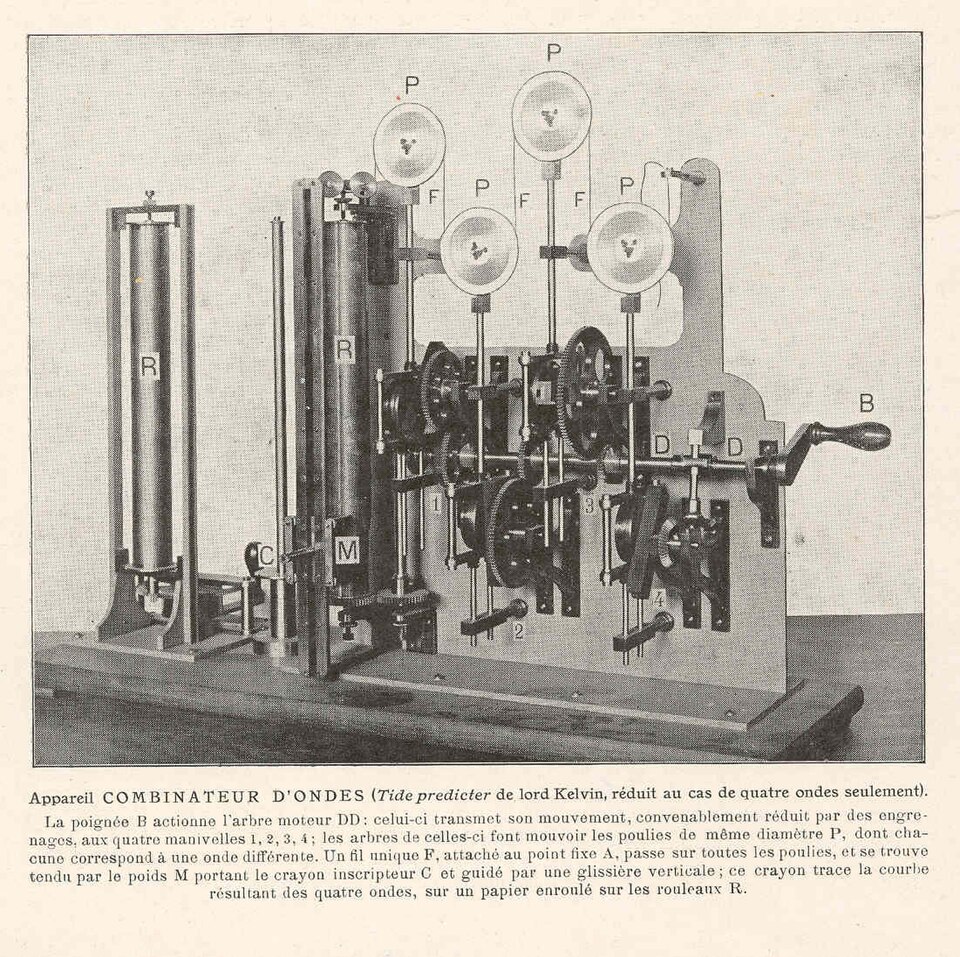
FMIB 36872 Appereil Combinateur d'Ondes (Tide Predicter de Lord Kelvin, Reduit au Cas de Quatre Ondes Seulement).jpeg) · Georges Clerc-Rampal · Public Domain Mark 1.0 · Wikimedia Commons
Yet it predicted tides, because its parts moved in the same pattern as the sea.
Judge by Behavior
So what makes a better world model? A common guess is the one that produces more realistic pictures.
That is the wrong test. A model is judged by whether it behaves like the process in the ways that matter.
Ask one question of any system: can it predict what happens next, or after an action?
Use that question to sort the cases below.
An Old Idea Comes Back
World models are not new. The idea has roots in Craik's 1943 psychology.[[1]](https://cpcontacts.markhuckvale.com/research/hp/Craik_NOE_Chapter_5.pdf)
In 2018, Ha and Schmidhuber named the modern AI version world models.
In 2025, Google DeepMind presented Genie 3 as a new frontier for world models.[[2]](https://deepmind.google/discover/blog/genie-3-a-new-frontier-for-world-models/)
- Craik's small-scale model: A psychologist proposes a mental copy of the world and our actions.
- Modern name: world models: Ha and Schmidhuber name the AI version.
- DeepMind's Genie 3: Presented as a new frontier for world models.
Quanta Magazine described world models as an old idea in AI mounting a comeback.[[3]](https://www.quantamagazine.org/world-models-an-old-idea-in-ai-mount-a-comeback-20250902/)
- Like a flight simulator, up to a point
- A snow globe inside the machine
Using the Idea Yourself
A world model is a working copy you can test ideas on, not a picture of reality.
When you meet one, ask what it lets an agent do. Can it try actions and predict their results before acting?
Then judge it by behavior. Like Kelvin's tide machine, it only has to move in the right pattern.
Realistic output can impress you. It does not prove the model works.
Check yourself
To judge whether a system is a useful model, focus on _____.
- whether it predicts what happens after an action
- whether it produces a realistic picture of the process
Answer: whether it predicts what happens after an action
A model is judged by whether it behaves like the real process in important ways. It does not need to look like the thing it models.
A _____ of a room records what was seen. A world _____ can predict what happens if an agent pushes the table.
Answer: A photo of a room records what was seen. A world model can predict what happens if an agent pushes the table.
A photo is a record, but a world model answers what-if questions about actions. That ability to predict results is the key difference.
You are carrying a sofa toward a doorway. How can a world model help before you lift it?
- It tests different turns in your mind and predicts which will fit
- It stores a picture of the doorway without predicting anything
- It waits for the sofa to hit the doorway, then chooses a turn
- It makes the real doorway wider before you carry the sofa
Answer: It tests different turns in your mind and predicts which will fit
It lets you imagine different turns and predict which one will fit before acting. Pure reaction waits until something happens.
Keep going
This is lesson 1 of 16 in World Models: How AI Simulates Worlds. Next up:
- Actions Turn a Video Into a World
- Imagine Before You Act
- Predicting Every Pixel
- Predicting Meaning, Not Pixels
- Practicing Inside a Dream
Wondering turns any topic into short lessons you can read, watch, or listen to, with practice questions and an AI tutor.