Free sample lesson · Wittgenstein's Blue Book
The Puzzle of Meaning
Why does the question 'What is meaning?' lead philosophers into endless confusion?
Lesson 1 of the Wondering course Wittgenstein's Blue Book
A Question That Seems Simple
"What is the meaning of a word?" It sounds like an easy question.
Ludwig Wittgenstein opens his Blue Book with exactly this question. Philosophers have puzzled over it for centuries without settling it.
His surprising claim: the trouble starts with the question itself.
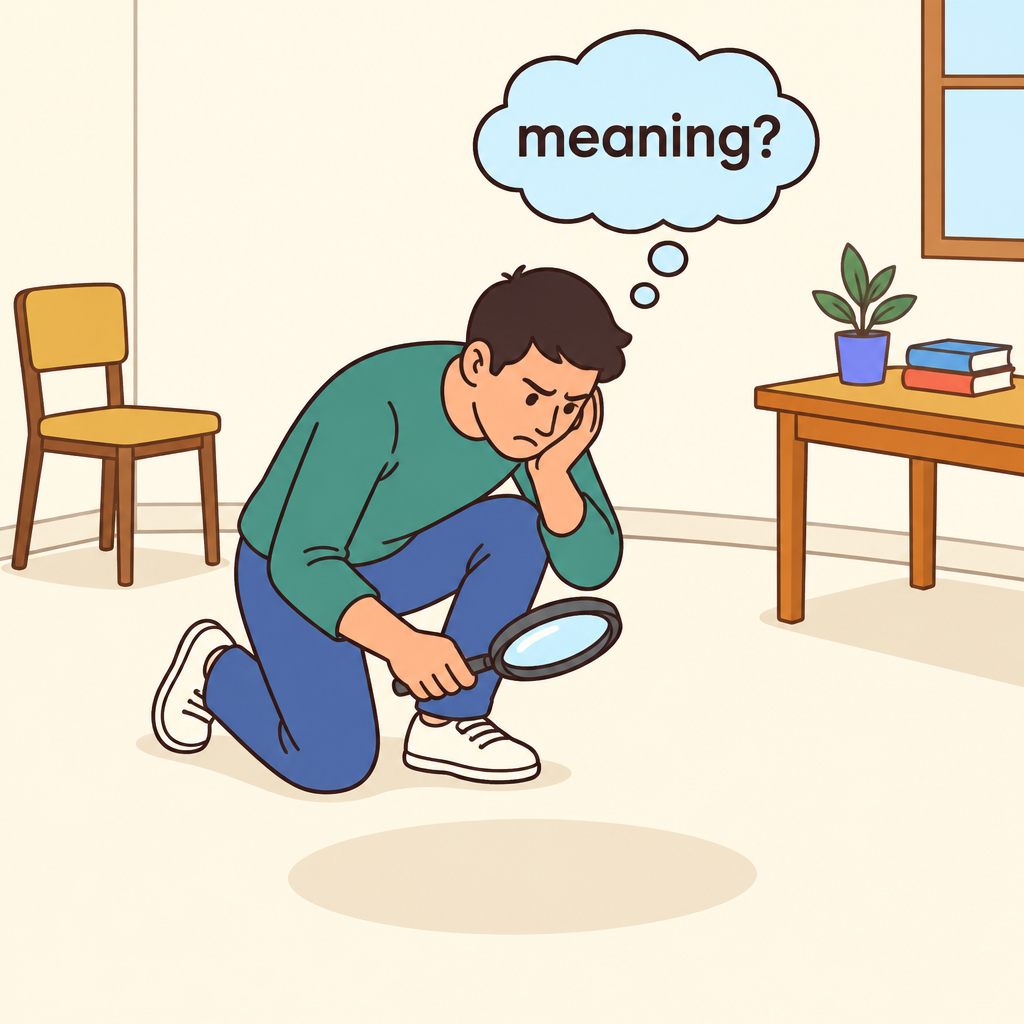
Notice that the search is careful and serious, yet the spot the thinker examines is empty: the question promised an object that is not there.
The way it is phrased sends us looking in the wrong place. That search ends in philosophical bewilderment, a confusion that never seems to clear.
Meaning Treated as a Thing
Compare two questions. Ask "What is a chair?" and you can simply point to one in the room.
Ask "What is meaning?" and the question has the same shape. It quietly suggests there is an object to point at or define.
- What is a chair?
- What is meaning?
That is the hidden assumption.
Wittgenstein argues this is why the question misleads. It treats meaning as a thing, so we expect to find one, and we end up bewildered.
Grammar Sets the Trap
Why does the question feel so natural? Wittgenstein blames the structure of our language.
"Meaning" is a substantive noun, a naming word, just like "chair" or "table".
We are used to nouns standing for objects. So the noun form tricks us into searching for a corresponding object.
For "meaning," no such object exists. Each failed search makes us ask again, and the confusion keeps going.
- Meet the noun: We see 'meaning' as a naming word.
- Assume an object: Nouns usually stand for things, so we expect one.
- Search for it: We look for the matching object.
- Find nothing: No such object exists, so we ask the question again.
Asking a Better Question
Wittgenstein does not try to answer "What is meaning?" directly. He swaps it for a different question.
"What counts as an explanation of meaning?"
This new question points somewhere we can actually look: how words function and how we explain them.
So when a "What is X?" question stalls, check whether X names something you can point to. If not, ask what counts as an explanation of X.
- 'What is X?'
- Can you point to X?
- Point to it: Like a chair, show the object.
- Ask what explains X: What counts as an explanation of X?
- Study how words function
- Yes
- No
The Cure for the Temptation
Wittgenstein promises that investigating how words function "will cure you of the temptation to look" for mysterious objects.
Notice the word temptation. The pull toward an object is strong, and it keeps coming back.
The cure changes where you look: away from hidden objects and toward how words actually work.
Once your attention moves, the old puzzle loses its grip.
Spotting the Trap Yourself
You can use this idea whenever you think about language.
When a question asks "What is X?" about an abstract noun, pause. Ask whether the noun form is pushing you to hunt for an object.
Then reframe it: what counts as an explanation of X?
Clearer thinking starts by noticing that a question itself can mislead.
Check yourself
Wittgenstein argues that the question 'What is meaning?' is misleading because it treats meaning as _____
- a thing we could point to
- a feeling we cannot share
Answer: a thing we could point to
The question's form suggests meaning is a thing we could point to or define, like a physical object. Wittgenstein argues no such object exists.
Wittgenstein suggests replacing the question 'What is _____?' with 'What counts as an _____ of meaning?'
Answer: Wittgenstein suggests replacing the question 'What is meaning?' with 'What counts as an explanation of meaning?'
The original question sends us hunting for an object. The replacement asks about our practice of explaining meaning, which we can actually investigate.
Why does asking 'What is meaning?' leave philosophers feeling bewildered?
- It sends them searching for a thing that isn't there
- Meaning is too complex for any human mind to grasp
- Different languages define meaning in conflicting ways
- Philosophers lack the scientific tools to observe meaning
Answer: It sends them searching for a thing that isn't there
The question presumes meaning is a thing to point to. When no such thing turns up, philosophers feel puzzled, but the bewilderment comes from the misleading question rather than from meaning being too complex.
Keep going
This is lesson 1 of 26 in Wittgenstein's Blue Book. Next up:
- Defining with Words
- The Limits of Pointing
- Meaning Is Use
- Language Games
- The Craving for Generality
Wondering turns any topic into short lessons you can read, watch, or listen to, with practice questions and an AI tutor.