Free sample lesson · Why Nations Fail
Inclusive vs. Extractive
Why does a fence through Nogales create a $20,000 income gap?
Lesson 1 of the Wondering course Why Nations Fail
One Town, Split by a Fence
Picture one town cut in half by a border fence. The north half is Nogales, Arizona, and the south half is Nogales, Sonora.
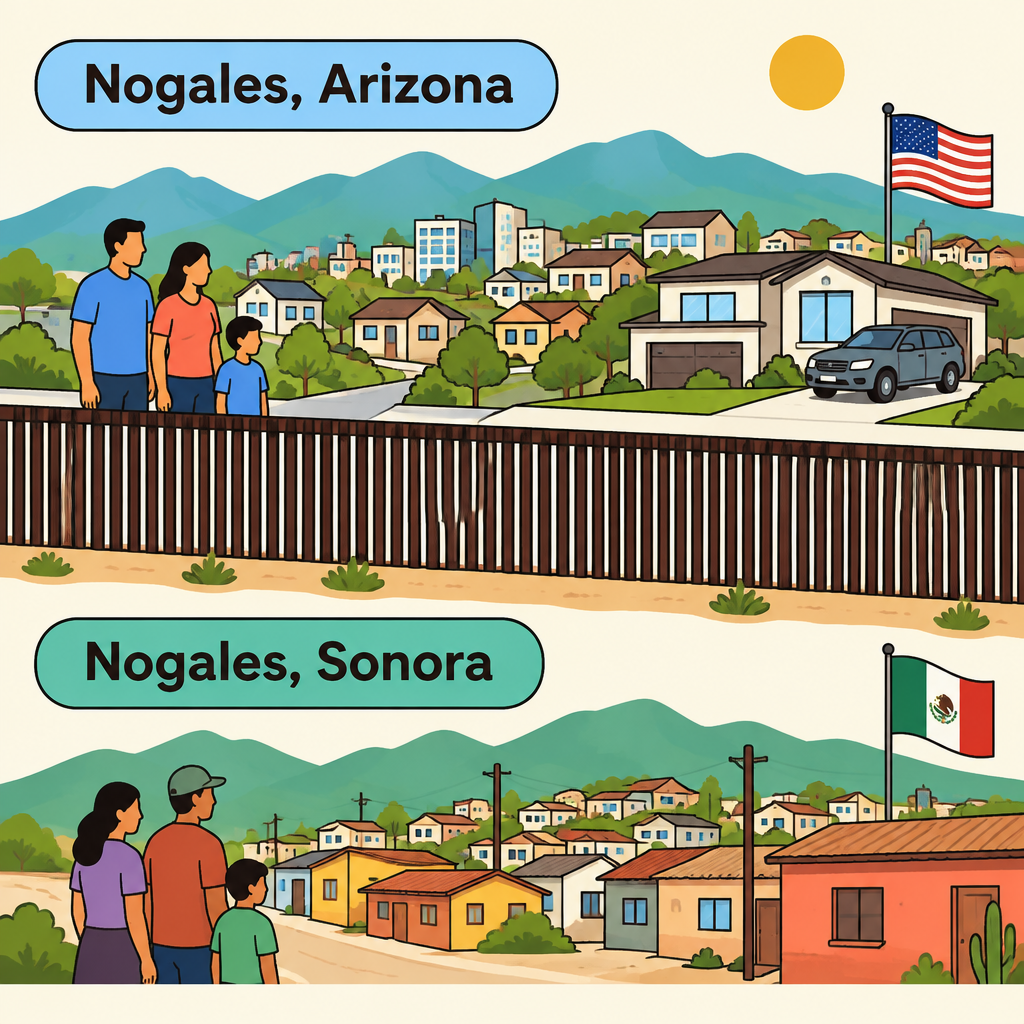
The fence separating the two Nogales
The two sides share the same geography, climate, culture, and even the same name.
Yet families on one side earn far more than families on the other.
This lesson explains why through institutions, the rules governing how power, opportunity, and resources are distributed in society.
The USD 20,000 Gap
Average household income in Nogales, Arizona is around USD 30,000.
Average household income in Nogales, Sonora is around USD 10,000.
- Nogales, Arizona: 30000
- Nogales, Sonora: 10000
The difference is about USD 20,000 between neighbors separated by a fence.
These neighbors share geography, climate, culture, and a name. What changes at the fence is the institutional system governing each side.
What Inclusive Institutions Provide
Inclusive economic institutions give a broad cross-section of society a fair chance to participate and benefit.
They have four defining features: secure property rights, an unbiased legal system that enforces contracts fairly, and public services that create a level playing field.
They also give people freedom to enter businesses and choose occupations.
- Inclusive institutions: They serve a broad cross-section of society.
- Secure property rights: Property rights extend across society.
- Unbiased legal system: It enforces contracts fairly.
- Public services: They create a level playing field.
- Economic freedom: People can enter businesses and choose occupations.
The key word is broad.
These protections reach many people, rather than only those at the top.
How Extractive Institutions Work
Extractive economic institutions are designed to pull wealth from one part of society to benefit another.
Usually, the majority loses and a narrow elite gains.
Common signs are insecure property rights for most people, a biased legal system, and barriers that block ordinary people from economic participation.
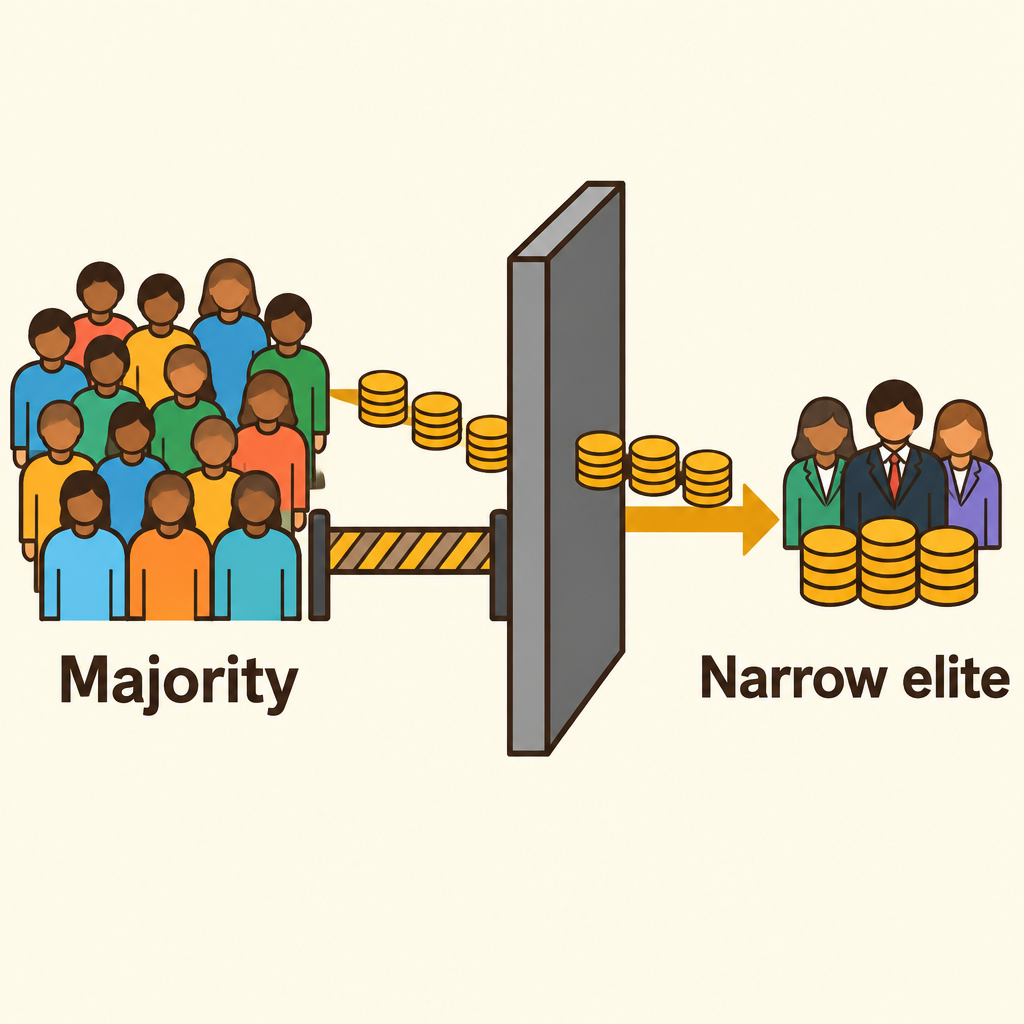
Trace wealth from the majority toward the narrow elite, while barriers block broad economic participation.
The pattern directs benefits from many people toward a few.
The word designed matters because the unfairness is built into the rules.
Compare the Two Systems
Compare the two systems across four diagnostic features: property rights, legal fairness, economic entry, and who benefits.
With inclusive institutions, rights are broadly secure, the legal system is unbiased, and contracts are enforced fairly.
Public services create a level playing field, while people remain free to enter businesses and choose occupations.
Extractive institutions reverse the pattern: rights are insecure for most, law is biased, barriers block participation, and a narrow elite benefits.
- Inclusive
- Extractive
Ruling Out Usual Explanations
It is tempting to blame global inequality on geography, culture, or luck.
Nogales tests these explanations. Both sides share the same geography, climate, culture, and name.
Yet average household income is around USD 30,000 in Nogales, Arizona and USD 10,000 in Nogales, Sonora.
The fence marks a change in governing institutions, the rules shaping power, opportunity, and resources.
This points to institutions as the root cause of the gap.
Spotting It in Practice
You can test any economic system with four plain questions.
First, are property rights secure for most people? Next, is the legal system unbiased and fair?
Then ask whether public services create a level playing field.
Finally, can people freely enter businesses and choose occupations?
- Examine the rules
- Property broadly secure?
- Legal system unbiased?
- Services level the field?
- Entry and choice free?
- Extractive sign
- Leans inclusive
A no at any point reveals an extractive sign. Four yes answers indicate institutions leaning inclusive.
Check yourself
Under _____ economic institutions, most ordinary people have secure property rights.
- inclusive
- extractive
Answer: inclusive
Inclusive institutions secure property rights for a broad cross-section of society. Extractive institutions leave most people's property rights insecure.
In _____ economic institutions, courts enforce contracts fairly for everyone, while _____ economic institutions rely on biased legal systems that favor the elite.
Answer: In inclusive economic institutions, courts enforce contracts fairly for everyone, while extractive economic institutions rely on biased legal systems that favor the elite.
A fair, unbiased legal system is a hallmark of inclusive institutions. Biased courts that protect the powerful are a feature of extractive institutions.
Which feature best describes inclusive economic institutions?
- People are free to start businesses and choose their jobs
- Business licenses are granted only to elite families
- The state assigns occupations based on social class
- Key industries are monopolies owned by rulers
Answer: People are free to start businesses and choose their jobs
Inclusive institutions allow freedom to enter new businesses and choose occupations. Licenses limited to elite families, assigned jobs, and monopolies held by rulers are barriers to participation typical of extractive institutions.
Keep going
This is lesson 1 of 24 in Why Nations Fail. Next up:
- Political Power Matters
- Power Reinforces Itself
- Geography Isn't Destiny
- Culture Follows Institutions
- Critical Junctures
Wondering turns any topic into short lessons you can read, watch, or listen to, with practice questions and an AI tutor.