Free sample lesson · Why Nations Fail
Inclusive vs. Extractive
Why does a fence through Nogales create a $20,000 income gap?
Lesson 1 of the Wondering course Why Nations Fail
One Town, Two Fates
A fence cuts through the city of Nogales.
North of it sits Nogales, Arizona, where average household income is around $30,000. South of it sits Nogales, Sonora, at roughly $10,000.
- Nogales, Arizona: North of the fence.
- Nogales, Sonora: South of the fence.
Same desert. Same climate. Same culture. Same name.
So what explains a $20,000 gap over a few meters of steel?
Ruling Out the Usual Suspects
Geography cannot be the answer. Both towns sit in the same desert basin.
Culture cannot be the answer either. Families on both sides share history, language, and food.
Luck does not explain a gap that holds year after year.
What is left is the set of rules on each side of the fence: the institutions.
What Inclusive Institutions Do
Inclusive economic institutions spread opportunity widely.
They secure property rights for a broad cross-section of society, not just for the well connected.
They enforce contracts through an unbiased legal system.
They fund public services that create a level playing field, and they leave people free to start businesses and choose their own occupations.
- Inclusive institutions: Spread opportunity widely
- Broad property rights: Secure for a broad cross-section, not just the well connected.
- Fair contracts: Enforced through an unbiased legal system.
- Public services: Funded to create a level playing field.
- Economic freedom: People can start businesses and choose occupations.
What Extractive Institutions Do
Extractive economic institutions run the opposite way.
They are designed to extract wealth from one subset of society, usually the majority, and hand it to another subset, usually a narrow elite.
Property rights stay insecure for most people. The legal system bends toward the powerful.
Barriers block entry into business, so opportunity depends on who you know.
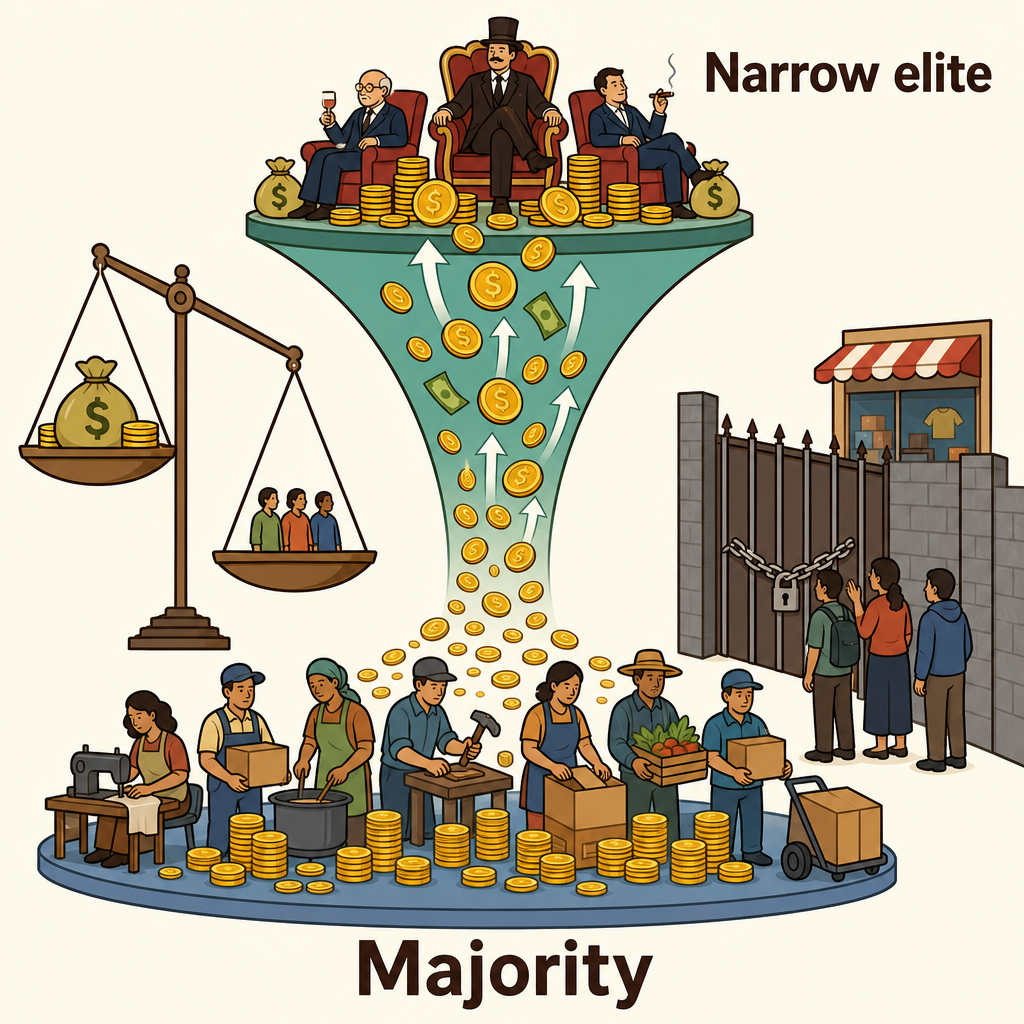
Notice how the wide base of ordinary people feeds a narrow channel of wealth upward, while barriers block them from entering business themselves.
Follow the Wealth
The clearest test of any system is simple: where does the wealth end up?
Under inclusive rules, gains flow back to the people who produce them. That reward encourages more work and more investment.
Under extractive rules, gains are siphoned upward to whoever controls the state.
- Inclusive rules
- Extractive rules
Ask that question of any economy and the label becomes obvious.
Rules Beat Geography
Nogales is the cleanest natural experiment there is.
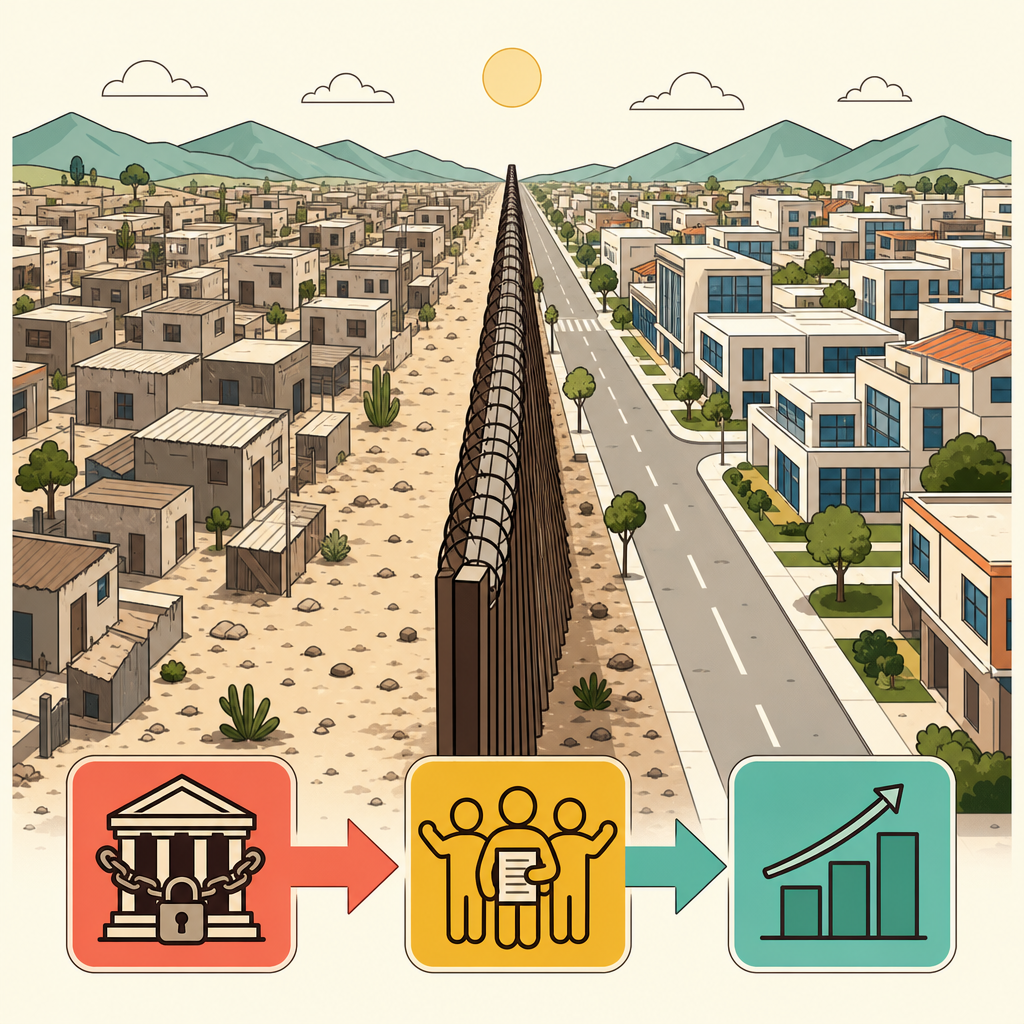
The fence at Nogales: everything constant except the institutions on each side.
Hold geography, climate, and culture constant. Change only the institutions. Income triples.
That is the core claim: global inequality traces back to how power and resources are governed.
Prosperity is built by rules that let ordinary people own, contract, and compete.
Check yourself
Inclusive economic institutions allow people to start businesses and choose occupations freely.
- True
- False
Answer: True
This is true. Inclusive institutions widen opportunity by allowing people to enter businesses and choose their occupations, rather than blocking participation.
Inclusive institutions protect _____ for many people and use an _____ to enforce contracts. Extractive institutions often leave property rights insecure and make the legal system favor the _____.
Answer: Inclusive institutions protect property rights for many people and use an unbiased legal system to enforce contracts. Extractive institutions often leave property rights insecure and make the legal system favor the powerful.
Inclusive institutions broadly protect ownership and apply legal rules fairly. Extractive institutions weaken protection for most people and bend legal decisions toward powerful groups.
Nogales, Arizona, and Nogales, Sonora, share the same desert environment and cultural background but have very different average incomes. Which explanation best fits this evidence?
- Different institutions govern economic activity on each side
- Different climates create different levels of productivity
- Different cultures produce different attitudes toward work
- A temporary stroke of luck creates the income gap
Answer: Different institutions govern economic activity on each side
The towns hold geography, climate, and culture largely constant. The major difference emphasized is their institutions—the rules governing power, resources, property, contracts, and participation.
Keep going
This is lesson 1 of 24 in Why Nations Fail. Next up:
- Political Power Matters
- Power Reinforces Itself
- Geography Isn't Destiny
- Culture Follows Institutions
- Critical Junctures
Wondering turns any topic into short lessons you can read, watch, or listen to, with practice questions and an AI tutor.