Free sample lesson · Why Nations Fail Analysis
Inclusive vs. Extractive
Why does a fence through Nogales create a $20,000 income gap?
Lesson 1 of the Wondering course Why Nations Fail Analysis
One Town, Two Fates
A single fence runs through the city of Nogales. North of it is Arizona. South of it is Sonora, Mexico.
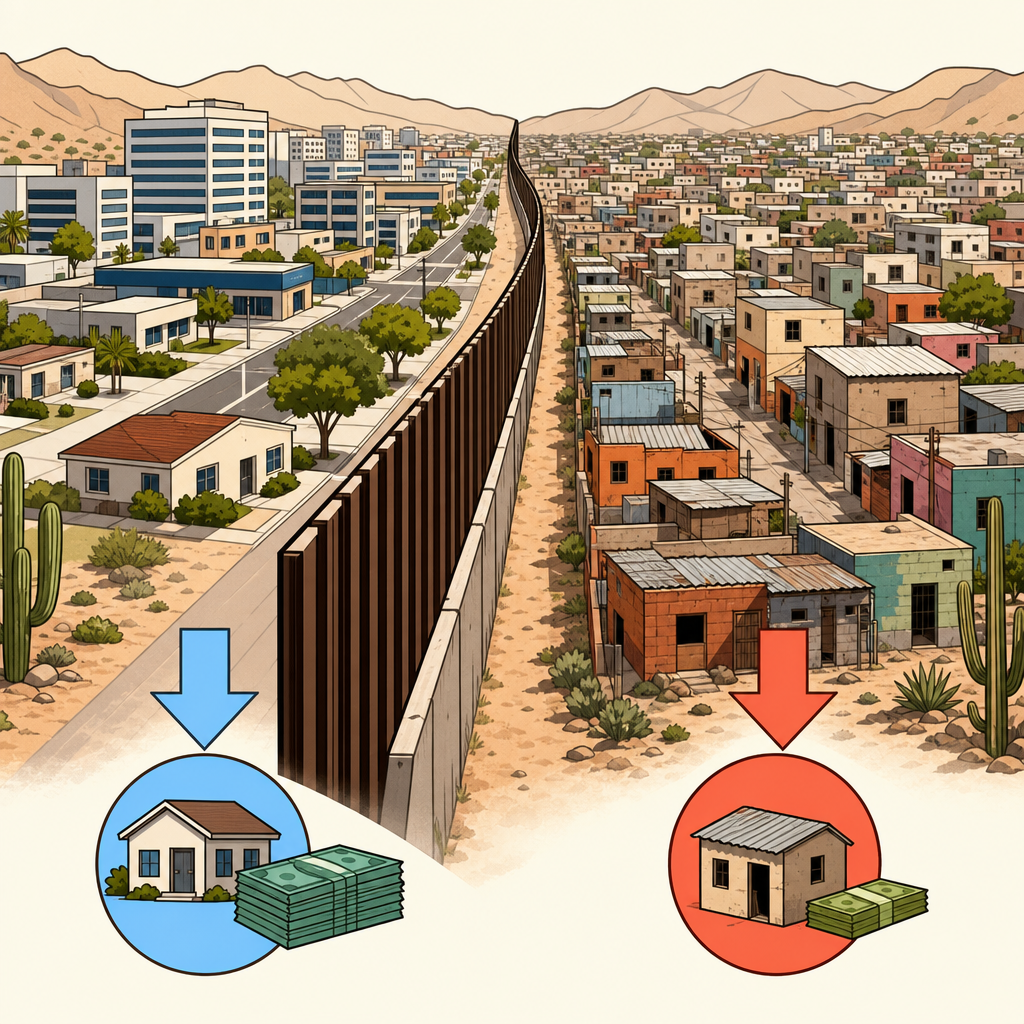
The fence that splits one city into two economies
Same name. Same desert. Same climate. Similar cultural roots.
Yet average household income on the Arizona side sits near $30,000, while the Sonora side sits near $10,000.
That gap of roughly $20,000 is the puzzle this lesson solves.
What Institutions Actually Are
Before explaining the gap, we need one foundational term: institutions.
Institutions are simply the rules that govern how power and resources are distributed in a society.
- Property laws: Rules about what people may own and keep.
- Courts: Bodies that enforce contracts and settle disputes.
- Schools: Public services that shape who can participate.
- Business entry rules: Rules about who may open a business.
- Power and resources: What institutions ultimately distribute.
They include property laws, courts, schools, and the rules about who may open a business.
Economic institutions shape who gets to produce, trade, invest, and keep what they earn.
Inclusive Institutions Defined
Inclusive economic institutions share four features.
- Core features
- Secure property rights: Extended to a broad cross-section of society.
- Unbiased legal system: Contracts are enforced fairly for everyone.
- Level playing field: Public services give people comparable starting conditions.
- Freedom of entry: People may start businesses and pick occupations.
All four work together; missing one weakens the rest.
First, secure property rights for a broad cross-section of society, not only for a favoured few.
Second, an unbiased legal system that enforces contracts fairly.
Third, public services that create a level playing field.
Fourth, freedom to enter new businesses and choose your own occupation.
Extractive Institutions Defined
Extractive economic institutions are built for a different purpose.
They are designed to extract wealth from one subset of society, usually the majority, to benefit another subset, usually a narrow elite.
- Inclusive
- Extractive
The features mirror the inclusive list in reverse: insecure property rights for most people, a biased legal system, and barriers to economic participation.
The word designed matters. Extraction is not an accident of poor management.
Who Gains, Who Pays
Extraction has a direction. Wealth flows from the majority upward to a narrow elite.
Picture the structure as a shape: a small group at the top that benefits, resting on a much larger group whose property rights are insecure and whose entry is blocked.
- Narrow elite: The subset of society that the rules are designed to benefit.
- Biased rules: A partial legal system and barriers to participation hold the structure in place.
- The majority: Insecure property rights mean most people cannot keep what they build.
Wealth moves upward through the layers, not downward.
This is why extractive systems can look stable for a long time. The people who set the rules are the people the rules reward.
The Income Gap in Numbers
Return to Nogales with the definitions in hand.
Average household income is about 30,000 USD in Nogales, Arizona and about 10,000 USD in Nogales, Sonora.
- Nogales, Arizona: Inclusive institutions govern this side.
- Nogales, Sonora: Extractive institutions govern this side.
The Arizona side is roughly three times richer. Geography, climate, culture, and even the town name are held constant.
The variable that changes at the fence is the set of institutions.
Why the Usual Answers Fail
Beginners often reach first for geography, climate, culture, or luck to explain national wealth.
Nogales is useful precisely because it removes those explanations. Both halves share the same desert, the same weather, and the same cultural roots.
Two towns, one name, one geography, two very different incomes.
So the remaining candidate is the rules on either side of the border.
Two Systems, Two Sides
Line the two sides up directly.
- Nogales, Arizona
- Nogales, Sonora
On the Arizona side, property rights are secure for a broad cross-section, contracts are enforced fairly, and people may open businesses.
On the Sonora side, property rights are insecure for most, the legal system is biased, and barriers block participation.
Same city. Two rule sets. Two outcomes.
Using the Distinction
For research purposes, treat inclusive versus extractive as a diagnostic question rather than a label.
Ask who holds secure property rights. Ask whether courts treat parties equally. Ask whether public services level the field. Ask who is free to enter a business.
- Property rights: Ask whether a broad cross-section holds secure property rights.
- Legal system: Ask whether courts enforce contracts without bias.
- Public services: Ask whether services create a level playing field.
- Freedom of entry: Ask who is free to open a business and choose an occupation.
Answer those four for any economy and you can locate it on the inclusive-to-extractive spectrum.
That is the root cause of global inequality this framework points to: the rules, not the land.
Check yourself
A system that protects property rights for many people and allows open business entry is _____. A system that transfers wealth to a narrow elite and blocks participation is _____.
Answer: A system that protects property rights for many people and allows open business entry is inclusive economic institutions. A system that transfers wealth to a narrow elite and blocks participation is extractive economic institutions.
Inclusive economic institutions protect property for many people, enforce contracts fairly, provide equalizing public services, and allow people to enter businesses and choose occupations.
What are institutions in the study of economic development?
- Rules that govern how power and resources are distributed
- Natural features that determine where people can live
- Cultural traditions shared by every household
- Temporary changes in household income
Answer: Rules that govern how power and resources are distributed
Institutions are the rules that determine how power and resources are distributed. They include laws, courts, schools, and business-entry rules.
Nogales, Arizona, has average household income near USD 30,000, while Nogales, Sonora, has about USD 10,000. Both sides share similar geography, climate, and cultural roots. Which explanation best fits the framework?
- Different economic institutions on the two sides
- Different desert climates on the two sides
- Different cultural roots on the two sides
- Different town names on the two sides
Answer: Different economic institutions on the two sides
Nogales controls for geography, climate, cultural roots, and the town’s name. The major difference at the border is the institutional rules, which help explain the income gap.
Keep going
This is lesson 1 of 24 in Why Nations Fail Analysis. Next up:
- Political Power Matters
- Power Reinforces Itself
- Geography Isn't Destiny
- Culture Follows Institutions
- Critical Junctures
Wondering turns any topic into short lessons you can read, watch, or listen to, with practice questions and an AI tutor.