Free sample lesson · Whitney Museum Art Guide
Urban Realism
What made artists trade idyllic landscapes for gritty city alleys?
Lesson 1 of the Wondering course Whitney Museum Art Guide
The City Takes Over
Around 1900, American painters made a strange choice. They stopped painting pretty countryside and started painting alleys.
Crowded tenements. Smoky streets. Tired faces on a train.
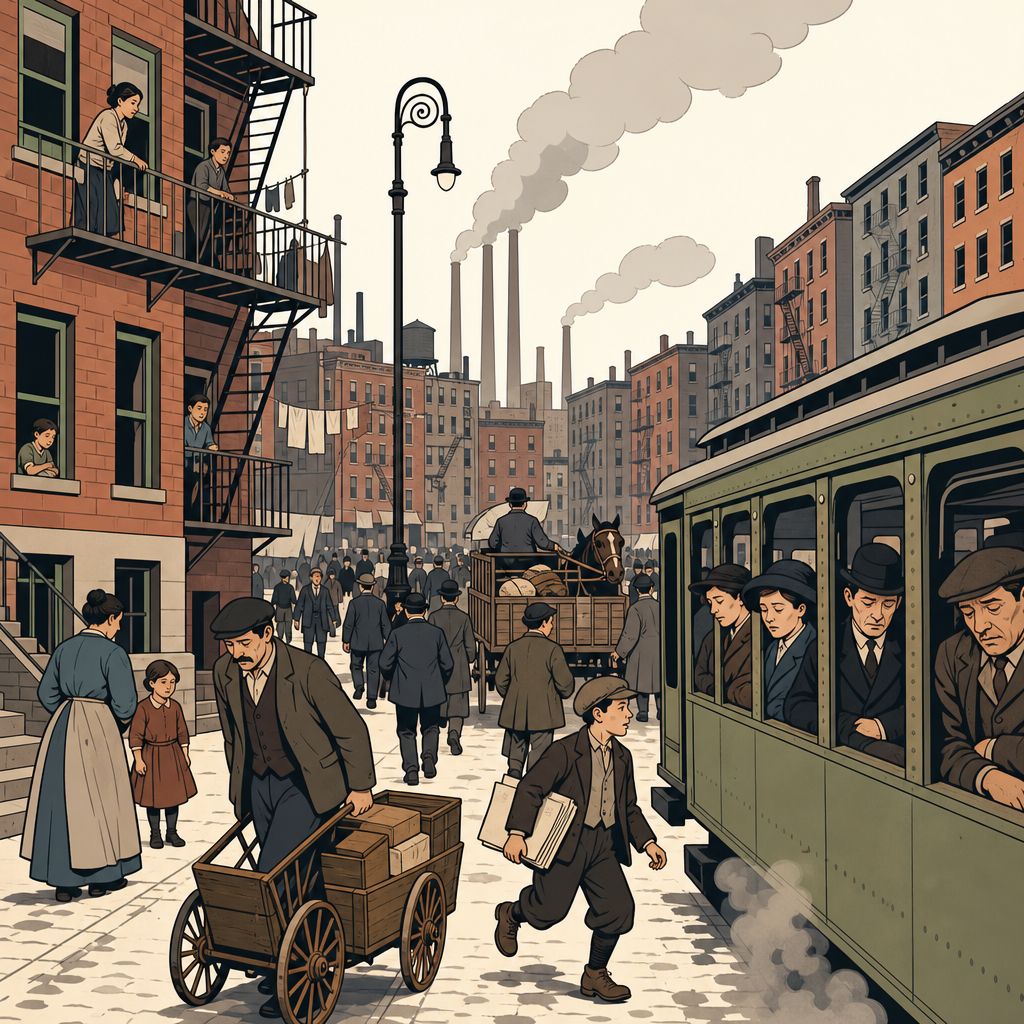
The gritty urban world these painters chose over pastoral scenes
This shift sits at the heart of the Whitney Museum's collection of American Modernism. It marks the moment American art stopped borrowing its subjects from Europe.
What the Ashcan School Was
The movement earned a nickname: the Ashcan School.
An ash can is a trash bin. Critics meant the name as an insult, since these artists painted what polite society threw away.
- Working class: Daily life of ordinary New Yorkers became the subject.
- Unvarnished honesty: Scenes appear without flattering light or cleaned-up composition.
- New York City: The growing American city supplied every subject.
- Critics: The insulting nickname stuck to the movement.
Their goal was daily life among New York's working class, shown with raw, unvarnished honesty. No flattering light. No cleaned-up composition.
Ideal Versus Real
European academic training prized idealized beauty. Pastoral landscapes. Balanced, noble subjects.
The Ashcan painters valued the real over the ideal.
- The ideal
- The real
That was a philosophical change, not only a change of subject. Once reality counted as worthy, almost anything could become a painting.
George Bellows and Physical Grit
George Bellows went after the physical grit of the streets.
Bodies in motion. Rough surfaces. Heavy paint pushed around fast.
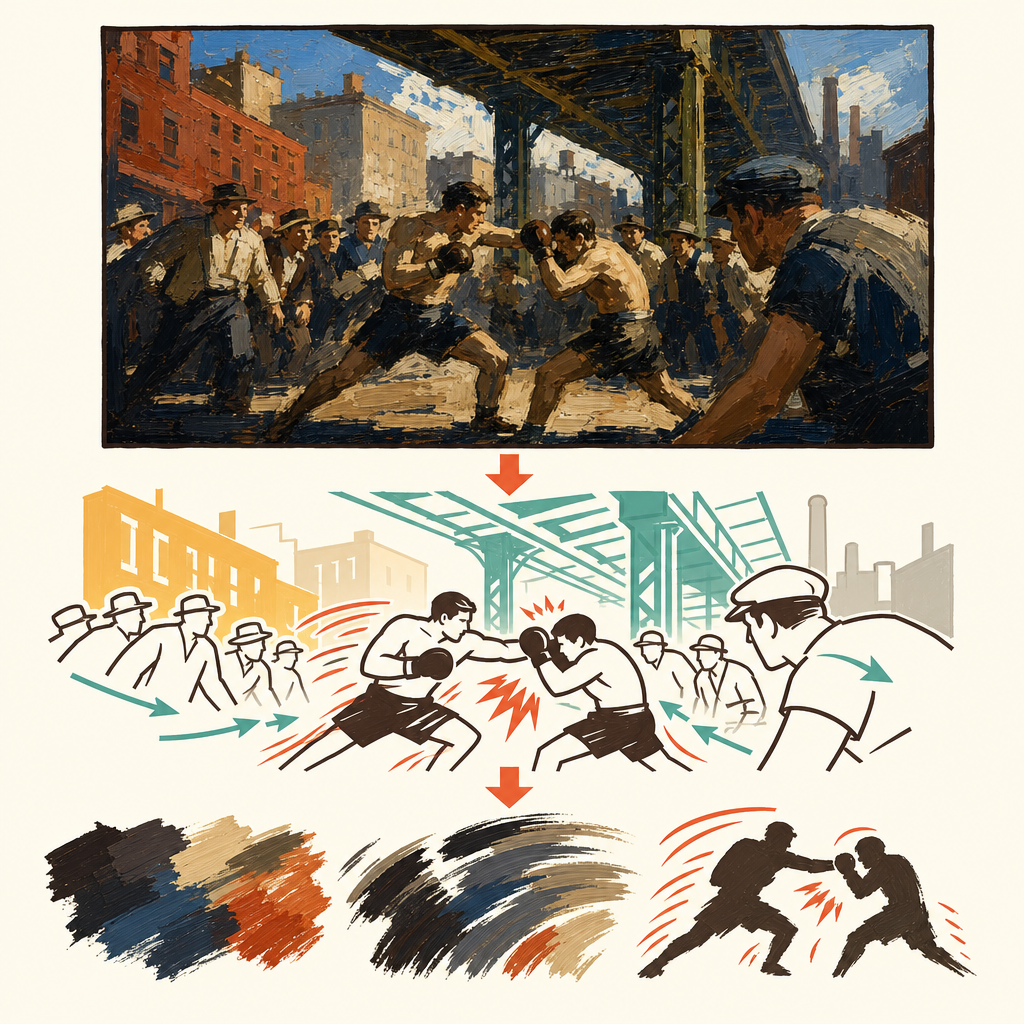
Bellows painting the physical energy of the street
His work insists that a city is something you feel through the body, not something you admire from a distance.
Edward Hopper and Quiet Depth
Edward Hopper worked the other end of city life.
He chased the psychological depth of city dwellers. A lonely diner. A figure sitting still while the street carries on outside.
- George Bellows
- Edward Hopper
Same commitment to the real. Different register: stillness instead of motion, interior feeling instead of physical force.
Documenting the Mundane
These painters documented what nobody thought worth recording.
Crowded tenements. Industrial sites. Ordinary rooms and ordinary hours.
- City spaces
- Crowded tenements: Packed working-class housing became a serious subject.
- Lonely diners: Ordinary interiors carried psychological weight.
- City conditions
- The industrial: Factories and machinery entered the picture frame.
- The mundane: Routine daily hours counted as worthy content.
The unglamorous city replaced the pastoral landscape.
The mundane was the point. Repetition and routine were treated as legitimate artistic content, which was a genuinely new idea in American painting.
A New Visual Language
Out of this came something new: a visual language that was uniquely American.
Not copied from Paris. Not borrowed from academies.
- Turn away: Artists moved away from European academic traditions of idealized beauty.
- Look local: They turned their gaze toward the rapidly growing American city.
- Record reality: They documented the mundane and the industrial around them.
- New language: The result was a visual language that was uniquely American.
It grew from a specific place, painted by artists who lived there. That is what makes the shift a founding moment rather than a passing style.
Why the Whitney Cares
The Whitney Museum exists to champion domestic creators.
That mission traces straight back to this moment. Once American artists had their own subjects and their own language, an American museum had something distinct to collect.
- Whitney mission: An enduring commitment to champion domestic creators.
- American Modernism: The collection built around a pivotal turn-of-the-century shift.
- Ashcan foundation: Urban realism laid the groundwork for later American modern art.
Each layer rests on the one inside it.
The Ashcan work in the collection is the foundation the later modern and contemporary galleries stand on.
Reading the Galleries
Carry one question through the modern and contemporary rooms.
Ask of any work: is this reaching for the ideal or reporting the real?
Abstraction, photography, video installation. Much of what followed still argues with the choice the Ashcan painters made first.
What to Carry Away
The Ashcan School painted New York's working class with raw honesty.
Bellows chased physical grit. Hopper chased psychological depth. Both refused idealized beauty.
Their choice of the real over the ideal opened the door to modern art in the United States and gave the Whitney its founding subject.
Check yourself
The Ashcan School portrayed New York’s working class with raw, unvarnished honesty.
- True
- False
Answer: True
This statement is correct. The Ashcan School focused on everyday working-class life without flattering or cleaning up its subjects.
George Bellows pursued _____ in bodies and rough street surfaces, while Edward Hopper pursued _____ in lonely urban figures.
Answer: George Bellows pursued physical grit in bodies and rough street surfaces, while Edward Hopper pursued psychological depth in lonely urban figures.
Bellows emphasized the bodily force and rough textures of city life. Hopper emphasized stillness, loneliness, and the inner feelings of city dwellers.
Why did critics use the name “Ashcan School” for this movement?
- The artists painted subjects society treated like discarded material.
- The artists mainly painted rural landscapes near coal mines.
- The artists used ash to prepare their painting surfaces.
- The artists copied a European academy called Ashcan.
Answer: The artists painted subjects society treated like discarded material.
“Ashcan” refers to a trash bin. Critics used the name as an insult because the artists painted subjects polite society considered worthless or disposable.
Keep going
This is lesson 1 of 8 in Whitney Museum Art Guide. Next up:
- Industrial Forms
- Action Painting
- Color Fields
- Everyday Objects
- Mass Media
Wondering turns any topic into short lessons you can read, watch, or listen to, with practice questions and an AI tutor.