Free sample lesson · Venture Deals
Only Two Kinds of Terms Really Matter
An investor fights hard over a minor clause. Are they "blowing smoke"?
Lesson 1 of the Wondering course Venture Deals
Two Questions Cut Through Noise
An investor fights fiercely over a minor clause. Does that intensity prove the clause matters?
A term sheet is the short summary of financing terms that comes before the full legal documents.
Feld and Mendelson offer two lenses: economics and control. They say these are what venture funds really care about.[[1]](https://feld.com/archives/2005/01/term-sheet-price/)
This split also organizes the book’s treatment of key terms.[[5]](https://media.wiley.com/product_data/excerpt/20/11195948/1119594820-303.pdf)
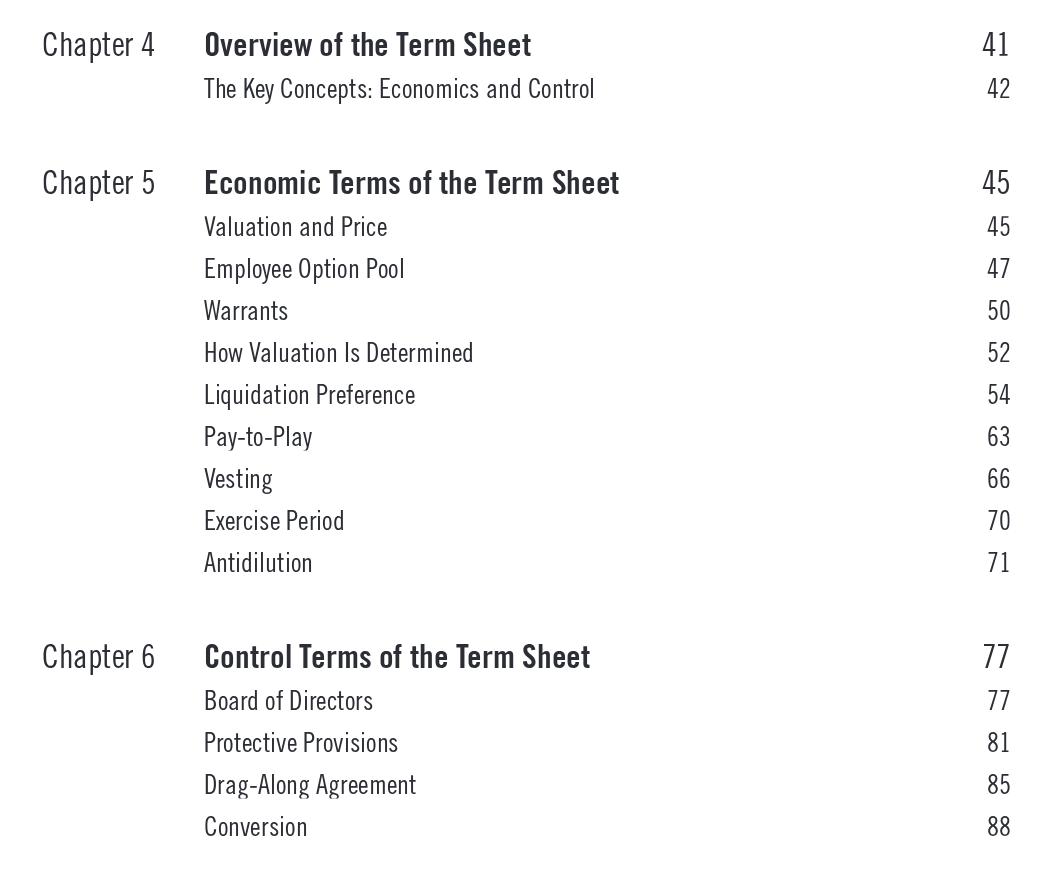
The book itself is built on this split: one chapter for economic terms, one for control terms. · Brad Feld and Jason Mendelson, Venture Deals, 4th edition (Wiley, 2019), table of contents excerpt
Your first task is sorting, not arguing.
Economics Changes the Return
A company is sold. Who receives what, and how much?
That is an economics question. Economic terms directly change the investor’s eventual return.
A liquidation preference changes who gets paid in a sale. Valuation, option pool size, warrants, and anti-dilution also belong in this category.[[1]](https://feld.com/archives/2005/01/term-sheet-price/) The book discusses dividends separately, among its other terms.[[5]](https://media.wiley.com/product_data/excerpt/20/11195948/1119594820-303.pdf)
Trace each clause to money. If it can change the payout, it deserves focused analysis and negotiating attention.
Control Changes Who Decides
The company wants to take on new debt. Can the investor block it?
That is a control question. Control terms let investors run the business or veto particular company decisions.
Board composition affects who holds decision-making seats. Protective provisions create approval or veto rights; drag-along terms also belong in the control category.[[5]](https://media.wiley.com/product_data/excerpt/20/11195948/1119594820-303.pdf)
- Control terms: Run the business or veto decisions.
- Board composition: Who holds decision-making seats.
- Protective provisions: Create approval or veto rights.
- Drag-along terms: Also in the control category.
Ask what happens when the parties disagree. Who can act, and who can stop them?
Some Terms Cross Boundaries
Where does pay-to-play belong? First, two kinds of shares. Venture investors typically buy preferred stock, shares that carry extra rights, such as a liquidation preference and protective provisions. Founders and employees usually hold common stock, which lacks those extra rights. Under pay-to-play, an investor who doesn’t participate in future rounds can lose preferred rights, for example by being converted to common stock.
The book lists pay-to-play among economic terms, and it clearly affects payout: converted shares lose their preferred economics, such as the liquidation preference. But it can also touch control, because losing preferred status can strip the voting or protective rights attached to those shares.
Other terms fit neither bucket. Neither does not mean meaningless. It means the term’s importance needs a clear connection to money or power.
Before spending goodwill, state the consequence: What payout changes? What decision changes? If neither answer is clear, lower the priority.
- Disputed clause
- Payout changes?: Is there a clear connection to money?
- Decision changes?: Is there a clear connection to power?
- Spend goodwill here
- Lower the priority: Neither does not mean meaningless, but it ranks lower.
Intensity Can Be a Distraction
An investor argues for a week over procedure. Meanwhile, the founder stops examining a higher liquidation preference.
The authors call resistance over a term affecting neither economics nor control probably “blowing smoke.”[[1]](https://feld.com/archives/2005/01/term-sheet-price/)
The minor fight may pull attention away from the terms that shape money and power. Investor intensity alone does not prove importance.
Pause and classify the disputed clause. Then inspect nearby economic and control requests before continuing the argument.
Triage the Whole Term Sheet
Try four clauses: liquidation preference is economics; a debt veto is control; pay-to-play can touch both, even though the book files it under economic terms. As an illustrative fourth case, which law firm drafts the first version would likely land in neither, unless someone can show how it changes money or power.
- Debt veto
- Pay-to-play
- Liquidation preference
- Drafting law firm
Use the same pass across your term sheet. Label every provision, explain its consequence, then focus negotiation on the clauses affecting returns or authority.
Investigate heated fights over neither terms for possible distraction. Preserve goodwill by avoiding equal effort on every clause.
This framework sharpens priorities, but it does not replace an experienced financing lawyer.
Check yourself
A liquidation preference is primarily an economics term.
- True
- False
Answer: True
Correct. A liquidation preference changes who gets paid and how much in a company sale, so it can change the investor’s return.
A liquidation preference changes sale proceeds, so it is _____. A debt veto changes who can block borrowing, so it is _____. Pay-to-play can affect both returns and authority, so it is _____.
Answer: A liquidation preference changes sale proceeds, so it is economics. A debt veto changes who can block borrowing, so it is control. Pay-to-play can affect both returns and authority, so it is both.
Economics terms affect payouts, while control terms affect decision-making power. Pay-to-play can affect both, so it belongs in both categories.
An investor argues for a week over which law firm drafts the first version of the documents. During that time, the founder stops examining a higher liquidation preference. What is the best response?
- Give the drafting clause equal negotiating attention because the investor is intense about it.
- Pause the minor dispute and scrutinize the liquidation preference and other economics or control terms.
- Assume the drafting clause must be an economic term because it appears in the financing documents.
- Accept every disputed clause without checking its effect on money or decision-making.
Answer: Pause the minor dispute and scrutinize the liquidation preference and other economics or control terms.
First classify the disputed clause and inspect nearby terms affecting money or decision-making. A fight over a clause affecting neither may be “blowing smoke,” while the higher liquidation preference directly affects the founder’s economic outcome.
Keep going
This is lesson 1 of 11 in Venture Deals. Next up:
- Who Can Actually Say Yes
- The Price Behind the Headline Valuation
- Who Gets Paid First in a Sale
- When the Next Round Is Cheaper
- Why Vesting Protects Founders Too
Wondering turns any topic into short lessons you can read, watch, or listen to, with practice questions and an AI tutor.