Free sample lesson · Venous Pressure and Blood Reservoirs
Central Catheters
Why can't you measure right atrial pressure just by putting a needle into a vein in your arm?
Lesson 1 of the Wondering course Venous Pressure and Blood Reservoirs
Why an Arm Needle Falls Short
Imagine a hospitalized cardiac patient. The care team wants to keep checking how well the heart is pumping.
A nurse suggests saving time by putting a needle into an arm vein and connecting it to a pressure recorder.
That needle measures peripheral venous pressure. It is easy to get this way, but it reflects a vein far from the heart.
Medical Book-19-20.pdf states that the only accurate way to measure right atrial pressure is a catheter threaded through the peripheral veins into the right atrium.
- Arm-vein needle
- Central catheter
Threading the Central Catheter
A central venous catheter is a thin tube passed through the peripheral veins until its tip rests inside the right atrium.
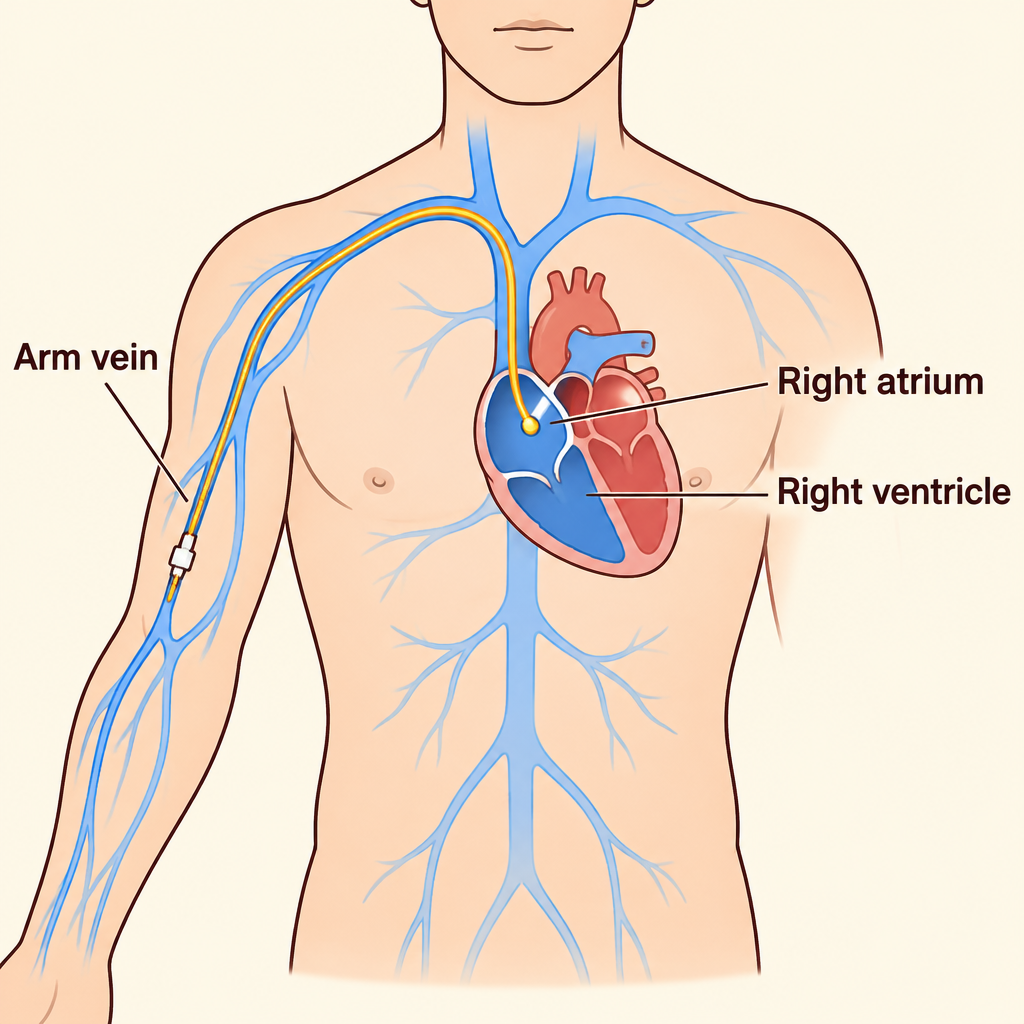
Follow the tube from the arm vein inward: only when its tip reaches the right atrium does it read right atrial pressure.
Now the sensor reads pressure in the chamber that fills the right ventricle.
Clinicians use these readings in some hospitalized cardiac patients for constant assessment of heart-pumping ability.
Continuous is the key word. The team can watch the pressure over time instead of taking one snapshot.
Zero Needs a Reference Point
You have likely heard right atrial pressure called 0 mm Hg and arterial pressure called 100 mm Hg. But 0 measured at what height?
Gravity matters. In most vessels, changing body position changes the measured pressure.
One point barely changes: at or near the tricuspid valve, position changes in a healthy person usually shift pressure by only 1 to 2 mm Hg.
So all circulatory pressures are referred to this level, called the reference level for pressure measurement.
- Right atrial pressure: The normal value, measured at the reference level.
- Arterial pressure: Also referred to the same level.
- Position effect at tricuspid valve: Why this point works as the reference.
The Heart Holds Its Own Zero
Why is the tricuspid level so stable? The heart itself acts as a feedback regulator of pressure there.
If pressure rises slightly, the right ventricle fills more, pumps blood faster, and brings the pressure back toward normal.
If pressure falls, the ventricle underfills, pumping drops, and blood dams up in the veins until pressure rises back to normal.
- Pressure shifts: Tricuspid pressure rises slightly above or falls below normal.
- Filling changes: The right ventricle fills more when pressure rises, less when it falls.
- Pumping adjusts: Pumping speeds up, or slows while blood dams up in the veins.
- Pressure restored: Pressure at the tricuspid level returns to the normal value.
(Added note: this fits the filling-drives-output idea you may know from physiology courses.)
Finding Zero in a Lying Patient
To zero the recorder, you need to know where the tricuspid valve sits inside the chest.
When a person lies on their back, the valve sits at almost exactly 60 percent of the chest thickness in front of the back.
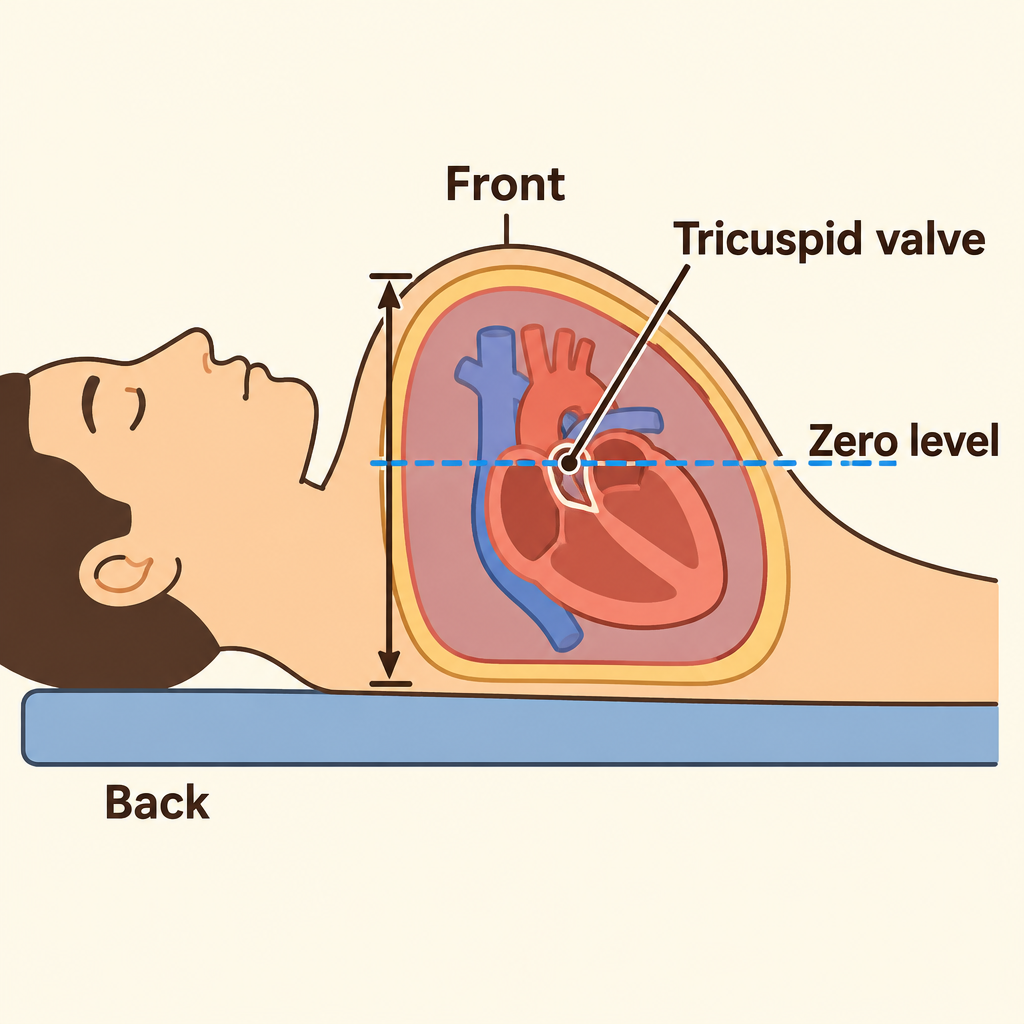
Notice that the zero line sits closer to the front of the chest than the back, at the depth of the tricuspid valve.
That spot is the zero pressure reference level for a person lying down.
Picture the chest from the side: measure from the back to the front of the chest, then go 60 percent of the way forward.
Working the Case
Return to our imagined cardiac patient and the nurse's arm-needle idea.
First, the shortcut fails: an arm-vein needle measures peripheral venous pressure, not right atrial pressure.
The team instead passes a central venous catheter into the right atrium and zeros the recorder at the tricuspid valve level.
In this hypothetical, readings stay near the normal 0 mm Hg, giving a continuous, accurate measure of heart-pumping ability.
- Reject arm needle: It measures peripheral venous pressure, not right atrial pressure.
- Place catheter: Pass a central venous catheter through the peripheral veins into the right atrium.
- Zero recorder: Set zero at the tricuspid valve, about 60 percent of chest thickness in front of the back.
- Monitor: Readings near the normal 0 mm Hg give continuous insight into heart pumping.
Key Takeaways
When you see a central venous pressure reading, check three things.
Where is the catheter tip? It must be in the right atrium, reached through the peripheral veins.
Where was zero set? At the tricuspid valve level, about 60 percent of chest thickness in front of the back when lying down.
What does it tell you? How well the heart is pumping, tracked continuously.
Check yourself
To measure right atrial pressure accurately, clinicians use _____
- a catheter advanced into the right atrium
- a needle placed in a peripheral vein
Answer: a catheter advanced into the right atrium
A needle in a peripheral vein reads peripheral venous pressure, not right atrial pressure. The only accurate method is a catheter threaded through the peripheral veins into the right atrium (a central venous catheter).
For a person lying on the back, pressures are referenced to the _____, located about _____ of chest thickness in front of the back. Normal right atrial pressure at this level is about _____.
Answer: For a person lying on the back, pressures are referenced to the tricuspid valve, located about 60 percent of chest thickness in front of the back. Normal right atrial pressure at this level is about 0 mm Hg.
The tricuspid valve is the zero reference level. In a supine person it sits at about 60% of the chest thickness in front of the back, and normal right atrial pressure there is about 0 mm Hg.
Why is the level of the tricuspid valve used as the reference level for circulatory pressure measurements?
- Body position changes alter pressure there by only about 1–2 mm Hg
- It is the site of highest pressure in the venous system
- It is the easiest site to reach with a peripheral needle
- It is where mean arterial pressure of 100 mm Hg is generated
Answer: Body position changes alter pressure there by only about 1–2 mm Hg
At or near the tricuspid valve, changes in body position usually alter measured pressure by only 1–2 mm Hg in a healthy person. This stability makes it a reliable zero reference. It is not chosen for being the highest pressure, the easiest access point, or the site where arterial pressure is set.
Keep going
This is lesson 1 of 9 in Venous Pressure and Blood Reservoirs. Next up:
- Reference Level
- Tricuspid Feedback
- Finding Zero
- Veins Store
- Blood Loss
Wondering turns any topic into short lessons you can read, watch, or listen to, with practice questions and an AI tutor.