Free sample lesson · Understanding Raptor Rocket Propulsion
Rocket Cycles
Why do different rocket engines burn fuel in fundamentally different ways?
Lesson 1 of the Wondering course Understanding Raptor Rocket Propulsion
What Is an Engine Cycle?
Rocket engines can burn fuel through different cycles, or flow arrangements.
A cycle determines how fuel and oxidizer move through pumps, turbines, and the main combustion chamber.
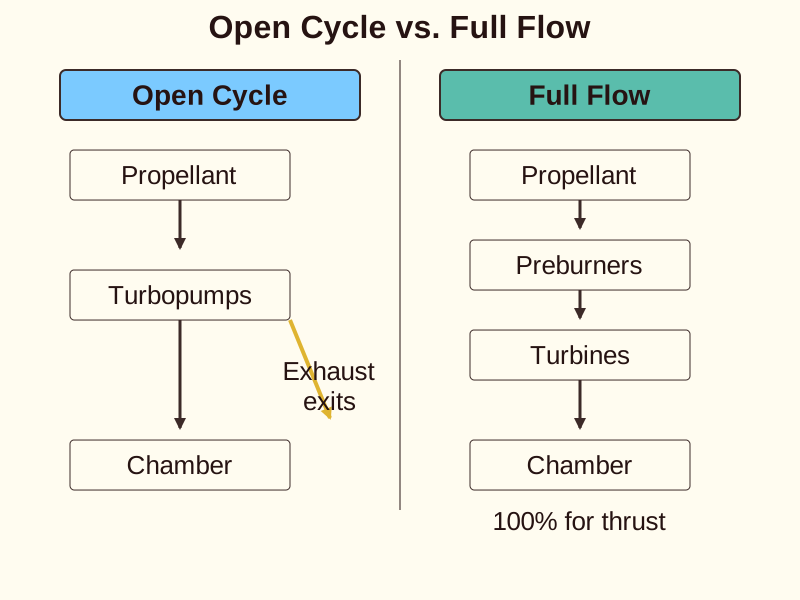
The key question is simple: does the engine discard some turbine exhaust, or send all propellant onward for thrust?
- Discard some exhaust
- Send all onward
The Raptor 3 uses Full-Flow Staged Combustion, a demanding design built for high efficiency.
Following the Propellant Flow
In an open-cycle engine, turbopumps need turbine power to move propellant. Some exhaust gas leaves the engine instead of entering the chamber.
FFSC takes a different route. All fuel and oxidizer pass through preburners, then drive turbines before reaching the main chamber.
Because the turbine flow continues into combustion, the engine uses 100% of its propellant for thrust.
Two Preburners, Two Mixtures
FFSC uses two separate preburners, each preparing one propellant stream.
One is oxygen-rich, meaning it contains extra oxygen. The other is fuel-rich, meaning it contains extra fuel.
These streams drive the turbines before entering the main combustion chamber. Using both sides lets the engine process all the fuel and oxidizer through the cycle.
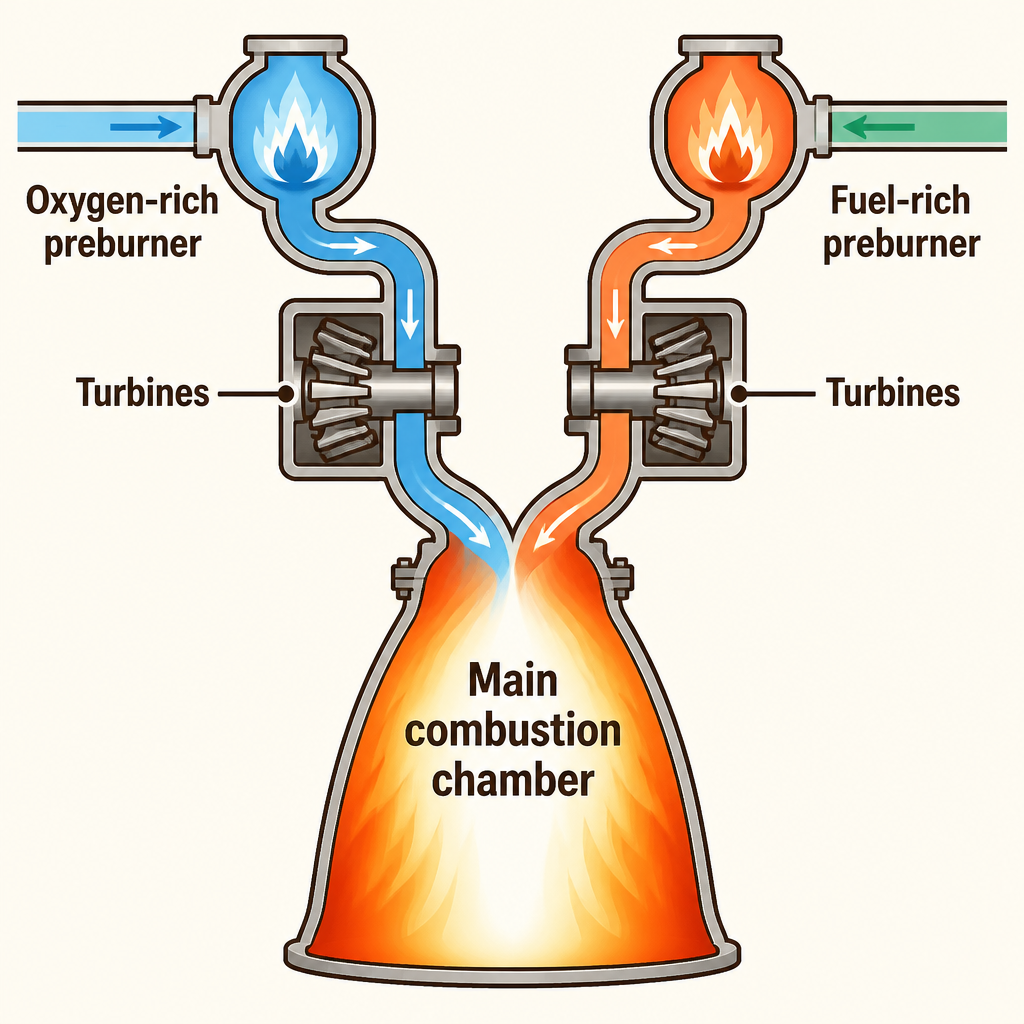
Trace how the two prepared propellant streams drive the turbines and then reunite in the main chamber.
Turning Liquids Into Gas
Before reaching the main chamber, liquid methane and liquid oxygen are gasified. This changes each liquid stream into gas that can flow through turbines.
Both streams then enter the chamber ready to mix and burn. This preparation supports higher mixing efficiency and combustion pressure than simpler engine designs.
The sequence is clear: preburn, turbine drive, then main combustion.
- Gasify: Liquid methane and liquid oxygen change into gases before reaching the main chamber.
- Drive turbines: The gasified streams flow through turbines and provide turbine drive.
- Combust: Both streams enter the main chamber ready to mix and burn.
Why Full Flow Is Efficient
Sending all propellant through the engine improves the use of onboard chemicals. The source describes 100% of the propellant as utilized for thrust.
This can raise specific impulse, a measure of how effectively an engine turns propellant into thrust. It also supports high combustion pressure.
The efficiency comes from the flow design, which avoids discarding turbine exhaust.
Engineering for Reuse
The FFSC cycle is difficult because preburners, turbines, and the chamber must handle extreme heat and pressure.
That challenge helps explain the Raptor 3 engine’s massive thrust-to-weight ratio, important for the Starship launch system.
Raptor 3 integrates components and removes complex external plumbing. This makes the FFSC cycle more reliable and easier to manufacture for rapid reuse.
Rocket Cycle Quick Reference
Check yourself
What does a rocket engine cycle describe?
- How fuel and oxidizer move through the engine
- Only how much fuel the engine stores
Answer: How fuel and oxidizer move through the engine
A rocket engine cycle describes the flow arrangement of fuel and oxidizer through the engine. It is not limited to the pumps or the combustion chamber alone.
FFSC uses an _____ preburner for the oxygen stream and a _____ preburner for the fuel stream.
Answer: FFSC uses an oxygen-rich preburner for the oxygen stream and a fuel-rich preburner for the fuel stream.
The oxygen-rich preburner handles the oxygen stream, while the fuel-rich preburner handles the fuel stream. Their different mixtures match the propellant streams they prepare.
What happens to some turbine exhaust in an open-cycle engine?
- Some turbine exhaust leaves the engine
- All turbine exhaust enters the main chamber
Answer: Some turbine exhaust leaves the engine
In an open-cycle engine, some turbine exhaust leaves the engine rather than entering the main combustion chamber. FFSC instead routes both propellant streams onward for combustion.
Keep going
This is lesson 1 of 11 in Understanding Raptor Rocket Propulsion. Next up:
- Staged Combustion
- Dual Preburners
- Methane Advantage
- Turbopump Flow
- Chamber Dynamics
Wondering turns any topic into short lessons you can read, watch, or listen to, with practice questions and an AI tutor.