Free sample lesson · Trigonometry for Complex Functions
Finding Angles
How do right triangles translate seamlessly to rotations on the coordinate plane?
Lesson 1 of the Wondering course Trigonometry for Complex Functions
From Rectangular to Polar
Every complex number carries two descriptions. The rectangular form $$z = x + iy$$ names a point; the polar form $$r e^{i\theta}$$ names a distance and a rotation.
Finding angles is the step that connects them.
On the Argand diagram, $$x$$ is the horizontal coordinate and $$y$$ the vertical one. The angle $$\theta$$ measures rotation from the positive real axis.
- Rectangular
- Polar
The Defining Relation
The argument of $$z = x + iy$$ satisfies
$$\tan(\theta) = \frac{y}{x}$$
This comes straight from the right triangle with legs $$x$$ and $$y$$ on the Argand diagram.
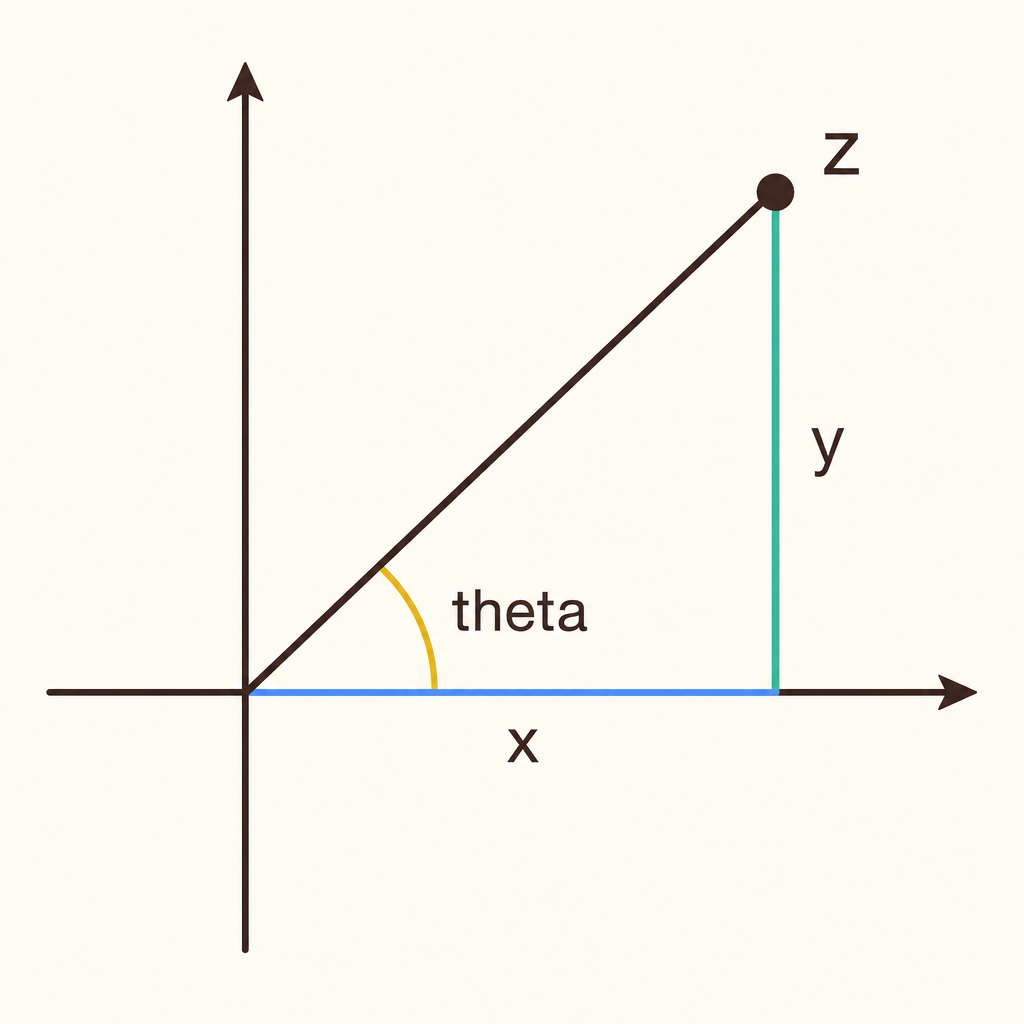
Notice that the same right triangle legs x and y that define the tangent ratio also fix the rotation theta from the positive real axis.
But the relation defines $$\theta$$ only up to the periodicity of tangent. That is where the trouble starts.
Why Tangent Alone Fails
The tangent function has period $$\pi$$. So $$\tan(\theta)$$ cannot distinguish an angle from that angle plus $$\pi$$.
The ratio $$y/x$$ is identical for $$z = 1 + i$$ and $$z = -1 - i$$, yet these points sit in opposite quadrants.
A naive arctangent collapses both onto the same answer. You must read the signs of $$x$$ and $$y$$ separately.
- z = 1 + i
- z = -1 - i
- x negative, y positive
- x positive, y negative
The atan2 Function
The four-quadrant inverse tangent formalizes the sign bookkeeping. Written $$\mathrm{atan2}(y, x)$$, it takes both coordinates rather than their ratio.
It returns a unique angle in the interval $$(-\pi, \pi]$$.
That interval is the principal value of the argument. One point, one answer.
- Read coordinates: Separate z into its x and y parts.
- Check signs: Note the sign of x and the sign of y to fix the quadrant.
- Apply atan2: Feed both coordinates into atan2(y, x) rather than the ratio y over x.
- Read interval: Accept the returned angle as the principal value in the interval from negative pi to pi.
Why the Interval Matters
The choice of $$(-\pi, \pi]$$ is a convention, and it has consequences.
Crossing the negative real axis makes the returned angle jump from near $$\pi$$ to near $$-\pi$$. Nothing about the point changed; only the labelling did.
That discontinuity is the branch cut. The behaviour of the angle determines whether a function stays continuous across the complex domain.
Where This Skill Is Used
Accurate arguments are not an exercise in bookkeeping. They are prerequisites.
Multi-valued functions, contour integration, and branch cuts all depend on placing $$\theta$$ correctly.
Get the quadrant wrong and every downstream polar computation inherits the error.
- Principal argument: The angle theta placed correctly in the interval from negative pi to pi.
- Multi-valued functions: Evaluating them requires a correctly placed angle.
- Contour integration: Depends on the argument being determined accurately.
- Branch cuts: The behaviour of the angle sets continuity across the domain.
- Polar form: Every downstream polar computation inherits an error in the quadrant.
Key Takeaways
The argument converts coordinates into rotation.
Tangent alone loses quadrant information because its period is $$\pi$$; atan2 recovers it by reading both signs and returning a unique angle in $$(-\pi, \pi]$$.
Master this, and polar form, branch cuts, and contour work all rest on solid ground.
Check yourself
The argument of a complex number measures rotation from the positive real axis.
- True
- False
Answer: True
The argument is the angle θ measured counterclockwise from the positive real axis on the Argand diagram.
For $$z=x+iy$$, use _____(y, x) rather than a naive _____ of y/x, because the two-coordinate function preserves quadrant information.
Answer: For $$z=x+iy$$, use atan2(y, x) rather than a naive arctangent of y/x, because the two-coordinate function preserves quadrant information.
atan2 receives y and x separately, while a naive arctangent receives only their ratio and can confuse opposite quadrants.
What is the principal argument of $$z=-1+i$$?
- $$-3\pi/4$$
- $$-\pi/4$$
- $$\pi/4$$
- $$3\pi/4$$
Answer: $$3\pi/4$$
The point has x = -1 and y = 1, so it lies in Quadrant II. Therefore, $$\mathrm{atan2}(1,-1)=3\pi/4$$, which lies in the principal interval $$(-\pi,\pi]$$.
Keep going
This is lesson 1 of 8 in Trigonometry for Complex Functions. Next up:
- Unit Circle
- Sum Formulas
- Double Angles
- Hyperbolic Basics
- Imaginary Relations
Wondering turns any topic into short lessons you can read, watch, or listen to, with practice questions and an AI tutor.