Free sample lesson · Tractatus Logico-Philosophicus
Facts, Not Things
What if the world isn't made of objects, but of relationships between them?
Lesson 1 of the Wondering course Tractatus Logico-Philosophicus
Two Bold Opening Lines
What if the world is made of relationships between objects, and the objects alone are only part of the story?
The Tractatus opens with two short statements that set up a whole picture of reality.
1: 'The world is all that is the case.'
1.1: 'The world is the totality of facts, not of things.'
Tractatus title page · Ludwig Wittgenstein · Public Domain Mark 1.0 · Wikimedia Commons

These lines are compact. This lesson unpacks what they mean and why they change how we think about existence.
Things Versus Facts
A thing is an object: a chair, a stone, a chess piece.
A fact is how things stand. It is a configuration of objects: which ones are related, and in what way.
- Things
- Facts
The Tractatus says reality is constituted by facts. What exists matters, and how those things are arranged and related matters too.
So the world is the full set of ways things stand to one another.
The Chess Board Test
The source gives a clear example: two chess positions.
Both boards hold the same pieces. Every king, queen, and pawn is identical.
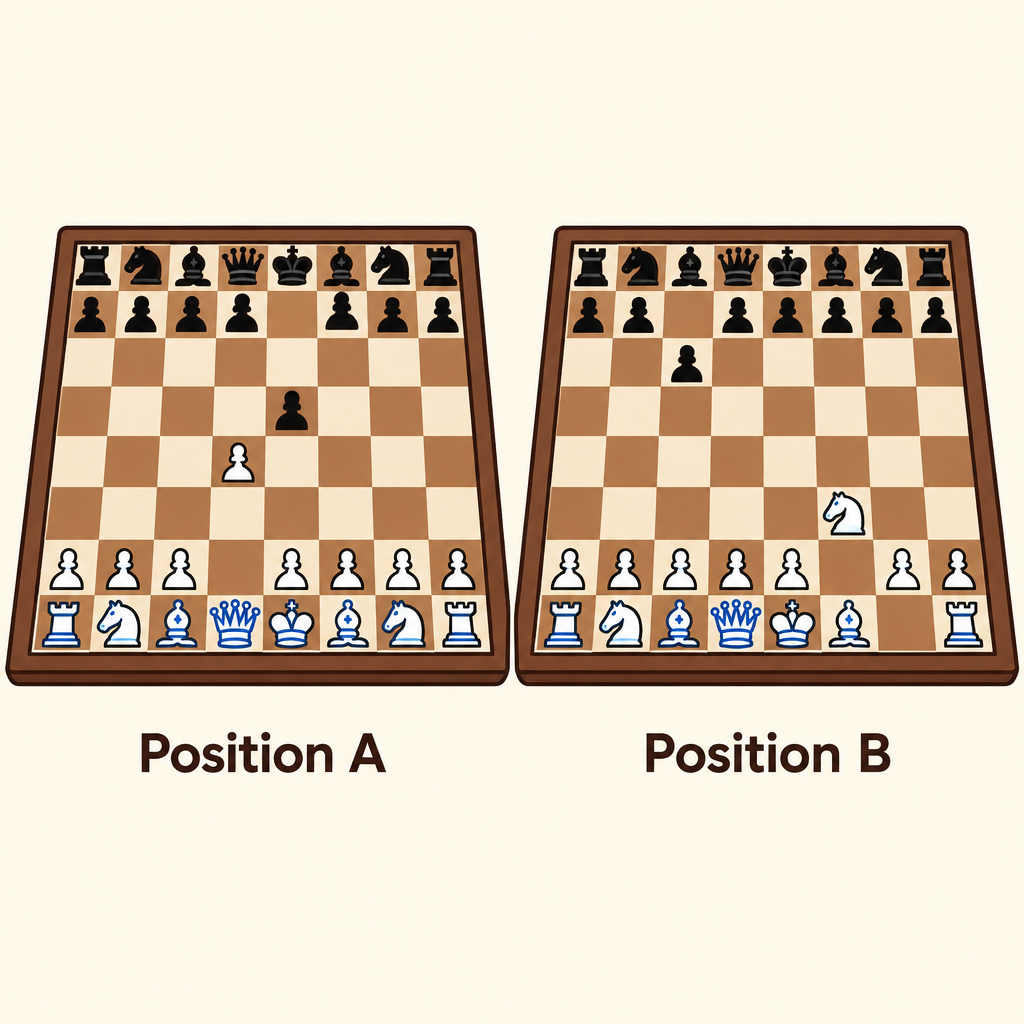
Notice that both boards use the identical set of pieces, yet the arrangements differ, so each board shows a different situation.
Yet the pieces are arranged differently. Same things, different facts, entirely different situations.
No player would treat these as the same game. What changed is the arrangement, so what changed is the world of the board.
Same Objects, Different Worlds
Now scale the chess idea up to a whole world.
Imagine two made-up worlds. Each contains exactly the same objects, with nothing added and nothing removed.
In the first world, a cup sits on a table. In the second, the same cup sits under the table.
A list of things describes both worlds identically. A list of facts does not. That is why they count as different worlds.
Why an Inventory Falls Short
A common mistake is to think the world is simply a catalog of everything that exists.
Picture a complete list of every object. Would it tell you what is the case?
It would not. The list leaves out how those objects are arranged and related, and that arrangement is exactly what the facts are.
This is why the opening line says the world is 'all that is the case.' Being the case is about how things stand.
Using the Idea Yourself
You can spot this idea wherever arrangement changes meaning.
When you describe a situation, first name the objects. Then ask the key question: how do they stand to one another?
- Name objects: List the things in the situation.
- Ask how: Ask how those things stand to one another.
- Compare: Check whether another case has the same items in a different arrangement.
- Name facts: Describe the situation by its facts, since they decide which world it is.
If two cases share the same items but differ in arrangement, treat them as different situations, just like two chess positions.
In plain words: the world is what is the case, and what is the case is facts.
Check yourself
In the Tractatus, Wittgenstein says the world is the totality of _____
- facts, meaning how objects are arranged and related
- things, meaning every object that exists
Answer: facts, meaning how objects are arranged and related
Wittgenstein writes that the world is the totality of facts, not of things (1.1). A fact is how objects are arranged and related, not just a list of what exists.
A full list of every piece on a chess board names only the _____. To capture the whole situation, you must also say how the pieces stand to one another, which gives the _____.
Answer: A full list of every piece on a chess board names only the objects. To capture the whole situation, you must also say how the pieces stand to one another, which gives the facts.
Objects are the things that exist. Facts are how those things are arranged and related. On Wittgenstein's view, the world is made of the facts.
Two chess boards hold exactly the same pieces. On one board the white king is in check. On the other board the pieces sit on different squares and no king is in check. On Wittgenstein's view, how do these two situations compare?
- They are different situations, because the facts differ
- They are the same situation, because the pieces are the same
- They differ only in appearance, because no piece was added or removed
- They cannot be compared, because they share no objects
Answer: They are different situations, because the facts differ
The pieces (things) are the same, but their arrangement (the facts) differs, so the situations are different. Matching objects is not enough to make two situations the same.
Keep going
This is lesson 1 of 24 in Tractatus Logico-Philosophicus. Next up:
- Simple Objects
- States of Affairs
- Logical Space
- Pictures as Models
- Logical Form
Wondering turns any topic into short lessons you can read, watch, or listen to, with practice questions and an AI tutor.