Free sample lesson · Thinking in Systems: A Primer
System Definition
Why do seemingly independent events create predictable patterns?
Lesson 1 of the Wondering course Thinking in Systems: A Primer
Independent Choices, Predictable Patterns
Every driver on a highway makes their own choices. Yet traffic jams form at the same spots, at the same hours, day after day.
Why do separate choices add up to a pattern you can predict?
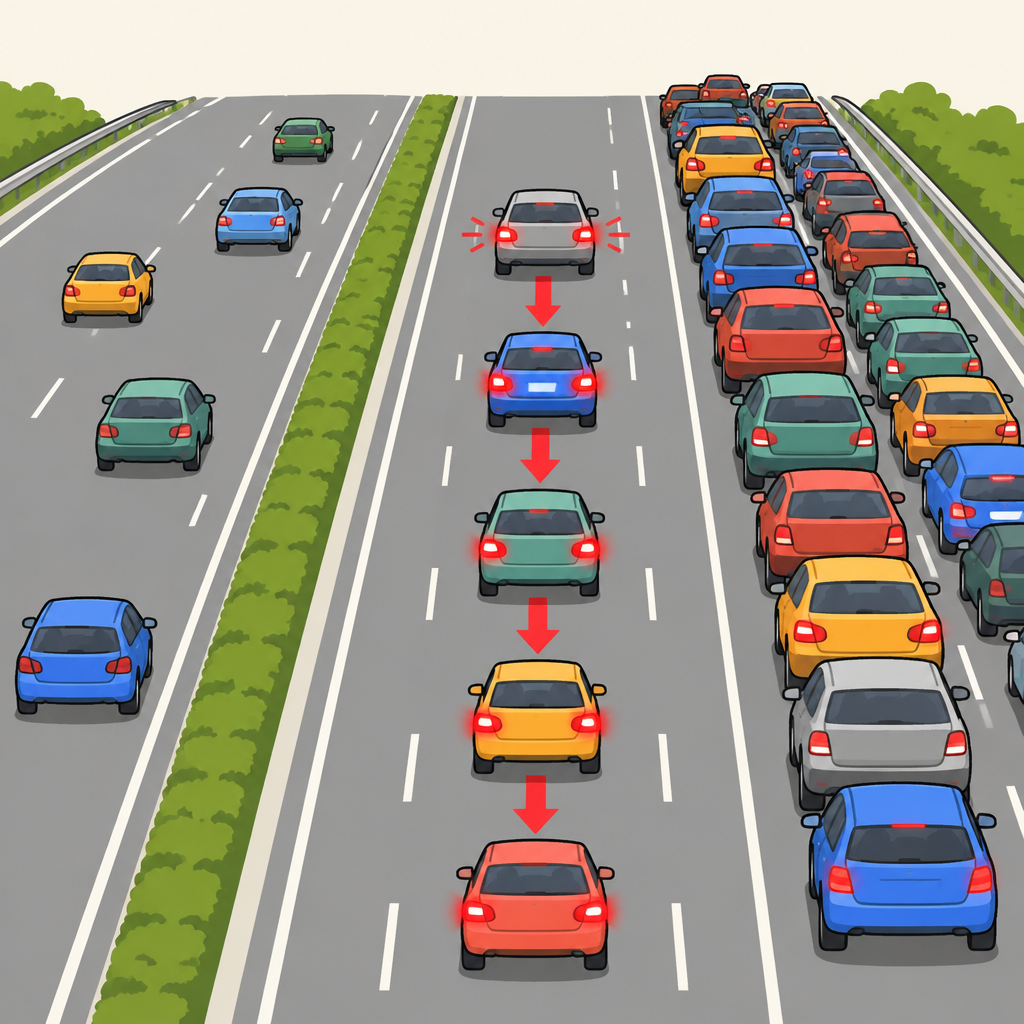
Each car is driven separately, yet the cars bunch up together in one stretch, showing a group pattern that comes from how drivers react to each other.
The drivers are part of a system: a set of things interconnected in such a way that they produce their own pattern of behavior over time.
Once you learn to spot systems, you will see them in nature, in organizations, and in daily life.
The Three Ingredients
The definition packs in three ingredients. Miss one, and you do not have a system.
- System: All three must be present.
- Parts: Drivers, trees, or employees.
- Interconnections: One driver braking makes the next brake.
- Pattern over time: A jam that builds, moves, and clears.
Parts: the things themselves, such as drivers, trees, or employees.
Interconnections: the ways those parts affect each other. One driver braking makes the next driver brake.
A pattern over time: the collective behavior the connected parts produce, like a jam that builds, moves, and clears.
More Than the Sum of Its Parts
A system is more than the sum of its parts. Its behavior emerges from the relationships between components.
Picture a heap of bicycle parts on the floor. Every piece is there, but nothing happens.
Connect them correctly and you get something new: a machine that rolls, steers, and carries you.
- Heap of parts
- Assembled bicycle
The new behavior lives in the connections, not in any single piece.
Structure Shapes Behavior
Here is the key idea: a system's structure determines its behavior.
Structure means how the parts are connected. External forces and individual elements acting alone do not explain the pattern.
Think of a company where the same problems keep returning even after staff change. The people are new, but the connections between roles stayed the same.
To change a pattern, look at the structure first.
Testing for a System
You can test whether something is a system with three questions.
Can you identify parts? Name the elements involved.
Do they affect each other? A change in one should ripple to the others.
Do they produce a collective effect? Look for a pattern none of the parts creates alone.
- Something to examine
- Identify parts?
- Affect each other?
- Collective effect?
- It is a system
- Just a collection
- Yes
- No
- Yes
- No
- Yes
- No
If any answer is no, you are probably looking at a collection, not a system.
Applying the Test
Try the test on a few examples.
A pile of loose coins has parts, but moving one coin does not change the others. No collective pattern appears.
A sports team passes every test. Players respond to each other, and the team develops a style of play over time.
A forest does too: trees, animals, and soil shape each other, producing growth patterns over years.
Seeing Systems in Your World
Systems are everywhere, and recognizing them is the first step to understanding how change happens.
When a pattern keeps repeating at work or at home, pause before blaming one person or one outside event.
Instead, name the parts, trace how they affect each other, and ask what structure keeps producing the pattern.
- Pause: Hold off on blaming one person or outside event.
- Name parts: List the elements involved.
- Trace connections: Ask how those parts affect each other.
- Examine structure: Find what structure keeps producing the pattern.
That habit helps you explain a pattern to a colleague, and find where to change it.
Check yourself
A behavior that appears only when parts interact, and not in any single part, arises mainly from _____.
- the relationships between parts
- the strongest individual part
Answer: the relationships between parts
Systems are more than the sum of their parts. Their behavior emerges from how the parts are connected and influence each other, not from any one part on its own.
A system is a set of _____ that are _____, so that together they produce their own pattern of _____ over time.
Answer: A system is a set of elements that are interconnected, so that together they produce their own pattern of behavior over time.
The definition has three key ingredients: parts (elements), connections between them (interconnected), and a resulting pattern of behavior that unfolds over time.
The parts of a bicycle lie scattered on a garage floor and cannot carry anyone. Once assembled, the bicycle can carry a rider. What best explains this new ability?
- The parts are now connected in a way that lets them work together
- Each part gained new strength during assembly
- The rider adds an external force that creates the ability
- The total number of parts increased after assembly
Answer: The parts are now connected in a way that lets them work together
The parts are the same before and after assembly. What changes is how they are connected. The ability to carry a rider emerges from the relationships between parts—this is what makes a system more than the sum of its parts.
Keep going
This is lesson 1 of 24 in Thinking in Systems: A Primer. Next up:
- System Components
- Stocks
- Flows
- Balancing Loops
- Reinforcing Loops
Wondering turns any topic into short lessons you can read, watch, or listen to, with practice questions and an AI tutor.