Free sample lesson · Thinking in Bets
Worst Call or Worst Result?
Pete Carroll's Super Bowl pass: worst call in NFL history, or worst result?
Lesson 1 of the Wondering course Thinking in Bets
The Call Everyone Hated
Super Bowl XLIX, 2015. Twenty-six seconds left. Seattle trails New England by four points and sits one yard from the end zone.[[1]](https://penguinrandomhousehighereducation.com/book/?isbn=9780735216372)
Coach Pete Carroll calls a pass instead of handing the ball to his star runner, Marshawn Lynch. The pass is intercepted. New England wins.[[1]](https://penguinrandomhousehighereducation.com/book/?isbn=9780735216372)
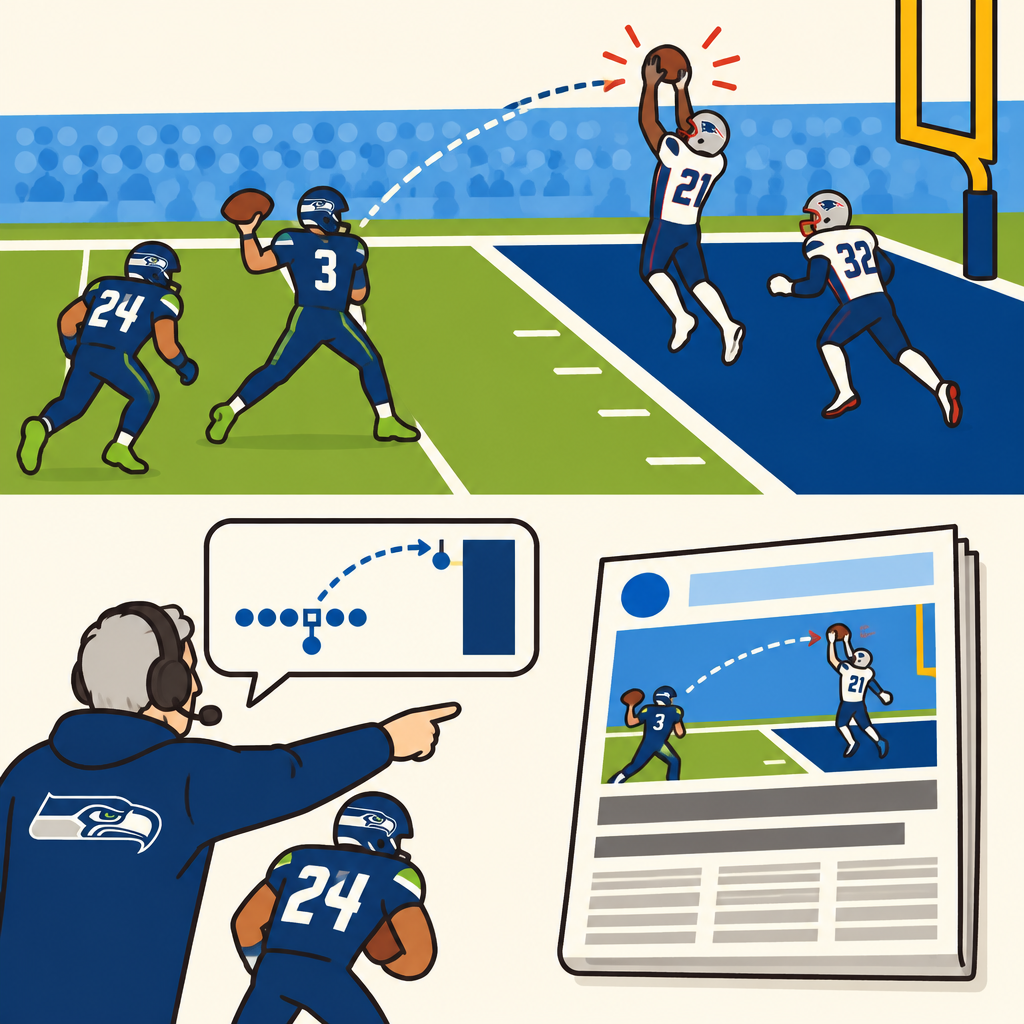
The one play that turned a coach into a punchline
The next day, a USA Today headline asked: "What on Earth Was Seattle Thinking with Worst Play Call in NFL History?"[[1]](https://penguinrandomhousehighereducation.com/book/?isbn=9780735216372)
But was it the worst call? Or just the worst result?
The Football You Need
To judge the call, you need only a few facts. Seattle had to carry the ball one yard into the end zone, with 26 seconds left.
A team gets four tries to do that. Seattle had already used one, so the play Carroll was about to call was its second try, with two more possible after it.
There were two kinds of play to choose from, and they treat the clock differently:
A run: Lynch takes the ball and charges forward. If he is stopped short, the clock keeps running.
A pass: the quarterback throws the ball. If nobody catches it, the clock stops. If a defender catches it, that is an interception, and here the game was over.
Seattle also had one timeout, which stops the clock once. Because a stopped run lets the clock keep ticking, 26 seconds might run out before all the tries were used. So they had this try plus two more, if the clock allowed.
- Distance to the end zone: 1 yard
- Time left: 26 seconds
- Tries left: This try plus two more, if the clock allowed.
- Timeouts left: Stops the clock once.
The Bet Carroll Was Making
Author Annie Duke argues Carroll "made a good-quality decision that got a bad result."[[1]](https://penguinrandomhousehighereducation.com/book/?isbn=9780735216372)
Her case rests on clock math: counting how many more tries Seattle could fit into 26 seconds after each kind of play.
Start with the run. If Lynch is stopped short, the clock keeps running while Seattle gets up and lines up for the next try, and the one timeout can stop it only once. By Duke's clock math, a failed run burns so much time that Seattle likely gets only one more try.[[3]](https://www.boldin.com/retirement/podcast-episode-18-annie-duke/)
A pass nobody catches stops the clock and leaves two more tries to hand the ball to Lynch.[[1]](https://penguinrandomhousehighereducation.com/book/?isbn=9780735216372)
The price is the interception risk. Duke puts it at a 1 to 2% chance.[[3]](https://www.boldin.com/retirement/podcast-episode-18-annie-duke/)
So the pass traded a small risk for one extra shot at the end zone. The rare bad branch is what happened.
- One yard, 26 seconds
- Hand off to Lynch
- Scores: Seattle wins.
- Stopped short: Clock runs; likely only one more try.
- Short pass
- Caught in end zone: Seattle wins.
- Nobody catches it: Clock stops; two more tries for Lynch.
- Intercepted: Game over. Duke puts the chance at 1 to 2%.
Judging by the Scoreboard
Duke sums up the critics in four words: "the play didn't work."[[1]](https://penguinrandomhousehighereducation.com/book/?isbn=9780735216372)
Now imagine the same pass caught for a touchdown. Same call, same odds. The headlines would have praised a brilliant call.[[1]](https://penguinrandomhousehighereducation.com/book/?isbn=9780735216372)
Poker players call this resulting: "Using the outcome as the sole determination if the decision was good or bad."[[5]](https://www.annieduke.com/how-to-make-smarter-decisions-when-you-dont-have-all-the-facts-thinking-in-bets/)
Carroll himself put it this way on the Today show: "It was the worst result of a call ever."[[2]](https://www.nfl.com/news/pete-carroll-concedes-worst-result-of-a-call-ever-0ap3000000469003)
Four Boxes, Not Two
Decision quality is how well a choice used the information, options, and odds available at the time. Outcome quality is how things turned out.
The two can disagree in both directions. Duke's example of a bad decision with a good outcome: getting home safely after driving drunk.
Here is a made-up pair. One manager tests a product carefully, then a competitor's surprise launch sinks it. Another skips testing, and a lucky viral post makes it a hit.
- Carroll's pass, by Duke's account
- Careful tester sunk by rival launch
- Driving drunk, getting home safely
- Skipped testing, lucky viral hit
Which manager made the better call? The grid says the careful one, even though the careless one got the hit.
Why Bold Calls Get Blamed
Picture the conventional option failing: Lynch stopped twice, Seattle loses. Critics would have credited the Patriots, not blamed Carroll.[[4]](https://future.com/podcasts/innovating-in-bets/)
Conventional failures get blamed on luck. Unconventional ones get blamed on the decider. So resulting punishes bold, reasonable calls.
Two analysts cited in the book, Benjamin Morris and Brian Burke, argued the pass was defensible because of the clock.[[1]](https://penguinrandomhousehighereducation.com/book/?isbn=9780735216372)
Analysts compare choices by estimating, as a percentage, how often a team would win after each one. Those estimates rest on assumptions, such as how often a pass gets intercepted. A difference of one percentage point means one choice wins about 1 more game in every 100.
- One analyst: close, not crazy
- Another analysis: running may have been slightly better
- The call nobody remembers
Arguing the call was close is decision analysis. Calling it the worst ever because it was intercepted is resulting.
- Decision analysis
- Resulting
Learning Without Resulting
Separating the two does not mean outcomes are irrelevant. A result still teaches you something, but it mixes your choice with luck and facts you could not see.
It also does not prove Carroll right. The honest claim is that the pass was a reasonable, close bet.
Try it on the headline. "Worst play call in history" becomes "A close bet: a small interception risk for one extra try at the end zone."
When you review a choice, ask what was knowable then, what the options were, and what the odds looked like. Then ask what the result adds.
- Spot the verdict: Notice when a judgment rests only on how things turned out.
- Recover the knowable: Ask what the decider could know at the time.
- List the options: Lay out each choice and its likely results.
- Weigh the odds: Compare how likely the good and bad branches were.
- Restate the judgment: Rewrite the verdict about the bet, then ask what the result adds.
Check yourself
Two hikers see a forecast with a high chance of afternoon storms. The first turns back at noon and misses the summit, and the storm never arrives. The second ignores the forecast, keeps climbing, and reaches the summit under clear skies. Compared with the second hiker, the first hiker made the _____ decision and got the _____ outcome.
Answer: Two hikers see a forecast with a high chance of afternoon storms. The first turns back at noon and misses the summit, and the storm never arrives. The second ignores the forecast, keeps climbing, and reaches the summit under clear skies. Compared with the second hiker, the first hiker made the better decision and got the worse outcome.
Decision quality depends on how well the choice used the information available at the time. The first hiker acted on a forecast that made a storm likely, so that was the better decision. The clear skies were luck, not something either hiker could know. The tempting swap, calling the first hiker's choice worse because the second one reached the summit, is resulting: it judges the decision only by how things turned out.
A manager picks a well-researched supplier, but a factory fire at the supplier delays every order. A review says, “That was a terrible decision because it failed.” What is the main problem with this review?
- It treats the loss as proof that the choice was poor.
- It fails to state that the choice was proven correct.
- It should have ignored what happened to the orders.
- It compares the supplier with too few alternatives.
Answer: It treats the loss as proof that the choice was poor.
This review is resulting. The fire was luck that the manager could not see, so the bad outcome says little about whether the choice made good use of what was knowable. The option saying results should be ignored entirely is the tempting misconception. The lesson says a result still teaches something, but it mixes the choice with luck.
A student skips studying for a multiple-choice exam, guesses on most questions, and scores 95%. Where does this belong on the decision-outcome grid?
- Good decision quality and bad outcome quality
- Bad decision quality and good outcome quality
- Bad decision quality and bad outcome quality
- Good decision quality and good outcome quality
Answer: Bad decision quality and good outcome quality
Skipping study made poor use of the time and options the student had, so the decision quality is bad. The high score came from luck. The tempting answer, good decision and good outcome, lets the score vouch for the choice. That is resulting.
Keep going
This is lesson 1 of 12 in Thinking in Bets. Next up:
- Life Is Poker, Not Chess
- Hindsight and the Fired President
- Wanna Bet? Every Decision Is a Bet
- Confidence Without Certainty
- Expected Value: Pricing a Bet
Wondering turns any topic into short lessons you can read, watch, or listen to, with practice questions and an AI tutor.