Free sample lesson · Thinking, Fast and Slow
Two Mental Systems
Why does 2 + 2 feel effortless while 17 × 24 requires concentration?
Lesson 1 of the Wondering course Thinking, Fast and Slow
Two Ways Your Mind Works
Try this: what is 2 + 2? The answer appeared before you even decided to look for it.
Now try 17 × 24. You probably paused, held numbers in your head, and felt a little strain.
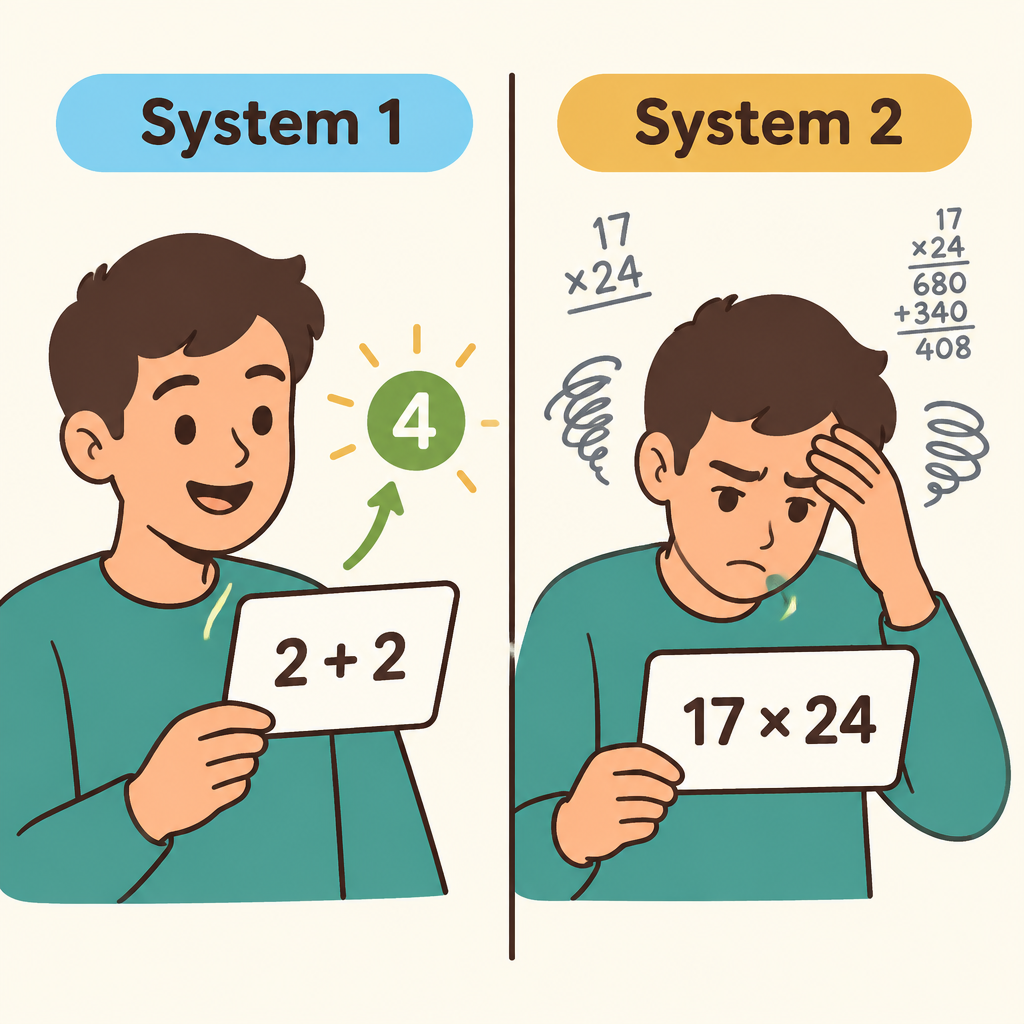
Notice the relaxed face beside the easy sum and the focused, strained face beside the hard one: that shift in effort is the switch from System 1 to System 2.
That difference points to two mental systems. System 1 is fast and automatic. System 2 is slow and deliberate.
Knowing which one is running helps you spot when a judgment might be unreliable.
System 1: Fast and Automatic
System 1 works automatically and quickly, with little or no effort.
You do not switch it on. It runs with no sense of voluntary control, producing impressions and feelings all day long.
- How it runs
- Automatic: You do not switch it on.
- Quick: Answers like 2 + 2 = 4 appear instantly.
- Little or no effort: No strain or focus is needed.
- No voluntary control: It keeps producing impressions and feelings all day.
Seeing 2 + 2 and knowing 4 is System 1 at work. So is the instant sense that an answer feels right.
Its speed is useful. It is also why it can hand you a confident answer before you check.
System 2: Slow and Effortful
System 2 allocates attention to effortful mental activities that demand it.
This includes complex computations like 17 × 24 and conscious decision-making, such as weighing options on purpose.
- No instant answer: System 1 offers nothing, so attention is needed.
- First part: Calculate 17 × 20 = 340 and hold it in mind.
- Second part: Calculate 17 × 4 = 68.
- Combine: Add 340 + 68 to reach 408.
Solving 17 × 24 means holding steps in mind: $$17 \times 20 = 340$$, then $$17 \times 4 = 68$$, then adding them to get 408.
You can feel System 2 working. It takes focus, and it is slow.
The Bat and Ball Trap
Try this puzzle: A bat and ball cost $1.10 in total. The bat costs one dollar more than the ball. How much does the ball cost?
Most people hear 10 cents right away. That is System 1, and the answer feels right.
It is wrong. A 10 cent ball means a bat of $1.10, so the total would be $1.20.
System 2 can recalculate. Try 5 cents: the bat is $1.05, and the total is exactly $1.10. The ball costs 5 cents.
- Read the puzzle
- Gut says 10 cents: System 1 offers an answer that feels right.
- Total equals $1.10?: A 10 cent ball gives a total of $1.20.
- System 2 recalculates: Try 5 cents: the bat is $1.05.
- Accept the answer: The ball costs 5 cents.
- Test again
Why System 2 Lets It Slide
Why do so many people accept 10 cents? Because System 2 is lazy.
Checking takes effort, so System 2 often defers to System 1 and goes along with whatever answer feels right.
The check was easy. It needed only a few seconds of attention, yet many people never run it.
A confident feeling is not proof. It only shows that System 1 produced an answer quickly.
Putting the Two Systems to Work
Use this as a quick check on your own thinking.
If an answer arrived instantly and effortlessly, System 1 produced it. That is fine for 2 + 2.
If the question involves numbers, tricky wording, or a real decision, pause. Ask System 2 to verify.
In plain words: one system guesses fast, the other checks slowly, and the checker often skips its job.
- System 1
- System 2
Check yourself
System 1 thinking operates _____
- automatically, with little effort
- deliberately, with focused effort
Answer: automatically, with little effort
System 1 is the fast, intuitive system. It works automatically and quickly, with little or no effort and no sense of voluntary control. Deliberate, focused effort is the mark of System 2.
_____ continuously generates impressions and feelings without voluntary control, while _____ handles complex computations and conscious decisions.
Answer: System 1 continuously generates impressions and feelings without voluntary control, while System 2 handles complex computations and conscious decisions.
System 1 runs automatically in the background, producing impressions and feelings. System 2 is the effortful system that allocates attention to demanding work like calculations and deliberate choices.
Which mental task most clearly requires System 2?
- Multiplying 17 × 24 in your head
- Sensing that a face looks angry
- Turning toward a sudden loud noise
- Reading a familiar word on a sign
Answer: Multiplying 17 × 24 in your head
Multiplying 17 × 24 in your head demands focused attention and effortful computation, which is System 2's job. Sensing anger in a face, reacting to a loud noise, and reading a familiar word happen automatically and effortlessly, which is System 1.
Keep going
This is lesson 1 of 32 in Thinking, Fast and Slow. Next up:
- System 2 Laziness
- Mental Effort Limits
- Cognitive Ease
- Priming Effects
- Anchoring Effect
Wondering turns any topic into short lessons you can read, watch, or listen to, with practice questions and an AI tutor.