Free sample lesson · The Venture Mindset
Power Law Wins
What if I told you that losing money 50% of the time could still make you incredibly successful?
Lesson 1 of the Wondering course The Venture Mindset
Losing Often, Winning Big
What if losing money on half your bets could still make you hugely successful?
In venture capital, that is normal. Returns follow a power law: a few winners grow so large that they dwarf everything else.
One single investment can return more than all other investments combined.
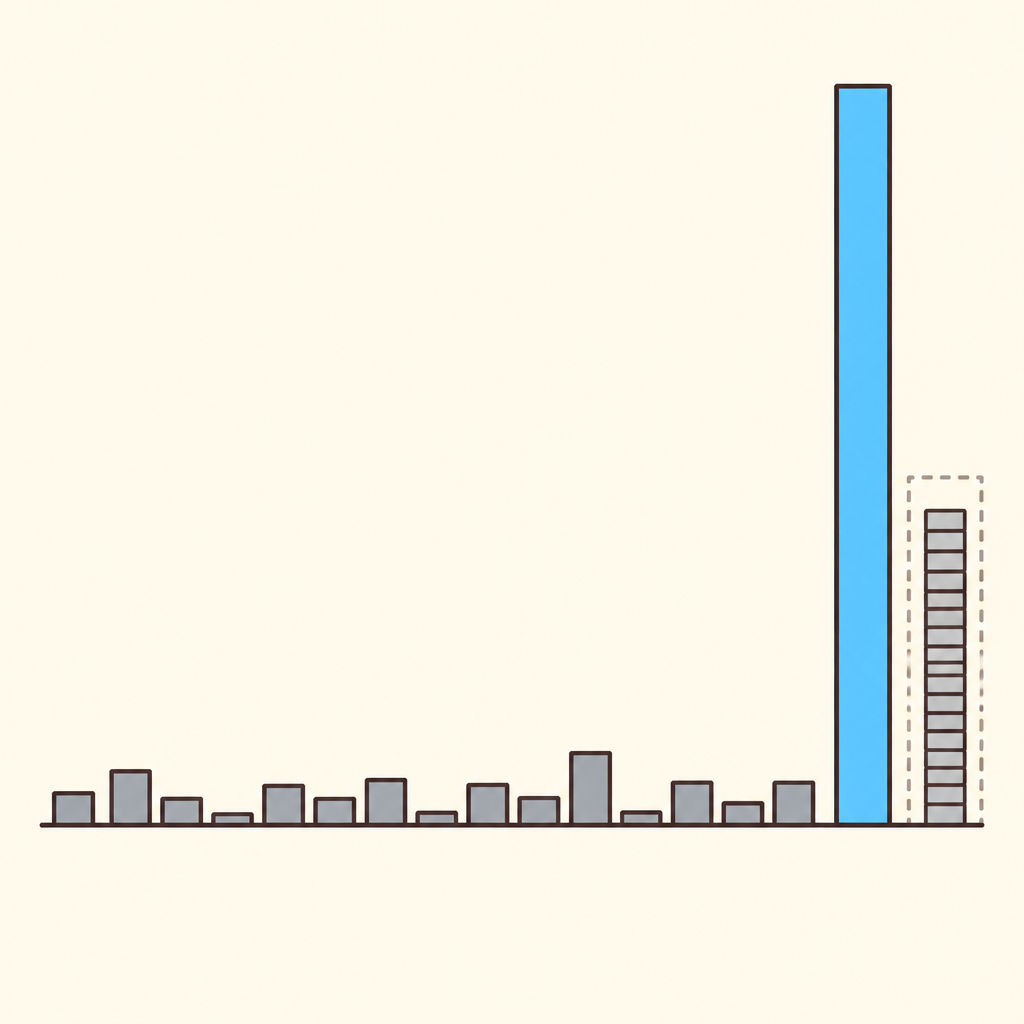
Notice how the single tall tower is bigger than all the short blocks put together, which is how one investment can outweigh every other deal combined.
This is why the usual rules of business do not apply to innovation.
The Top 10% Carry Everything
In a power law, results are not spread evenly. They pile up at the very top.
Globally, the top 10% of venture investments generate 60-80% of all returns.
- Share of venture investments: The small group of best-performing deals.
- Share of all returns they generate: Most of the value comes from that small group.
The other 90% of deals share what is left.
The remaining 90% of deals share what is left. Many of them return little or nothing.
So an average deal tells you very little. The outliers decide the outcome.
Fund Returners Are Rare
A fund returner is one company that pays back the entire fund that invested in it.
Researchers analyzed 11,350 startups. Only about 121 companies became fund returners.
That is just 1.1% of the startups, while the other 98.9% did not.
- Fund returners: About 121 companies paid back their whole fund.
- Other startups: These did not return the entire fund.
Finding these few companies is the whole game.
Great Funds Have a Giant
Researchers studied venture funds from 1986 to 2018. They looked at funds that made at least 3x their money.
Among funds that made at least 3x, 90% had at least one fund returner and only 10% did not.
- Had a returner: One company paid back the whole fund.
- No returner: Success without a giant is rare.
In other words, strong funds rarely win by being steady. They win because one company carries them.
Home Runs vs. Strikeouts
Think of each investment as a swing. A strikeout is a failed company. A home run is the next Google.
A strikeout costs you, at most, the money you put in.
Missing a home run costs far more. One winner can return more than all your other deals combined.
That is why missing the next Google matters far more than several failed investments.
- Strikeout
- Missed home run
Rethinking What a Mistake Is
Traditional business thinking says avoid losses. Keep your error rate low.
Power law thinking flips this. You can lose money on half your bets and still do very well.
The real mistake is saying no to the one company that could return the whole fund, more than your other deals combined.
Fear of failure can quietly cause the biggest loss of all.
Putting Power Law Thinking to Work
When you judge an opportunity, ask one question first: could this become a fund returner?
Expect many failures. They are part of the pattern.
Remember the numbers: about 1.1% of startups return a fund, and the top 10% drive 60-80% of returns.
Your job is to avoid missing the rare giant, because one winner can carry everything.
- Ask the question: Could this company become a fund returner?
- Accept failures: Many deals will fail, and that is part of the pattern.
- Recall the odds: About 1.1% of startups return a fund.
- Catch the giant: Avoid missing the one winner that can carry everything.
Check yourself
In venture capital, the majority of all returns come from _____
- a tiny fraction of investments
- most investments roughly equally
Answer: a tiny fraction of investments
Venture returns follow a power law: a tiny fraction of investments (about 1-2%) generate most of the returns. They are not spread evenly across a portfolio.
In venture capital, the top _____ of investments generate about _____ of all returns.
Answer: In venture capital, the top 10% of investments generate about 60-80% of all returns.
A small top slice (10%) of investments produces the large majority (60-80%) of returns, which is the signature of a power law.
What is a 'fund returner' in venture capital?
- One company that returns the entire fund's capital
- A fund that returns investors' money after closing
- A company that breaks even on its investment
- An investor who reinvests profits into a new fund
Answer: One company that returns the entire fund's capital
A fund returner is a single company whose return equals or exceeds the entire capital of the fund that invested in it. Only about 1.1% of startups studied (121 of 11,350) did this.
Keep going
This is lesson 1 of 30 in The Venture Mindset. Next up:
- Maximize Upside
- Portfolio Construction
- When Stability Works
- When Uncertainty Calls
- Dual Mindset Success
Wondering turns any topic into short lessons you can read, watch, or listen to, with practice questions and an AI tutor.