Free sample lesson · The Selfish Gene
Genes Drive Evolution
If evolution favors survival, why do salmon die immediately after spawning?
Lesson 1 of the Wondering course The Selfish Gene
The Salmon Puzzle
Salmon fight their way upstream, spawn, and then die almost immediately.
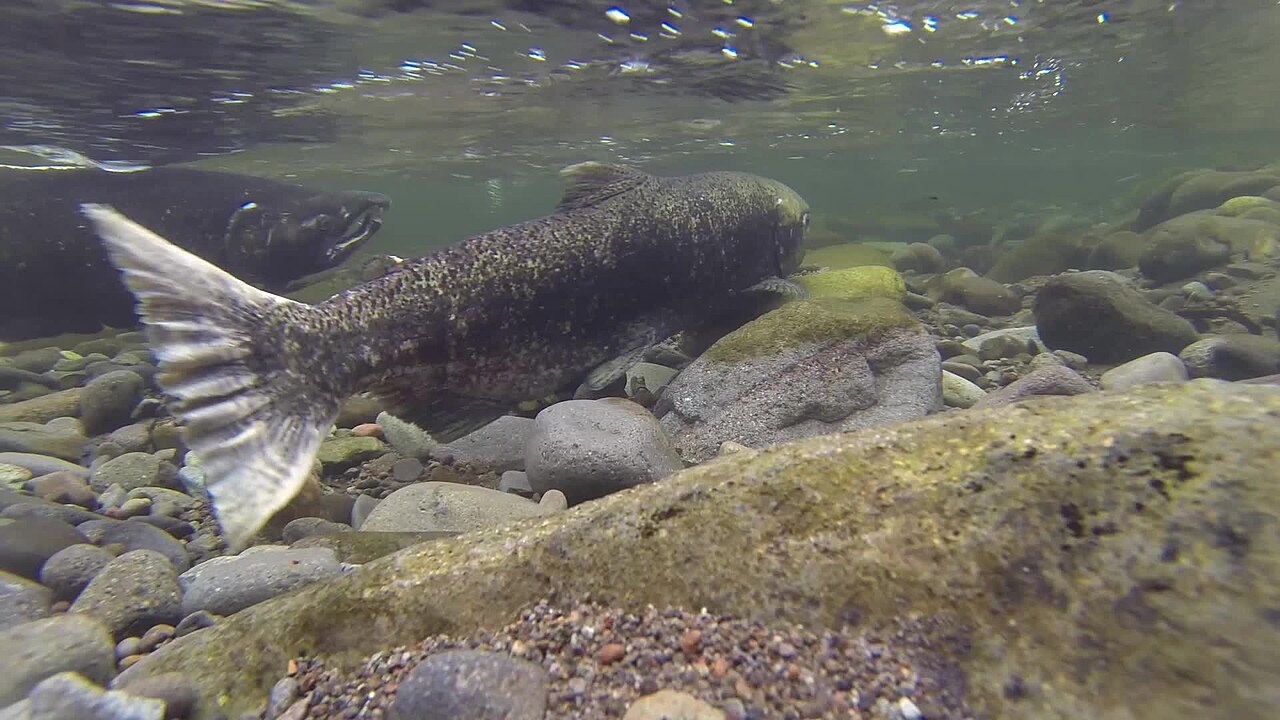
Spring chinook spawning on the Salmon River (30060261062).jpg) · BLM Oregon & Washington · Public Domain Mark 1.0 · Wikimedia Commons
If evolution simply favored survival, this would make no sense. Why would natural selection shape an animal that destroys itself right after it reproduces?
The answer comes from shifting where we look.
Richard Dawkins argued that natural selection acts primarily on genes, not on organisms or species. From that angle, the salmon puzzle starts to make sense.
Two Views of Evolution
Traditional evolutionary thinking focuses on organisms or species. It asks which animals survive, or which species last.
Dawkins flips the focus.
In his view, the gene is the primary unit of natural selection. Organisms and groups matter, but they are not what selection mainly acts on.
- Traditional view
- Gene-centered view
This is often called the gene-centered view of evolution. The next pages show why Dawkins favors it.
What Lasts Across Generations
Think about what actually passes from parent to child.
An organism lives once and then dies. Its body does not continue into the next generation.
Genes are different. They are copied and passed on, so they persist across generations relatively unchanged.
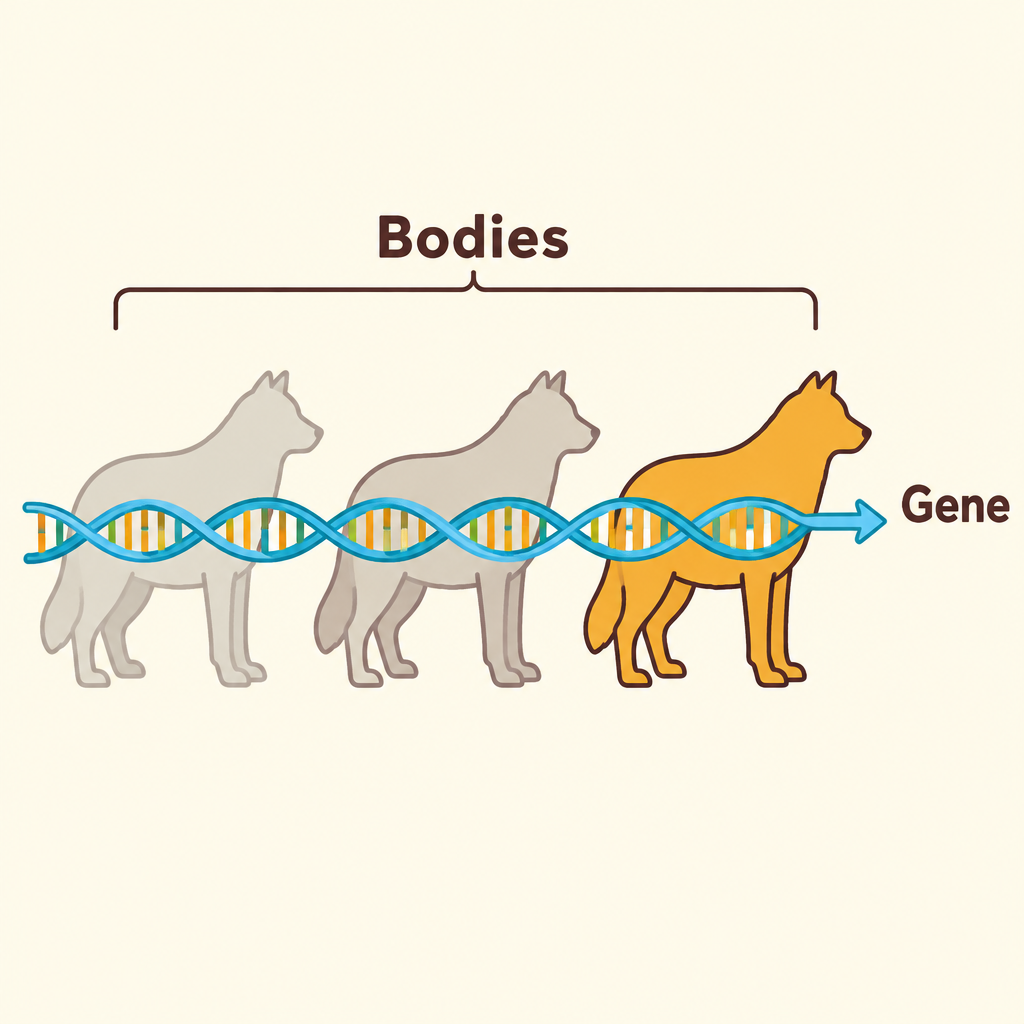
Notice that each body ends, while the same gene strand runs unbroken through every generation; that continuity is why genes, not bodies, are what selection shapes.
That makes genes the only entities that last long enough for selection to shape them over many generations.
A body is temporary. A gene can outlast every body that carries it.
Genes as Replicators
Dawkins calls genes replicators: things that get copied and carried forward.
A gene cannot do this alone. It needs a body that grows, survives, and reproduces.
So genes build organisms. The organism survives long enough to reproduce, which passes copies of the genes into a new organism.
- Genes build body: Genes construct an organism to carry them.
- Body survives: The organism lives long enough to reproduce.
- Body reproduces: Reproduction passes copies of the genes on.
- New body carries genes: The copies sit in a new organism, and the cycle repeats.
Then the cycle starts again.
Each round, genes that build better survival machines leave more copies.
Organisms as Survival Machines
If genes are the replicators, what are organisms?
Dawkins calls them survival machines or vehicles. Genes construct them to help the genes replicate.
A vehicle carries passengers to a destination. The vehicle can wear out, as long as the passengers arrive.
Now return to the salmon. Its body is used up in spawning, but its genes have already passed into the next generation.
Survival of the machine was never the final goal.
Evolution as Gene Survival
So what is evolution, in this view?
Evolution occurs through differential gene survival. Some genes get copied more often than others, and they become more common in later generations.
Organism survival is not the core measure. Neither is the survival of groups or species.
A common mistake is to treat the individual animal as the thing being selected. Individuals die, and their genes are what carry forward.
Applying the Gene-Centered View
You can now test any trait with a few questions.
First, ask what persists. Bodies die, so look at the genes.
Next, ask how the trait helps those genes get copied. A trait can cost the organism dearly and still spread, as the salmon shows.
Finally, explain it plainly: organisms are vehicles, and genes are the passengers that travel on.
- Find what persists: Bodies die, so focus on the genes.
- Trace the copying: Ask how the trait helps those genes get copied.
- Name the vehicle: Treat the organism as the vehicle carrying the genes.
Check yourself
In the gene-centered view of evolution, an organism like a dog is best described as _____.
- a survival machine that genes build to get themselves copied
- the main unit that natural selection keeps across generations
Answer: a survival machine that genes build to get themselves copied
Organisms are temporary survival machines, or vehicles, that genes build to help get themselves copied. Organisms die, so they are not what selection keeps across generations. Genes are.
Genes are the _____, copied from parent to offspring. Organisms are temporary _____ that genes build. Evolution happens through differences in how well genes achieve _____ over time.
Answer: Genes are the replicators, copied from parent to offspring. Organisms are temporary survival machines that genes build. Evolution happens through differences in how well genes achieve survival over time.
Genes are the replicators that last across generations. Organisms are short-lived survival machines. Evolution is differential gene survival: some genes get copied more than others.
A rabbit lives for a few years, has babies, and then dies. Which of these can last across many generations, passed down in copies with little change?
- The rabbit itself
- A gene copied into its babies
- The rabbit's adult body
- The family group in its burrow
Answer: A gene copied into its babies
Genes are copied into offspring, so they can last for many generations with little change. The rabbit, its body, and its burrow group all die or break up.
Keep going
This is lesson 1 of 45 in The Selfish Gene. Next up:
- Selfish Gene Explained
- Replicators
- Molecules to Life
- Gene Immortality
- Genes in Reproduction
Wondering turns any topic into short lessons you can read, watch, or listen to, with practice questions and an AI tutor.