Free sample lesson · The Rational Optimist: How Prosperity Evolves
Why Humans Got Richer as They Multiplied
A hand axe stayed unchanged for a million years; a mouse lasts five. Why?
Lesson 1 of the Wondering course The Rational Optimist: How Prosperity Evolves
More People, More Prosperity?
Why did human prosperity grow as the human population grew?
Ridley calls humans the only species that becomes more prosperous as it becomes more populous.[[2]](https://www.ted.com/talks/matt_ridley_when_ideas_have_sex/transcript)
His answer is exchange. People swap goods, services, and ideas, gaining access to discoveries beyond their own experience.
More people can therefore mean more possible connections. But progress still depends on trade and trust.[[1]](https://www.mattridley.co.uk/books/the-rational-optimist-how-prosperity-evolves/)
The Axe and Mouse
Look at this roughly 450,000-year-old Acheulean hand axe, a single stone shaped by one maker.[[7]](https://commons.wikimedia.org/wiki/File:Acheulean_hand_axe,_c._450,000_years_before_present,_stone_-_Canterbury_Museum_-_Christchurch,_NZ_-_DSC02244.jpg)

An Acheulean hand axe, about 450,000 years old: one stone, one maker, and a design that barely changed for a million years. · Photo: Daderot, Canterbury Museum, Christchurch, via Wikimedia Commons (CC0) · CC0

Ridley says its basic design barely changed for about a million years, roughly 30,000 generations.[[2]](https://www.ted.com/talks/matt_ridley_when_ideas_have_sex/transcript)
A computer mouse, by contrast, combines plastic, a laser, and transistors, and Ridley says it becomes obsolete after about five years.[[2]](https://www.ted.com/talks/matt_ridley_when_ideas_have_sex/transcript)
The difference is accumulated ideas.
When Ideas Have Sex
Can a culture be inherited yet remain static? Yes.
When knowledge passes mainly from parent to offspring, each group works with a narrow set of ideas. Transmission alone does not ensure accumulation.
Exchange lets innovations from different groups meet and recombine. Ridley calls it the cultural equivalent of sex combining genes from different lineages.[[2]](https://www.ted.com/talks/matt_ridley_when_ideas_have_sex/transcript)[[3]](https://www.scientificamerican.com/article/when-ideas-have-sex/)
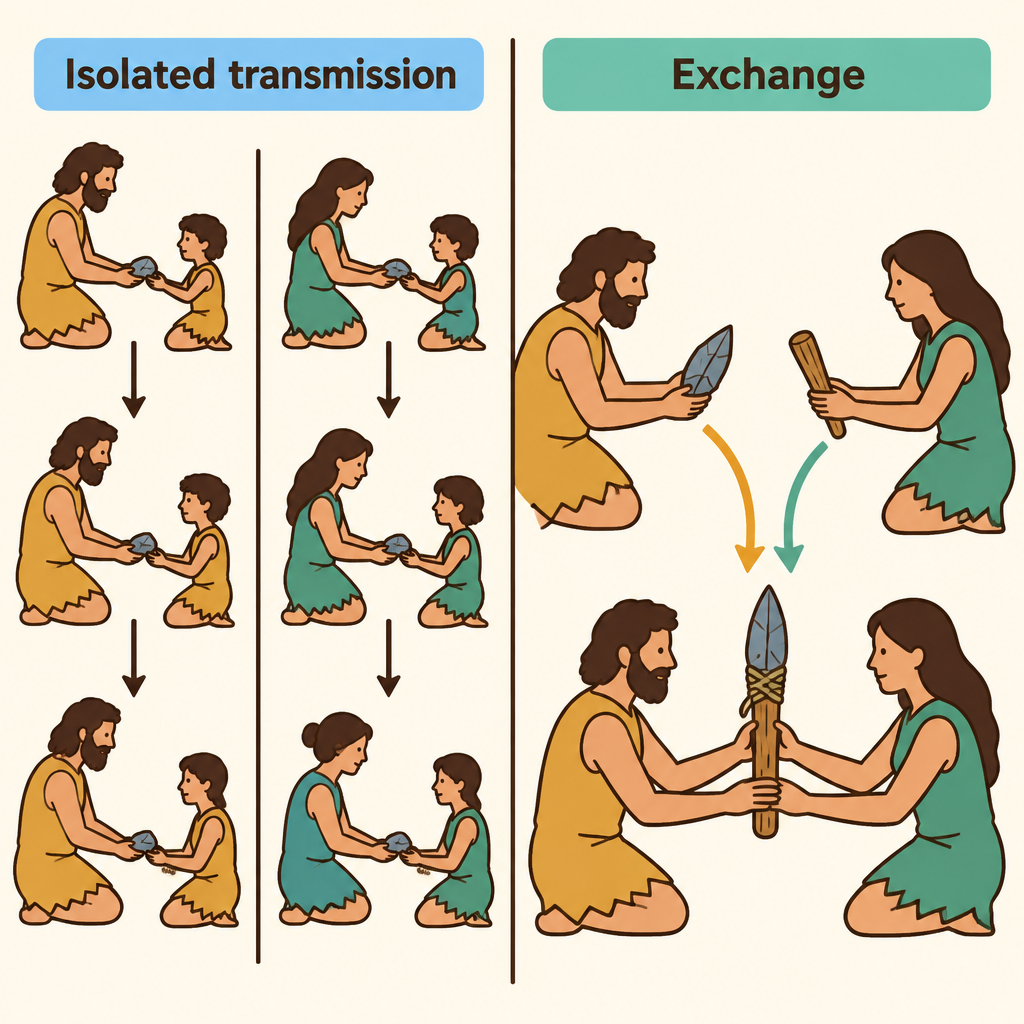
On the left, each group copies the same tool down the generations; on the right, innovations from different groups meet and combine into something new.
Without those meetings, tools may be copied for generations without major change.
Exchange Is Not Reciprocity
A chimp grooms another chimp that previously groomed it. That is reciprocity, because the same kind of favour returns.
Exchange swaps one object or service for something different. Adam Smith observed that nobody sees a dog fairly exchange one bone for another.[[2]](https://www.ted.com/talks/matt_ridley_when_ideas_have_sex/transcript)
- Reciprocity
- Exchange
Chimpanzees and killer whales transmit culture, but their cultures do not expand and accumulate.[[2]](https://www.ted.com/talks/matt_ridley_when_ideas_have_sex/transcript)
Animal cooperation therefore does not automatically count as trade.
Specialization Multiplies Knowledge
How can one person use a mouse without understanding lasers, plastics, and transistors?
Specialization means people focus on different tasks. Exchange then joins their separate outputs, allowing each person to use knowledge held by many others.
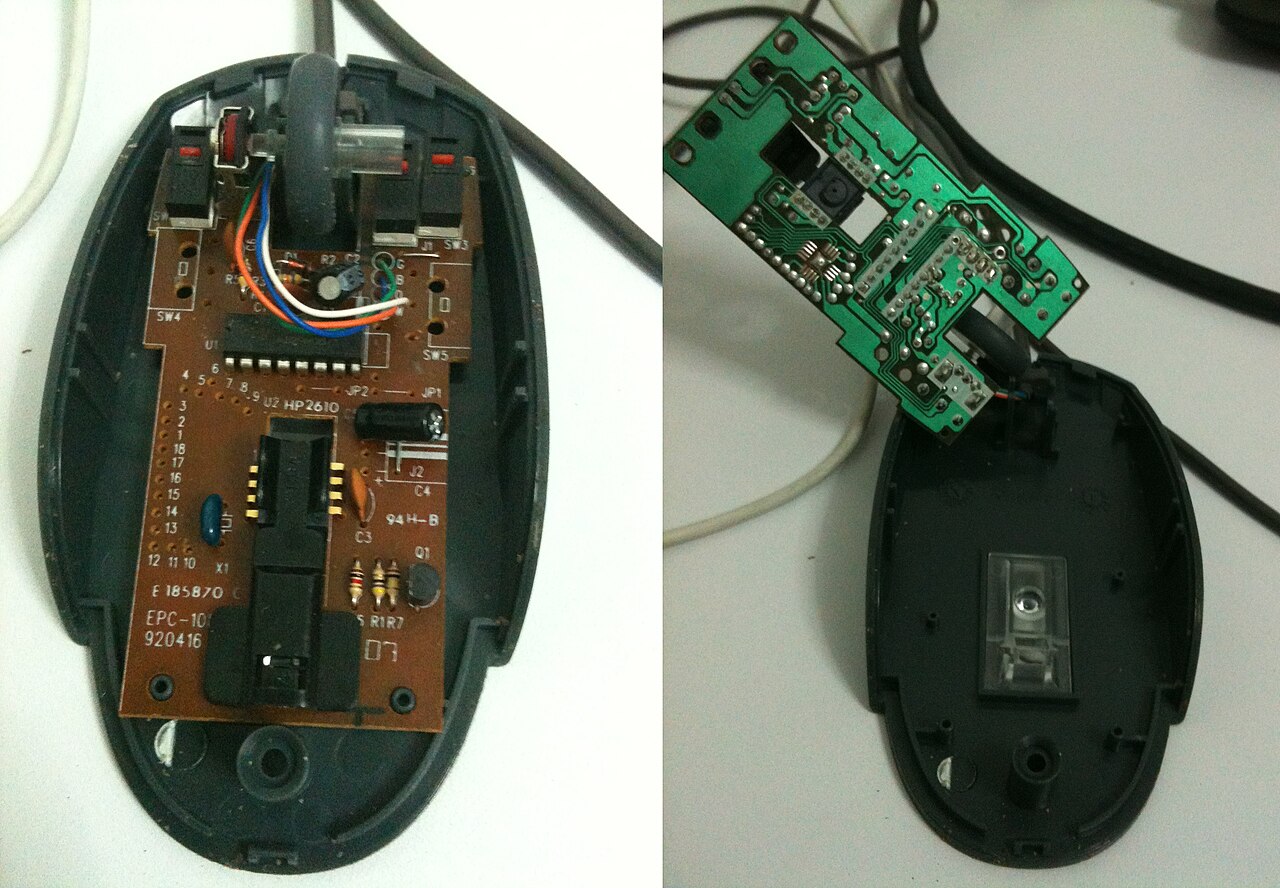
Mouse printed circuit board both sides IMG 0959a · Own work · CC0 1.0 · Wikimedia Commons

This expanding combination of exchange, specialization, and invention drives prosperity.[[4]](https://www.nytimes.com/2010/05/18/science/18tier.html)
Trust matters because productive trade depends on people believing others will honor the exchange.[[1]](https://www.mattridley.co.uk/books/the-rational-optimist-how-prosperity-evolves/)
Optimism With Conditions
Can a rising population coexist with rising prosperity? Ridley argues that it can when trade and trust let ideas combine.[[1]](https://www.mattridley.co.uk/books/the-rational-optimist-how-prosperity-evolves/)
- World population passed 8 billion
Population is not an automatic engine of progress.
When weighing pessimistic claims, examine long-run changes in food, shelter, protection, and idea exchange. Then ask whether trade and trust are actually working.
Diagnose Growth or Stagnation
When a culture or workplace stalls, ask three questions.
Are people swapping different goods, services, or ideas? That is exchange. Returning the same favour is reciprocity.
Can ideas cross between groups? Without that movement, knowledge may be preserved without accumulating.
Are specialists able to trade and trust one another? If so, separate inventions can recombine.
- Culture or workplace stalls
- Swapping different things?: Different goods, services, or ideas, not the same favour returned.
- Ideas cross groups?
- Specialists trade, trust?
- Inventions can recombine: Like the mouse: a network of exchanged ideas.
- Isolated transmission: Like the hand axe: knowledge preserved without accumulating.
The hand axe signals isolated transmission. The mouse reveals a network of exchanged ideas.
Check yourself
A chimp grooms another chimp that previously groomed it; this is _____.
- reciprocity
- exchange
Answer: reciprocity
This is reciprocity because the same kind of favour is returned. Exchange would involve swapping one object or service for something different.
Two human groups each pass the same tool design from parents to children, but they never share ideas. What is most likely?
- The design stays mostly unchanged
- The design quickly combines many inventions
- The groups automatically become more prosperous
- The tool disappears after one generation
Answer: The design stays mostly unchanged
The tool may be copied for many generations, but it will not easily accumulate new improvements. Exchange lets ideas from different groups meet and combine.
A computer mouse uses plastic, a laser, and transistors. Which process best explains how one person can use it without making all these parts?
- Specialization followed by exchange
- One family copying one tool for generations
- Reciprocity between animals
- A larger population working without trade
Answer: Specialization followed by exchange
Specialists focus on different tasks, and exchange joins their separate outputs. This allows one person to use knowledge held by many others.
Keep going
This is lesson 1 of 12 in The Rational Optimist: How Prosperity Evolves. Next up:
- Adam and Oz: Why the Weaker Trader Still Wins
- Prosperity Is Time Saved
- Nobody Knows How to Make a Pencil
- Big Brains Were Not Enough
- When Islands Forget
Wondering turns any topic into short lessons you can read, watch, or listen to, with practice questions and an AI tutor.