Free sample lesson · The Order of Time
Why good clocks disagree
Why can two working clocks disagree after a mountain trip?
Lesson 1 of the Wondering course The Order of Time
Two good clocks, two answers
Two friends set accurate clocks to the same time. One friend lives on a mountain. The other lives on the plain below.
Years later they reunite and compare clocks. The readings disagree, yet neither clock is broken.[[1]](https://www.penguinrandomhouse.com/books/551483/the-order-of-time-by-carlo-rovelli/9780735216129/)
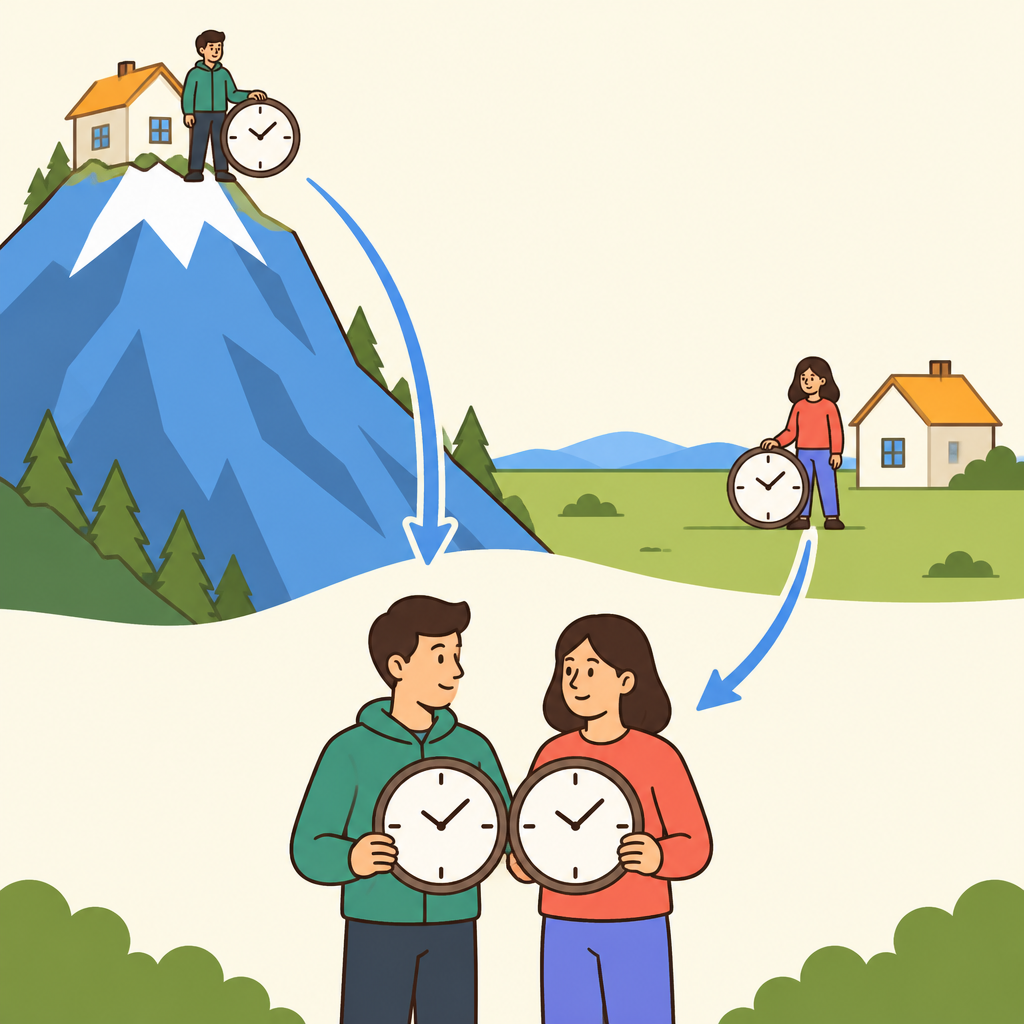
Notice that each friend lives a full, ordinary life in a different place, so each clock follows a different history before the reunion.
Carlo Rovelli uses this scene in The Order of Time to show that elapsed time depends on where each clock spent its time.[[1]](https://www.penguinrandomhouse.com/books/551483/the-order-of-time-by-carlo-rovelli/9780735216129/)
So a mismatch can record different physical histories, not a fault.
Proper time: time along a path
A clock counts repeated physical processes, such as ticks or atomic vibrations. That count belongs to the clock's own journey.
Rovelli calls the duration along a particular history proper time.[[1]](https://www.penguinrandomhouse.com/books/551483/the-order-of-time-by-carlo-rovelli/9780735216129/)
To compare two durations, you need a shared starting event and a shared ending event. Two displayed times on their own tell you little.
- Meet: Both clocks start together at one shared event.
- Separate: Each clock follows its own history and counts its own proper time.
- Reunite: The clocks meet again at one shared ending event.
- Compare: Only now do the two counted durations mean something side by side.
- Clocks within an atomic cloud
- Elapsed time as route length
Higher clocks gain time
Now the direction of the effect.
For otherwise comparable stationary clocks near Earth, a higher clock accumulates more time than a lower one.[[1]](https://www.penguinrandomhouse.com/books/551483/the-order-of-time-by-carlo-rovelli/9780735216129/)[[2]](https://www.nist.gov/news-events/news/2022/02/jila-atomic-clocks-measure-einsteins-general-relativity-millimeter-scale)
So at the reunion, the mountain friend's clock shows more elapsed time than the plain friend's clock.
- Mountain clock
- Plain clock
This is gravity at work. Each clock still ticks correctly for its own location, and both friends lived ordinary local rhythms.
Motion changes elapsed time too
Motion also affects elapsed time.[[1]](https://www.penguinrandomhouse.com/books/551483/the-order-of-time-by-carlo-rovelli/9780735216129/)
Rovelli's second scene contrasts a friend who stays put with a friend who travels away and comes back. In this simple out-and-back case, the stay-at-home friend is inertial.
The travelling history accumulates less proper time. At the reunion, the traveller's clock shows less elapsed time.
- Stay-put friend
- Traveller
What matters is each whole path between the two meetings, not a label like moving or stationary.
Specify before you predict
A claim like "all moving people age less" is too vague to judge.
You must name the clocks, their shared starting and ending meetings, and each full path. Moving relative to what?
Gravity and motion can also pull in opposite directions. When both effects are present, the net difference depends on the exact setup.
- Hear a clock claim
- Shared start and end?: Do the clocks begin and finish at the same events?
- Full paths specified?: Are each clock's motion and elevation described?
- Ask for details: Request the reference, the clocks, and their paths.
- Compare proper times: Now gravity and motion effects can be weighed.
- Recheck
Without these details, you cannot predict which clock will read more.
What disagreement does not mean
Clock disagreement is not necessarily damage, a time-zone setting, or boredom making time drag.
Relativity concerns measurable elapsed duration. Nobody's local life feels slowed from within.
The traveller does not feel every thought and heartbeat dragging. Their heart, thoughts, and clock all follow the same local physics, so they stay in step with one another.
Is there one true time?
Here is the core idea. Each accurate clock measures its own local duration correctly.
Higher stationary clocks near Earth gain time. In the simple out-and-back case, the traveller accumulates less. Every complete comparison names the clocks and their whole paths.
When someone claims a clock is wrong, first ask what path it followed.
This raises a deeper puzzle about whether one single time exists at all.
Check yourself
Proper time is the elapsed duration measured along a clock's own physical history.
- True
- False
Answer: True
Correct. Proper time belongs to the particular path or history followed by that clock.
A fair clock comparison uses a shared _____, a shared _____, and each clock's own _____.
Answer: A fair clock comparison uses a shared starting event, a shared ending event, and each clock's own proper time.
The clocks need common beginning and ending events. Between those events, each clock accumulates its own proper time along its own history.
Two friends start together, reunite later, and compare accurate clocks. One clock stayed in place while the other followed a simple out-and-back journey. Which result matches this comparison?
- The traveller's clock shows less elapsed time.
- The traveller's clock shows more elapsed time.
- Both clocks must show exactly the same elapsed time.
- The traveller feels every thought and heartbeat slow down.
Answer: The traveller's clock shows less elapsed time.
In this simple out-and-back case, the travelling history accumulates less proper time, so the traveller's clock shows less elapsed time at reunion. This does not mean the traveller feels slowed: local thoughts, heartbeats, and the clock remain in step.
Keep going
This is lesson 1 of 12 in The Order of Time. Next up:
- Why there is no universal now
- Why heat has a direction
- When spacetime becomes part of physics
- Why a stone is a process
- Change without a master clock
Wondering turns any topic into short lessons you can read, watch, or listen to, with practice questions and an AI tutor.