Free sample lesson · The KLI Framework
Framework Overview
Why does a strategy that works in a math class often fail in a language lab?
Lesson 1 of the Wondering course The KLI Framework
What You Will Learn
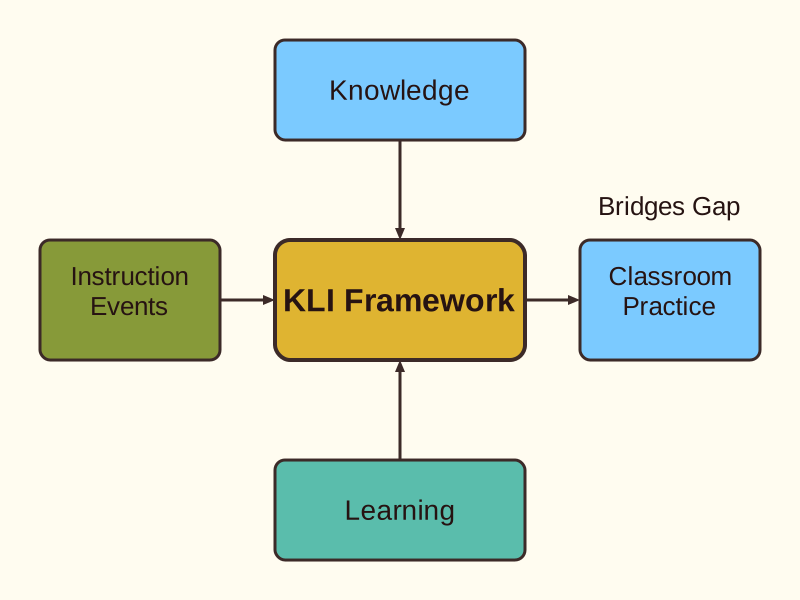
The KLI framework provides a unified language to bridge the gap between abstract cognitive science and daily classroom practice.
The Gap in Learning Science
Why does a strategy that works in a math class often fail in a language lab?
Cognitive science offers deep research, but applying it to real classrooms is often messy and inconsistent.
Product managers and designers need a way to bridge this gap. We need a systematic approach to turn abstract science into effective instruction.
- Cognitive Science
- Classroom Practice
Introducing the KLI Framework
The Knowledge-Learning-Instruction (KLI) framework is a theoretical structure designed for learning engineering.
It identifies the critical dependencies between three core elements: what students learn, how they learn it, and how we teach it.
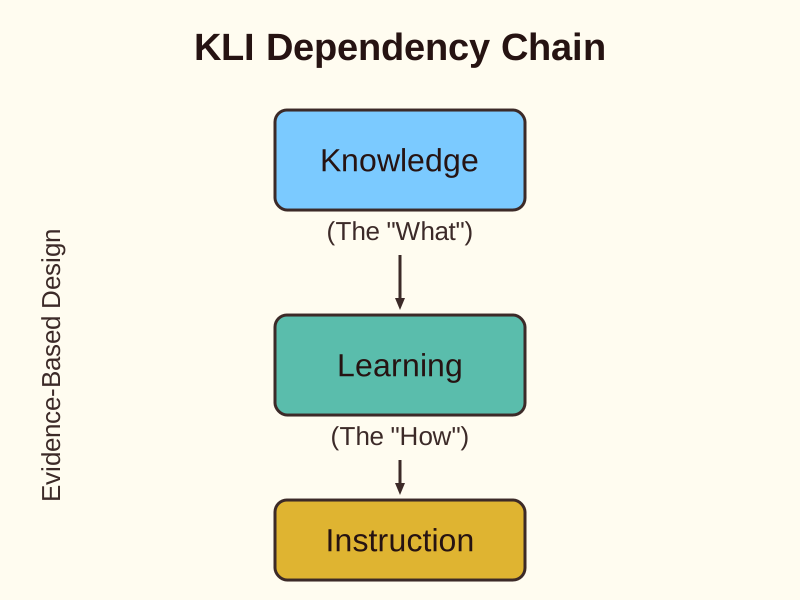
By using KLI, we can move away from "one-size-fits-all" solutions and toward evidence-based design.
The Three Coordinated Taxonomies
KLI organizes educational design into three specific categories.
First, we analyze the Knowledge (the specific facts or skills). Next, we look at the Learning processes required to acquire that knowledge.
Finally, we choose the Instructional events that trigger those processes. This alignment ensures your product actually delivers results.
Designing for Generality
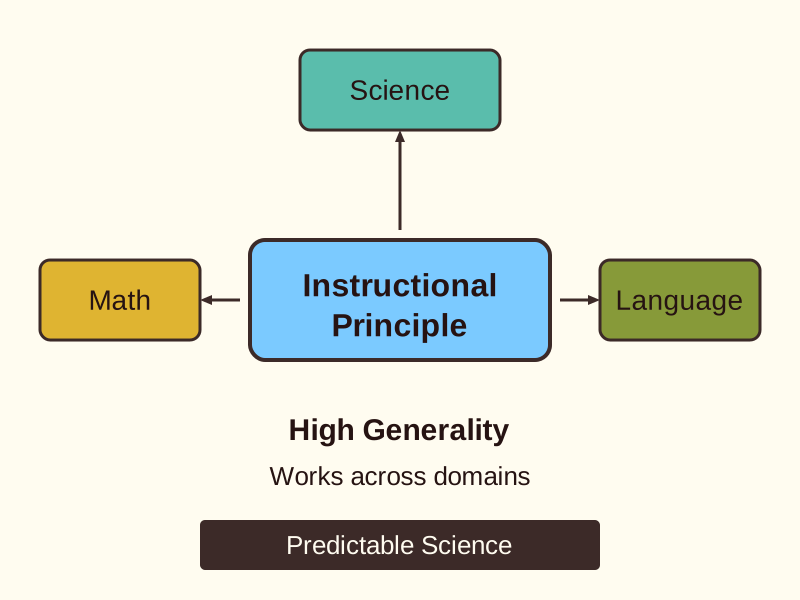
The goal of KLI is to find instructional principles with high potential for generality.
This means finding patterns that work across different domains, like science and math.
By explicitly identifying constraints, designers can build tools that are both flexible and scientifically grounded. It turns teaching from an art into a predictable science.
Putting It All Together
- Analyze Knowledge: Identify the specific facts, rules, or principles to be learned.
- Map Learning: Determine the cognitive processes required to acquire that knowledge.
- Select Instruction: Choose instructional events that effectively trigger those learning processes.
- Scale Design: Apply these general principles across different subjects and domains.
Check yourself
The KLI framework is designed to _____ the gap between cognitive science research and classroom instruction.
- bridge
- increase
Answer: bridge
KLI stands for Knowledge-Learning-Instruction; it aims to connect scientific research with practical teaching methods.
The KLI framework consists of three coordinated taxonomies: _____ types, _____ processes, and _____ choices.
Answer: The KLI framework consists of three coordinated taxonomies: knowledge types, learning processes, and instructional choices.
These three components form the core structure of the framework to analyze educational events.
What is a primary benefit of using the KLI framework for educational designers?
- It identifies instructional principles with high potential for generality.
- It replaces the need for classroom teachers.
- It provides a single teaching method that works for all subjects.
- It focuses only on math and ignores language learning.
Answer: It identifies instructional principles with high potential for generality.
KLI helps identify which instructional principles can be generalized and which are constrained by specific types of knowledge.
Keep going
This is lesson 1 of 15 in The KLI Framework. Next up:
- Learning Events
- Instructional Events
- Assessment Events
- KC Definition
- Constant Facts
Wondering turns any topic into short lessons you can read, watch, or listen to, with practice questions and an AI tutor.