Free sample lesson · The Intelligent Investor
Investing vs Speculation
Are you building wealth or just gambling with your money?
Lesson 1 of the Wondering course The Intelligent Investor
Building Wealth or Gambling?
Two people buy the same stock on the same day. One may be investing. The other may be speculating.
The difference lies in how each person decides and what each one expects to happen.
One studies the business. The other watches the price jump around and hopes to guess its next move.
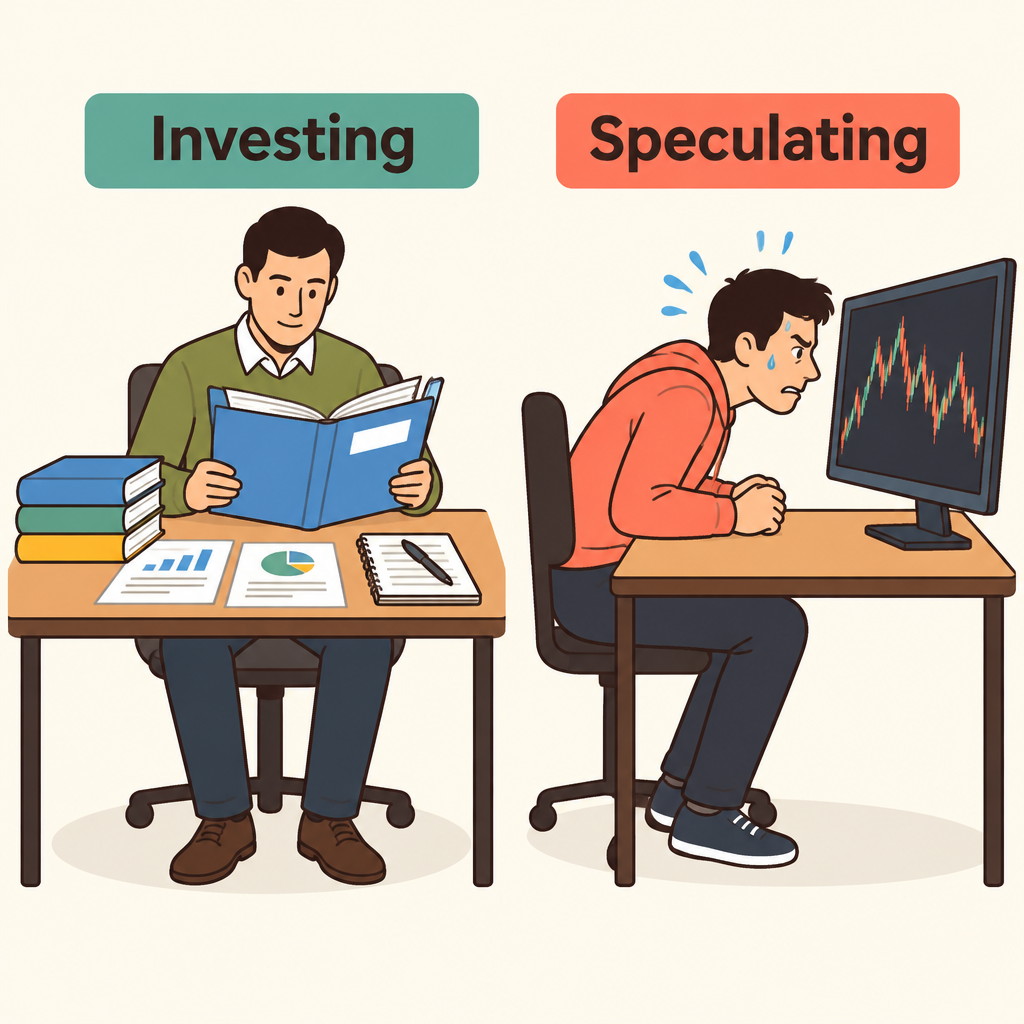
Notice where each person's attention goes: one studies the business, the other only watches the price move.
This lesson gives you a simple test, so you never mistake a lucky bet for a sound plan.
The Three-Part Investment Test
Here is the core definition: an investment operation is one which, upon thorough analysis, promises safety of principal and an adequate return.
That gives you three checks: thorough analysis, safety of principal, and an adequate return.
Principal simply means the money you put in.
All three checks must pass. Miss any one, and the operation is speculative.
- Money decision
- Thorough analysis done?
- Principal kept safe?
- Return adequate?
- Investment: All three checks pass.
- Speculation: At least one check fails.
- Yes
- No
- Yes
- No
- Yes
- No
Analysis Means Studying the Business
The first check is thorough analysis. You study the company itself, beyond its ticker symbol.
An investor asks two big questions. What is this business really worth? How good are its long-term prospects?
- Thorough analysis: Study the company itself.
- Intrinsic worth: What is this business really worth?
- Long-term prospects: How good are its prospects over years?
What a business is really worth is its intrinsic worth. It can differ from today's market price.
Without this work, you have no basis for judging whether your money is safe.
Safe Principal, Adequate Return
The second check is safety of principal. Your first goal is to protect the money you put in.
The third check is an adequate return. Notice the word: adequate, not extraordinary.
An investor accepts a reasonable reward in exchange for safety.
Chasing extraordinary gains usually means putting principal at risk. That moves you toward speculation.
- Adequate return
- Extraordinary return
What Speculation Looks Like
Speculation tries to predict short-term price movements. The speculator asks, "Will this go up next week?"
It often relies on market timing: guessing the right moment to buy or sell.
Business fundamentals get little attention. Intrinsic worth and long-term prospects are ignored.
- Focuses on
- Short-term price movements
- Market timing
- Ignores
- Business fundamentals
- Intrinsic worth
- Long-term prospects
Result: closer to gambling than investing.
Because the outcome depends on guessing price swings, speculation resembles gambling more than investing.
Luck Is Not Skill
Here is the trap. A speculative bet can make money.
A stock you bought on a hunch might double. That win can feel like proof you were right.
The test judges the decision, not the result. With no thorough analysis, it was speculation, whatever happened next.
Confusing luck with skill invites bigger, riskier bets later.
Apply the Test Yourself
Before any money decision, run the three checks. Did I analyze the business? Is my principal protected? Is my expected return adequate?
If you are mainly guessing where the price goes next, label it honestly: speculation.
Some people choose to speculate. Just avoid calling it investing.
That honesty keeps your wealth plan disciplined.
Check yourself
An investor who demands extraordinary returns is following the definition of an investment operation _____
- incorrectly
- correctly
Answer: incorrectly
An investment operation aims for an adequate return, not an extraordinary one. Chasing outsized returns usually means taking risks that threaten principal, which points toward speculation.
An investor studies a company's _____ and long-term prospects, while a speculator tries to predict _____ price movements.
Answer: An investor studies a company's intrinsic worth and long-term prospects, while a speculator tries to predict short-term price movements.
Investors focus on the underlying value of the business (intrinsic worth) over the long term. Speculators ignore that value and bet on short-term price changes and market timing.
Which set lists the three elements required for an investment operation?
- Thorough analysis, safety of principal, adequate return
- Market timing, safety of principal, maximum return
- Thorough analysis, price prediction, extraordinary return
- Quick trading, diversification, adequate return
Answer: Thorough analysis, safety of principal, adequate return
An investment operation needs thorough analysis, safety of principal, and an adequate return. Market timing, price prediction, and maximum returns are traits of speculation, not investment.
Keep going
This is lesson 1 of 25 in The Intelligent Investor. Next up:
- Price vs Value
- Margin of Safety
- Mr. Market
- Defensive Investor
- Stock-Bond Allocation
Wondering turns any topic into short lessons you can read, watch, or listen to, with practice questions and an AI tutor.