Free sample lesson · The Humane Representation of Thought
Power of Representation
What if the way you write down an idea could make impossible thoughts suddenly thinkable?
Lesson 1 of the Wondering course The Humane Representation of Thought
Thinking Outside Your Head
A representation is any way we put thought onto an external medium: marks on paper, symbols, numbers, or charts.
Over the last 2000 years, new representations have driven much of humanity's intellectual progress.
Each breakthrough let people think thoughts that were previously unthinkable. Three famous examples are Arabic numerals, algebraic notation, and data graphics.
- Representations: Thought put onto an external medium
- Arabic numerals
- Algebraic notation
- Data graphics
Same mind, new tool, new thoughts.
Offloading the Mental Load
Your head can only hold a few things at once.
Representations let you offload cognition. The paper holds the details, so your mind is free to work on the next step.
Imagine a made-up case: a student solving a long problem. Once it is written down, every step stays visible and checkable.
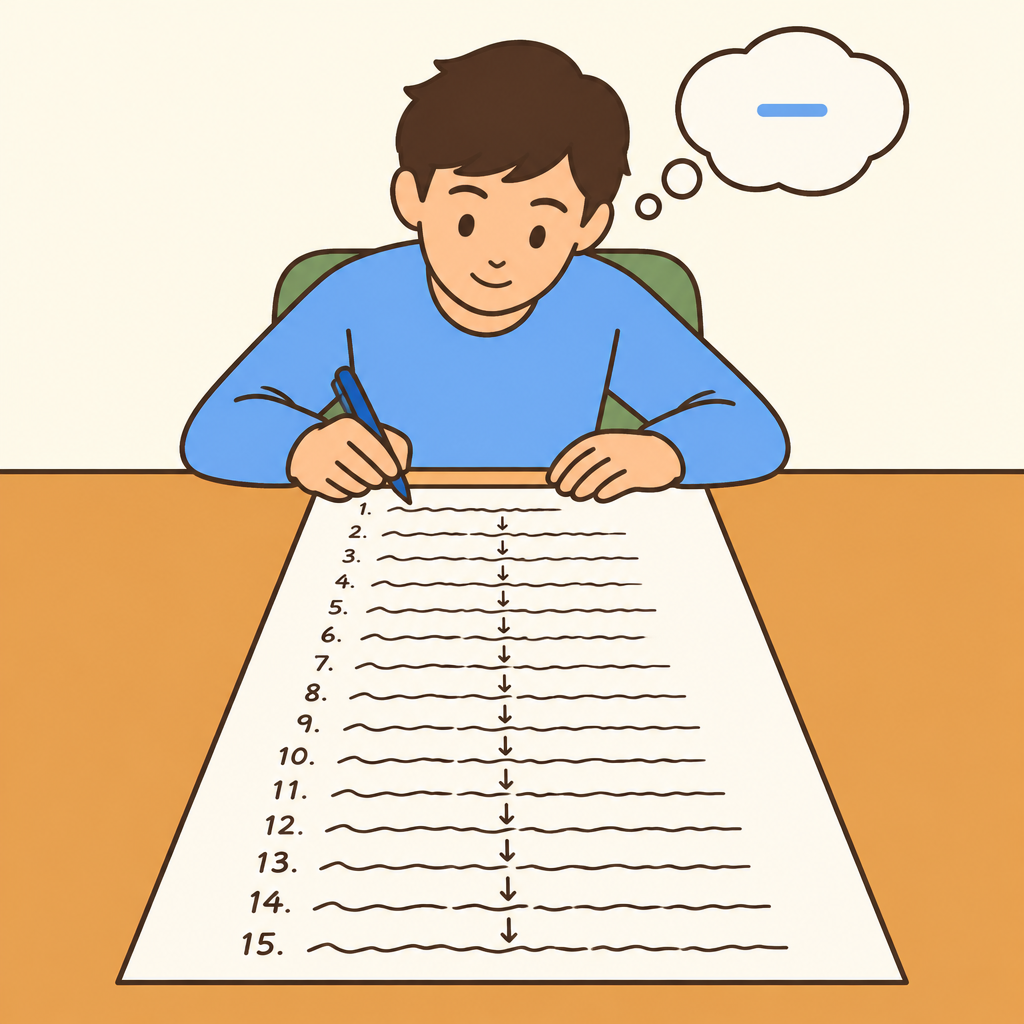
Notice that the paper holds the many steps, leaving the student's mind free to focus on just the next one.
Offloading is the first way representations push thinking forward.
Why Roman Numerals Lost
Roman numerals work fine for writing a number down. Try multiplying with them, though.
Arabic numerals replaced Roman numerals because they made calculation tractable, meaning practical to actually carry out.
- Roman numerals
- Arabic numerals
In Arabic numerals, a digit's place shows its value. So you can line numbers up and work column by column.
Same quantities. Very different thinking.
Algebra: Symbols Over Sentences
Before algebraic notation, mathematicians described relationships in words.
Here is a made-up example: "a number, added to itself, equals twice that number." Now picture a whole page of sentences like that.
Notation shrinks it to $$x + x = 2x$$. Now you can move symbols around by rules.
- Words: A number, added to itself, equals twice that number.
- Symbols: The same idea becomes x + x = 2x.
- Rules: You move symbols around by rules instead of rereading sentences.
- Abstract thinking: Relationships can be manipulated in ways words never allowed.
This let mathematicians manipulate abstract relationships in ways impossible with verbal descriptions.
Playfair's Data Graphics
In 1786, William Playfair invented data graphics: charts that turn numbers into shapes.
His insight was to bring map-reading capabilities to bear on data.
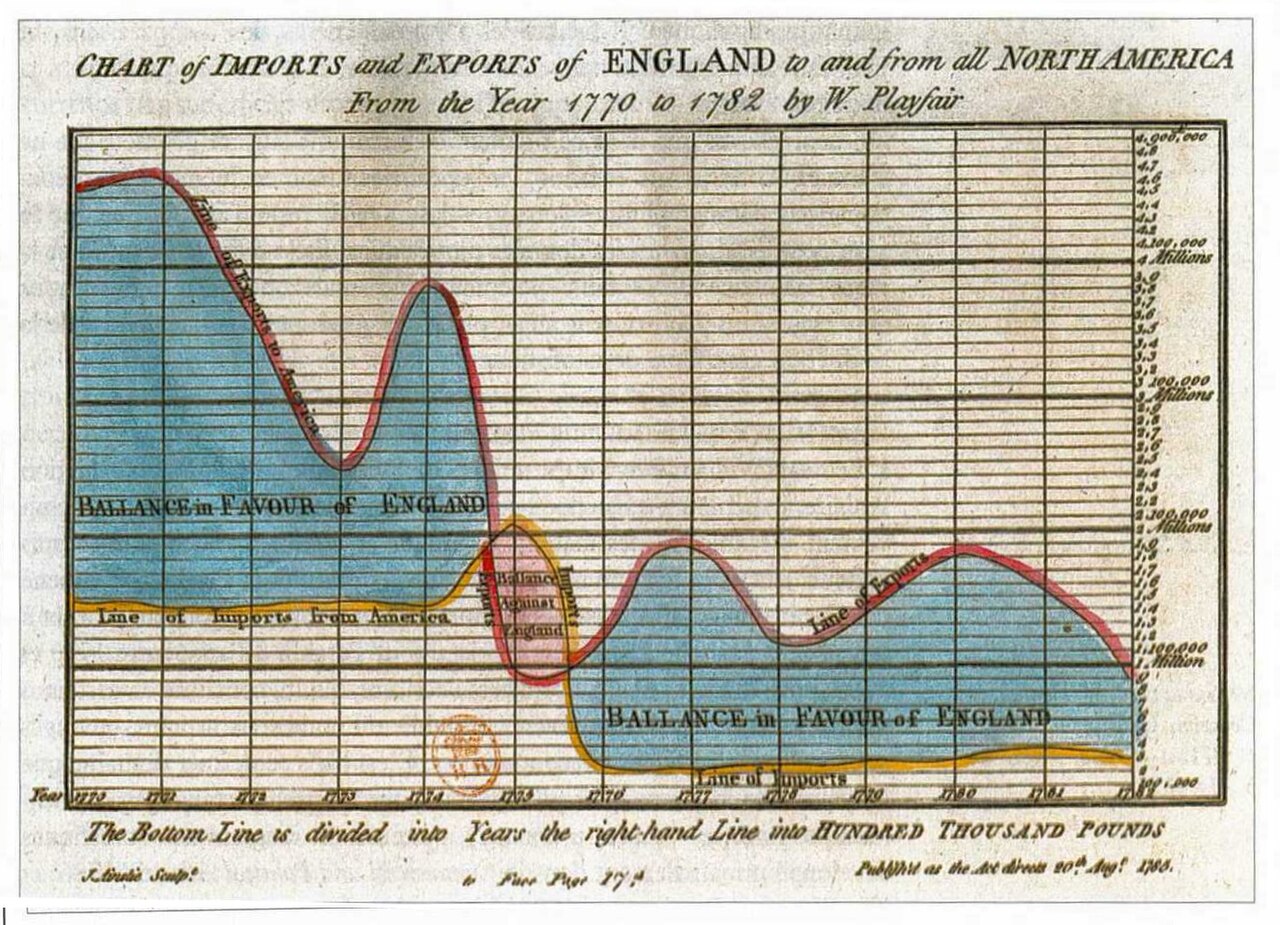
1786 Playfair - Chart of import and exports of England to and from all North America from the year 1770 to 1782 · William Playfair · Public Domain Mark 1.0 · Wikimedia Commons

People already knew how to read a map, spotting rises, gaps, and paths at a glance. Charts let them read numbers the same way.
A trend buried in a column of figures suddenly became visible.
Matching Medium to Mind
Look at what these breakthroughs share. Each one matched a problem to a strength people already had.
Playfair used our skill at reading maps. Arabic numerals used our skill at following simple column-by-column steps.
Algebra used our skill at moving symbols by rules.
- Numerals
- Algebra
- Data graphics
The mind did not change. The representation changed to fit the mind.
Using This in Your Own Work
When a problem feels impossible, the trouble may be the representation, not you.
Ask: does this format use a strength I already have? Could a chart, a symbol, or a sketch make the pattern visible?
- Problem feels impossible
- Check the format: Look at how the problem is written down.
- Uses a strength?: Does this format use a skill you already have?
- Try new medium: A chart, a symbol, or a sketch.
- Keep working
- Look again
If not, try a new medium and look again.
Choosing the right representation is one of the most powerful moves for making progress.
Check yourself
Writing ideas down, drawing charts, and using number symbols mainly help people _____
- think thoughts that were impossible to think before
- store ideas they had already fully worked out
Answer: think thoughts that were impossible to think before
External representations let us offload thinking onto paper or other media, so we can think thoughts that were impossible before. They do more than store old ideas.
Putting thinking onto paper lets us _____ work from our heads. Algebra symbols let mathematicians _____ abstract relationships, which was nearly impossible with _____ descriptions.
Answer: Putting thinking onto paper lets us offload work from our heads. Algebra symbols let mathematicians manipulate abstract relationships, which was nearly impossible with verbal descriptions.
Representations let us offload cognition. Algebraic notation made abstract relationships easy to manipulate, unlike long verbal (word-only) descriptions.
Long ago, Europe used Roman numerals (like XLVII). Over time, people switched to Arabic numerals (like 47). What was the main reason for the switch?
- They made doing math with numbers much easier
- They looked more modern on paper
- They were required by church rules
- They were older and more trusted
Answer: They made doing math with numbers much easier
Arabic numerals made calculation tractable. Adding or multiplying with Roman numerals is very hard, so the new way of writing numbers changed what people could actually do with them.
Keep going
This is lesson 1 of 21 in The Humane Representation of Thought. Next up:
- Media Specialization Cost
- The Cage Metaphor
- Computer Limitations
- Modes of Understanding
- Intelligence Frameworks
Wondering turns any topic into short lessons you can read, watch, or listen to, with practice questions and an AI tutor.