Free sample lesson · The Great Mental Models Volume 4
Scarcity
Why can't we have everything we want?
Lesson 1 of the Wondering course The Great Mental Models Volume 4
Why We Cannot Have Everything
You want a new phone, a trip, and more free time. Your money and hours run out long before your wish list does.
That gap has a name: scarcity. Resources are limited, but our wants keep growing.
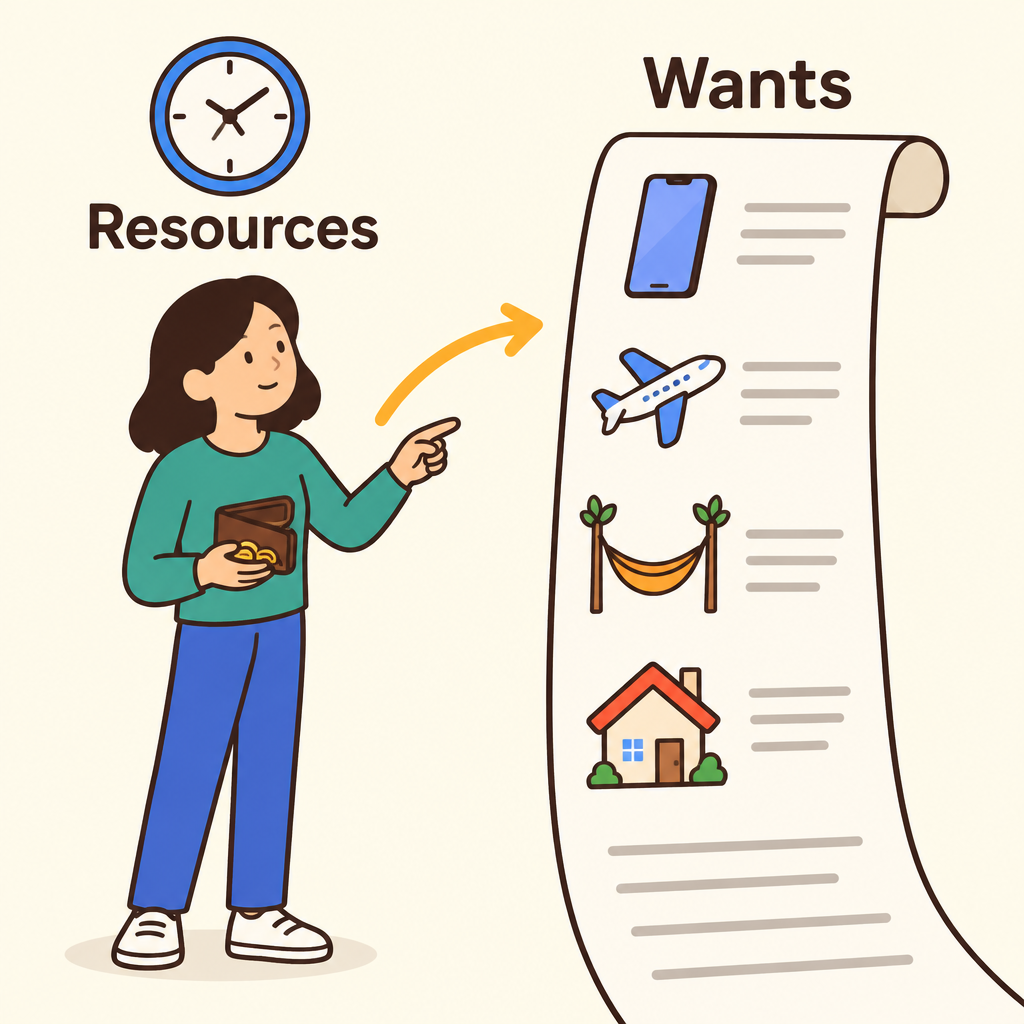
Notice how the small pile of money and the single clock cannot cover the long list of wants, so the person must choose.
Economics exists because of this problem. Individuals, groups, and whole societies must decide how to allocate scarce resources to meet limitless needs.
Scarcity forces prioritization. Using a resource one way means you cannot use it another way.
Scarcity Is More Than Money
When people hear scarcity, they often picture money or materials. Those are tangible resources you can touch and count.
Scarcity also covers intangible resources. Time, attention, energy, expertise, and relationships are all limited.
- Scarce resources
- Tangible: Things you can touch and count.
- Money
- Materials
- Intangible: Limited, but you cannot hold them.
- Time
- Attention
- Energy
- Expertise
A manager with a full budget may still lack the hours or focus to finish a project.
Look for both kinds in your own work.
Time: The Universal Limit
Time is perhaps the most universally scarce resource.
Even billionaires cannot buy more hours in a day. Money can buy help or speed, but the day itself does not get longer.
Attention works the same way. Each hour you spend on one task is an hour you cannot spend elsewhere.
This is why every decision involves a trade-off: you give up one thing to get another.
How Scarcity Shapes Prices
When resources are genuinely limited, markets develop ways to allocate them. The main tool is price, which helps decide who gets what.
Understanding scarcity helps you predict how people and markets respond when availability changes.
During crises like pandemics or natural disasters, some resources suddenly become scarce. Those become the most valuable.
- Availability drops: A crisis makes a resource harder to find.
- Value rises: The scarce resource becomes more valuable.
- Price allocates: Price helps decide who gets what.
- People prioritize: People focus on what they truly need.
Ask: what is getting harder to find? Expect its value to rise and people to prioritize what they truly need.
When Scarcity Is Created on Purpose
Not all scarcity is natural. Artificial scarcity is created on purpose to increase perceived value.
Luxury brands deliberately keep supply limited. This preserves exclusivity and supports high prices.
Genuine scarcity comes from real limits on resources. Artificial scarcity comes from a choice to limit.
- Genuine scarcity
- Artificial scarcity
When something feels rare, ask whether the limit is real or designed.
Scarcity Sparks Innovation
Scarcity is a problem, and problems push people to find new solutions.
The printing press reduced the scarcity of information. Knowledge that was once hard to get could reach far more people.

Gutenberg's printing press in the Gutenberg Museum, Mainz, Germany (48988292696) · dronepicr · CC BY 2.0 · Wikimedia Commons
This fundamentally changed how knowledge was distributed.
Addressing scarcity drives innovation. When a resource is limited, someone has a reason to find a way around the limit.
Putting Scarcity to Work
Scarcity is the fundamental economic problem: limited resources, limitless wants.
Use it as a lens. When you face a decision, name the scarce resource first.
Then check what you give up, whether the limit is real or created, and how a change in availability might shift behavior.
You will see trade-offs everywhere, because they cannot be avoided.
Check yourself
Even a billionaire cannot buy more hours in a day. This shows that scarcity applies to _____
- both tangible and intangible resources
- only money and physical goods
Answer: both tangible and intangible resources
Scarcity is not limited to material goods. Time, attention, energy, and expertise are also limited. Time may be the most universally scarce resource, since no amount of money creates more of it.
Economics exists because people must allocate _____ resources to meet _____ needs.
Answer: Economics exists because people must allocate scarce resources to meet limitless needs.
The central economic problem is a mismatch: resources are limited (scarce), while human wants and needs are effectively without limit. This mismatch is why choices must be made.
Maya has 3 free hours tonight. She wants to study, see friends, and watch a movie, but each takes 3 hours. What does scarcity tell us about her situation?
- She must prioritize and give up some options
- She can do all three if she plans well
- Scarcity does not apply because time is not money
- She faces no trade-off since all options are free
Answer: She must prioritize and give up some options
Because her time is limited, Maya must prioritize. Choosing one activity means giving up the others. This is a trade-off. Scarcity applies to time, so the fact that the activities are not physical goods does not change this.
Keep going
This is lesson 1 of 24 in The Great Mental Models Volume 4. Next up:
- Supply and Demand
- Trade-offs
- Opportunity Cost
- Market Competition
- Creative Destruction
Wondering turns any topic into short lessons you can read, watch, or listen to, with practice questions and an AI tutor.