Free sample lesson · The Great Mental Models Volume 3
Balancing Loops
Why does your room temperature stay comfortable even though outside weather changes constantly?
Lesson 1 of the Wondering course The Great Mental Models Volume 3
Why Your Room Stays Comfortable
Outside, the weather swings from cold mornings to hot afternoons. Inside, your room stays comfortable.
The quiet hero is the thermostat. It keeps checking the temperature and nudging it back toward your setting.
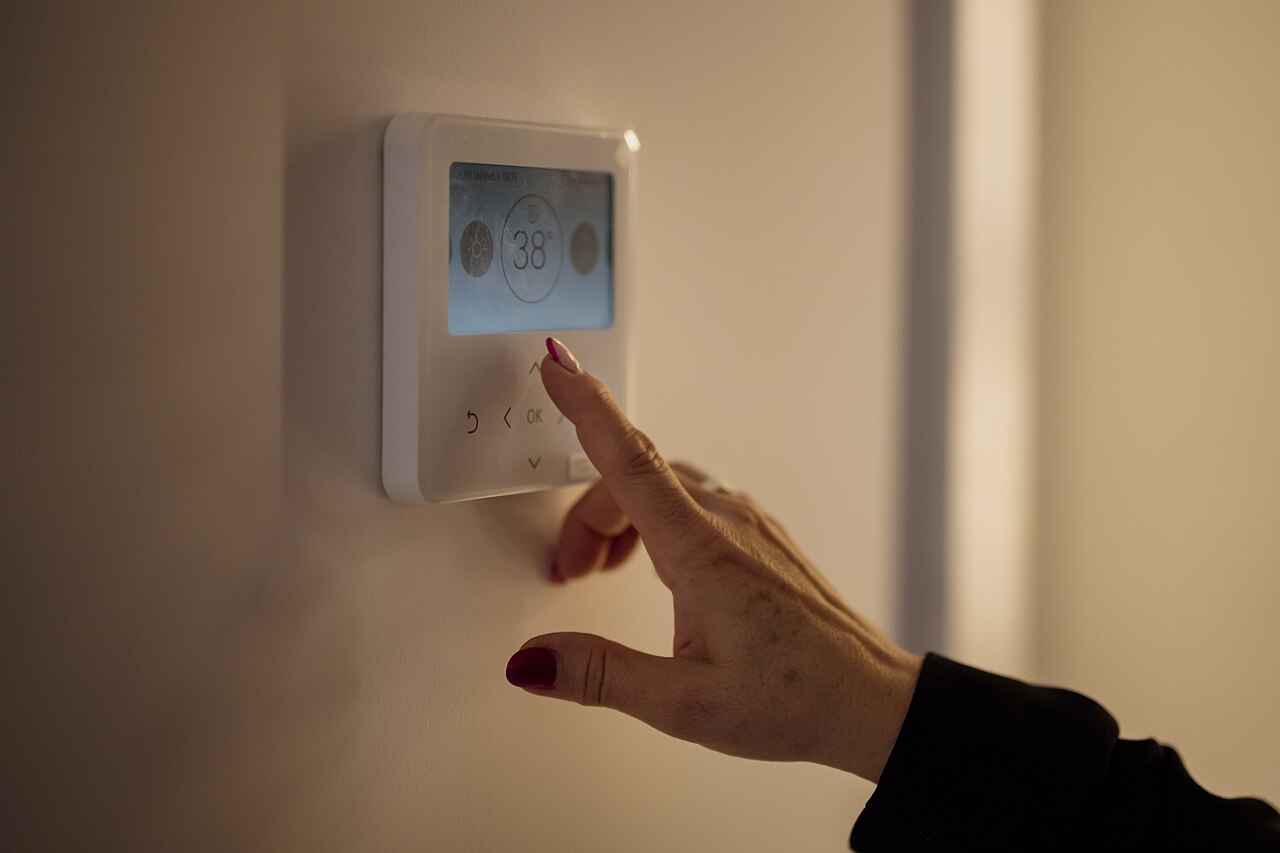
Adjusting the temperature on a thermostat in a home setting · Shixart1985 · CC BY 2.0 · Wikimedia Commons
This is a balancing feedback loop: a system that uses information about itself to steer toward a goal.
Once you spot this pattern, you will start seeing it in homes, organizations, and society.
The Cycle Behind the Loop
Every balancing loop runs the same basic cycle.
- Sense: Read the current temperature.
- Compare: Check the reading against the desired setting.
- Adjust: Turn heating or cooling on to close the gap.
First, the thermostat senses the current temperature. Then it compares that reading to the desired setting.
Next, it adjusts heating or cooling to close the gap.
Then it senses again. The cycle never stops, so the room keeps correcting itself.
The Gap Drives Everything
A balancing loop reacts to the gap between where things are and where they should be.
Room too cold? The gap tells the system to heat. Room too warm? It switches to cooling.
- Set desired temperature
- Read room temperature
- Matches the setting?
- Heat or cool: Heat if too cold, cool if too warm.
- Hold steady: No gap means nothing to correct.
- Check again
- Keep watching
When the gap closes, there is nothing left to correct.
This is why the system settles at equilibrium, a steady state near the goal.
Balancing vs Reinforcing Loops
Feedback loops come in two basic types.
Balancing loops resist change. They pull a system back toward a goal, like a thermostat holding a temperature.
Reinforcing loops amplify change. Growth feeds more growth, as with compound interest or viral growth.
- Balancing loop
- Reinforcing loop
Quick test: does the loop push things back toward a target, or push them further away?
Balancing Loops in Society
Balancing loops are not limited to machines.
The justice system gives feedback on behavior through criminal judgments and penalties.
Those penalties discourage certain actions, pulling behavior back toward what society expects.
The structure matches the thermostat: a goal, a signal about the current state, and a correction.
Spotting Balancing Loops
You can find balancing loops in your own work by asking a few questions.
- Name the goal: Identify the desired state the system aims for.
- Find the signal: Spot how the system learns its current state.
- Find the correction: See what action closes the gap.
- Predict: Expect the system to push back toward its goal.
What is the goal? How does the system know its current state? What closes the gap?
If you can answer all three, you have found a balancing loop.
Now you can predict its response to change: it will push back toward its goal. You can also design systems that correct themselves.
Check yourself
A feedback loop that constantly adjusts a system toward a goal or equilibrium is called a _____ feedback loop
- balancing
- reinforcing
Answer: balancing
Balancing loops self-correct toward a target state, like a thermostat holding a set temperature. Reinforcing loops instead amplify change, as in compound interest or viral growth.
Feedback loops come in two types: a _____ loop keeps a system near equilibrium, like a thermostat, while a _____ loop amplifies change, like compound interest.
Answer: Feedback loops come in two types: a balancing loop keeps a system near equilibrium, like a thermostat, while a reinforcing loop amplifies change, like compound interest.
Balancing loops counteract deviations to hold a system steady. Reinforcing loops feed change back into more of the same change, causing growth or decline to accelerate.
In a balancing feedback loop, what determines how the system adjusts its behavior?
- The gap between the current state and the desired state
- How much the current state grew in the last cycle
- The total amount of change accumulated over time
- A fixed schedule that ignores the current state
Answer: The gap between the current state and the desired state
A balancing loop measures the difference between where the system is and where it should be, then acts to shrink that difference. When the gap closes, the corrective action eases off.
Keep going
This is lesson 1 of 25 in The Great Mental Models Volume 3. Next up:
- Reinforcing Loops
- Equilibrium
- Bottlenecks
- Scale
- Margin of Safety
Wondering turns any topic into short lessons you can read, watch, or listen to, with practice questions and an AI tutor.