Free sample lesson · The Great Mental Models Volume 2
Relativity
Ever wonder why smart people disagree so strongly?
Lesson 1 of the Wondering course The Great Mental Models Volume 2
Why Smart People Disagree
Two smart people look at the same facts and reach opposite conclusions. Often neither one is careless.
They are simply standing in different places.
That idea has a name: relativity.
All observations depend on the observer's frame of reference, the position from which they look. What seems true from one vantage point may look completely different from another.
Einstein's Big Discovery
The idea comes from physics. Einstein's theory of relativity showed there is no absolute frame of reference.
Our sense of movement, distance, and even time depends on our position and speed relative to what we observe.
Picture a passenger on a moving train. To her, the cup on her table sits still. To someone on the platform, that same cup races past.
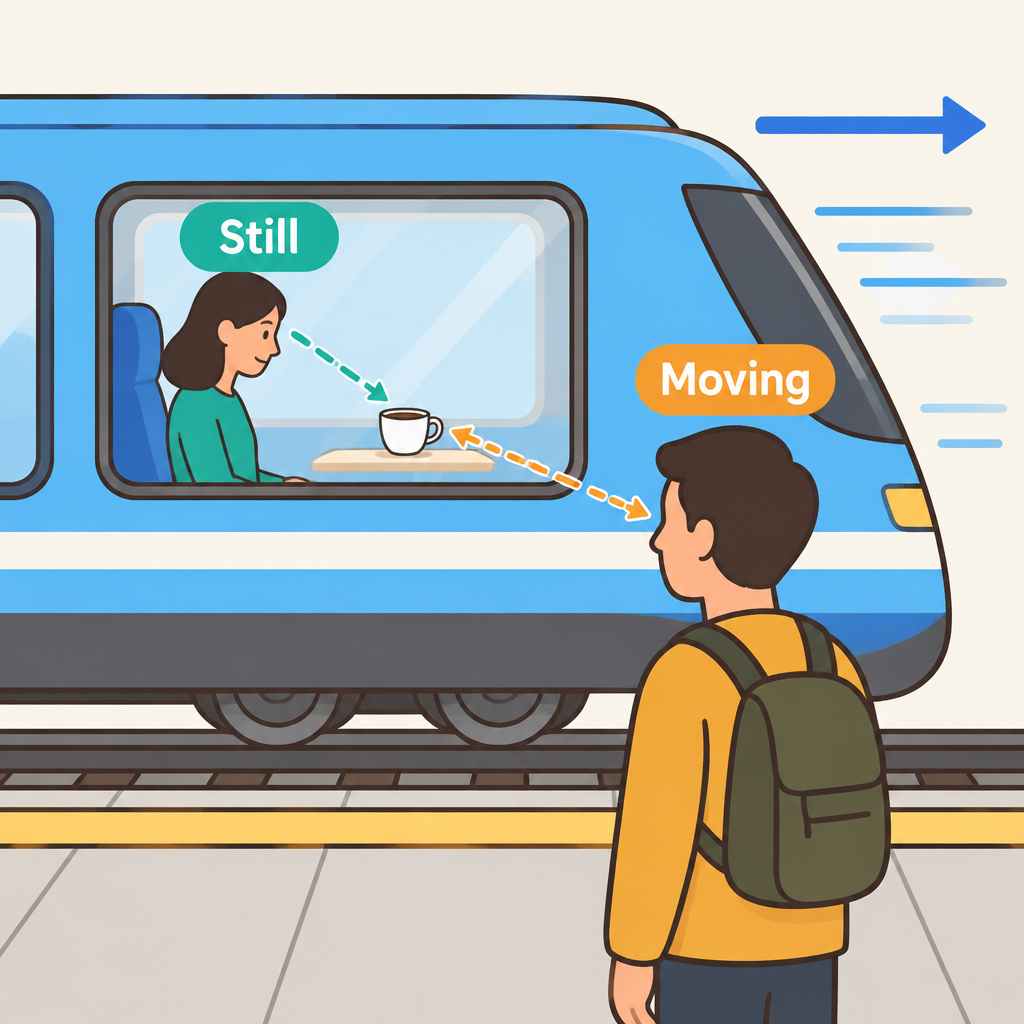
Notice that both people watch the same cup, yet the passenger sees it resting while the platform observer sees it moving fast.
Both observations are correct. Each one is relative to the observer.
What Shapes Your Frame
The same rule applies to how we understand everyday situations.
Your view is shaped by your unique perspective, your experiences, your background, and your position within the system you are observing.
- Your frame of reference: Where your view comes from.
- Perspective: Your unique angle on the situation.
- Experiences: What has happened to you before.
- Background: Where you come from.
- Position in system: Your spot inside what you observe.
A manager and a new employee can sit in the same meeting and leave with very different stories. Each saw it from a different spot in the team.
Nobody sees from nowhere. Everyone has a frame.
Step Into Their Frame
When you disagree with someone, the natural move is to defend your view as the single correct one.
Relativity suggests a better move: shift your frame of reference and look at the situation from their vantage point.
Ask what they can see from where they stand. Their position, experiences, and background may reveal things you missed.
You do not have to agree. You do have to look.
- Notice your frame: Recognize that your view comes from where you stand.
- Find their vantage: Ask where the other person is standing.
- Look from there: Consider their position, experiences, and background.
- Compare views: Note what they see that you missed.
Many Views, Fuller Picture
Insisting on one fixed view shows you only one side.
The most complete understanding comes from examining a situation from multiple perspectives. Each one reveals a different part of the truth.
- One fixed view
- Multiple perspectives
One caution: relativity does not mean all perspectives are equally valid. Some views rest on better evidence or a clearer vantage point.
The goal is to recognize the role of perspective, then judge carefully.
Context Always Matters
Relativity reaches far beyond physics. Context always matters.
Moral judgments: an action can look right from one frame and wrong from another.
Cultural norms: what feels normal in one culture may seem strange in another.
Historical events: the same event can read as victory or loss depending on who tells it.
Business strategies: a move can look smart from one position and risky from another.
Before a hard call, ask: whose frame am I missing?
Check yourself
Two coworkers disagree about a new office policy. One says it saves time, the other says it adds work. Applying relativity, the best first step is to _____
- understand where each person sits in the situation and why it looks different from there
- decide which single view is the correct one and convince the other to drop theirs
Answer: understand where each person sits in the situation and why it looks different from there
Relativity suggests shifting your frame of reference to see the situation from the other person's vantage point. Insisting on one "correct" view ignores that each position can reveal something different.
Einstein showed there is no _____ frame of reference. As a result, what we measure about movement, distance, and even _____ depends on our position and _____ relative to what we observe.
Answer: Einstein showed there is no absolute frame of reference. As a result, what we measure about movement, distance, and even time depends on our position and speed relative to what we observe.
Relativity says there is no universal frame of reference; measurements of movement, distance, and time depend on the observer's position and speed.
You sit on a train moving at a steady speed. A cup of coffee rests on the table in front of you. Is the cup moving?
- It depends: still to you, but moving to someone on the platform
- Yes, it is truly moving, and you are simply mistaken
- No, it is truly still, and the person on the platform is mistaken
- Neither can say, because motion cannot be measured at all
Answer: It depends: still to you, but moving to someone on the platform
Motion depends on the frame of reference. To you on the train, the cup is still; to someone standing on the platform, it rushes past with the train. There is no single absolute answer.
Keep going
This is lesson 1 of 25 in The Great Mental Models Volume 2. Next up:
- Reciprocity
- Energy Conservation
- Entropy
- Inertia
- Friction
Wondering turns any topic into short lessons you can read, watch, or listen to, with practice questions and an AI tutor.