Free sample lesson · The Fabric of Reality
Four Strands
What if four seemingly unrelated scientific theories are actually one unified explanation of everything?
Lesson 1 of the Wondering course The Fabric of Reality
One Theory, Four Strands
Physicist David Deutsch makes a bold claim: four big theories belong together.
They are quantum physics, epistemology (the theory of knowledge), computation, and evolution. Most people file them in separate drawers.
Deutsch weaves them into one coherent explanatory structure. He calls them the four strands.
Quantum physics uses the many-worlds interpretation. Epistemology uses Popper's theory of knowledge.
Computation uses quantum computation and the Turing principle. Evolution uses Dawkins' refinement of Darwinian theory.
- Deutsch's theory: One coherent explanatory structure.
- Quantum physics: Many-worlds interpretation.
- Epistemology: Popper's theory of knowledge.
- Computation: Quantum computation and the Turing principle.
- Evolution: Dawkins' refinement of Darwinian theory.
Not Everything Is Particles
A common view says everything reduces to particle physics. Explain the smallest parts, and you have explained it all.
Deutsch disagrees.
His view is emergentist: explanations at higher levels, like knowledge or life, are real and needed.
- Reductionism
- Emergentism
In his structure, no single strand is the foundation. The four strands support each other.
Think of a rope. No one strand holds the weight alone.
Many Universes Tie It Together
The quantum strand uses the many-worlds interpretation. It says reality contains many universes, not just one.
Deutsch treats this multiplicity of universes as the key that unifies all four strands.
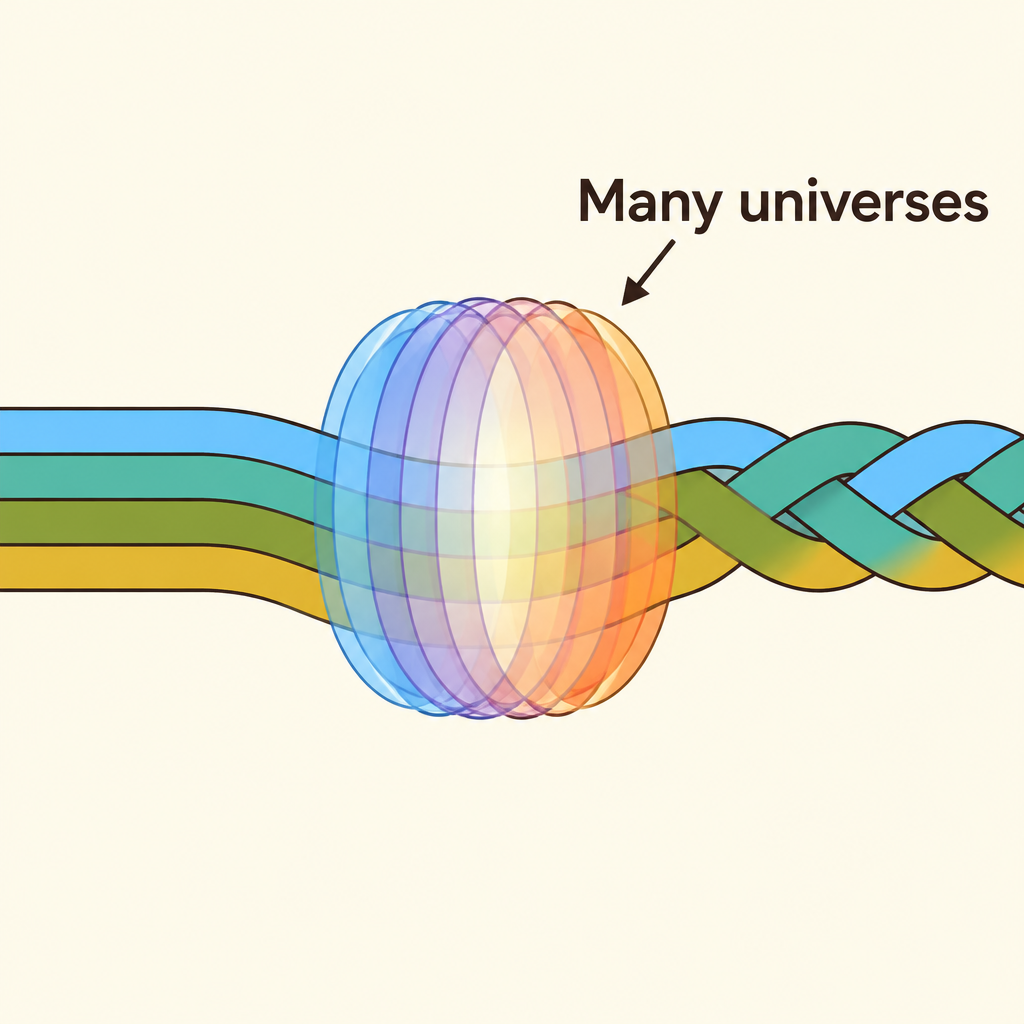
Notice that all four strands pass through the same central knot of stacked universes, which is what holds them together as one rope.
Each of the other strands is then understood against this larger picture of reality.
It is the most surprising part of the theory. It is also its centerpiece.
The Other Three Strands
Epistemology comes from Karl Popper. It explains how knowledge grows: we make guesses, then criticize and test them.
Computation draws on quantum computation and the Turing principle, which concerns what physical machines can compute.
Evolution follows Richard Dawkins' refinement of Darwin, which focuses on genes as replicators.
- Epistemology
- Computation
- Evolution
Each looks like a separate field. Look closer, and each leans on the others.
Why You Need All Four
Here is the striking claim: understanding any one strand requires understanding the other three.
Follow the links. Evolution raises questions about knowledge. Knowledge depends on what can be computed. Computation depends on physics.
- Quantum physics
- Epistemology
- Computation
- Evolution
So the four strands form a web, not a ladder.
At the center, the multiplicity of universes unifies them all.
Putting the Idea to Work
You can now spot this idea in your own thinking.
When an explanation sits in one field, ask which of the other strands it quietly depends on.
Watch for the reductionist reflex: assuming particle physics alone settles every question.
- Name the strand: Decide which of the four fields the explanation lives in.
- Find hidden links: Ask which other strands it quietly depends on.
- Resist reducing: Do not assume particle physics alone settles it.
- Find the key: Connect it back to the multiplicity of universes.
To explain it to a colleague: four theories, one fabric, held together by many universes.
Check yourself
In Deutsch's worldview, the four strands are best understood _____
- as mutually dependent, each needing the others
- as independent fields, each complete on its own
Answer: as mutually dependent, each needing the others
Deutsch treats the four strands as an interconnected structure: understanding any one requires understanding the other three. They are not independent fields that can be fully grasped in isolation.
Deutsch's four strands each draw on a key theory: quantum physics uses the _____ interpretation, epistemology uses _____ theory of knowledge, computation uses the _____, and evolution uses _____ refinement of Darwin.
Answer: Deutsch's four strands each draw on a key theory: quantum physics uses the many-worlds interpretation, epistemology uses Popper's theory of knowledge, computation uses the Turing principle, and evolution uses Dawkins' refinement of Darwin.
Quantum physics → many-worlds interpretation; epistemology → Popper's theory of knowledge; computation → quantum computation and the Turing principle; evolution → Dawkins' refinement of Darwinian theory.
Which idea does Deutsch treat as the key to unifying the four strands into one coherent whole?
- The multiplicity of universes
- Natural selection of genes
- Falsification of theories
- Universal Turing machines
Answer: The multiplicity of universes
The multiplicity of universes, from the many-worlds interpretation of quantum physics, is the key that ties quantum physics, knowledge, computation, and evolution together.
Keep going
This is lesson 1 of 24 in The Fabric of Reality. Next up:
- Multiverse Unifies
- Shadow Photons
- Observer-Relative Tangibility
- Double-Slit Mystery
- Quantum Computers
Wondering turns any topic into short lessons you can read, watch, or listen to, with practice questions and an AI tutor.