Free sample lesson · The Early Story of Stripe
Auctomatic Was an Education
What did Auctomatic teach before Stripe existed?
Lesson 1 of the Wondering course The Early Story of Stripe
Auctomatic Was an Education
Discover how Patrick and John Collison turned an early acquired startup into earned pattern recognition for Stripe.
The Education Before the Breakthrough
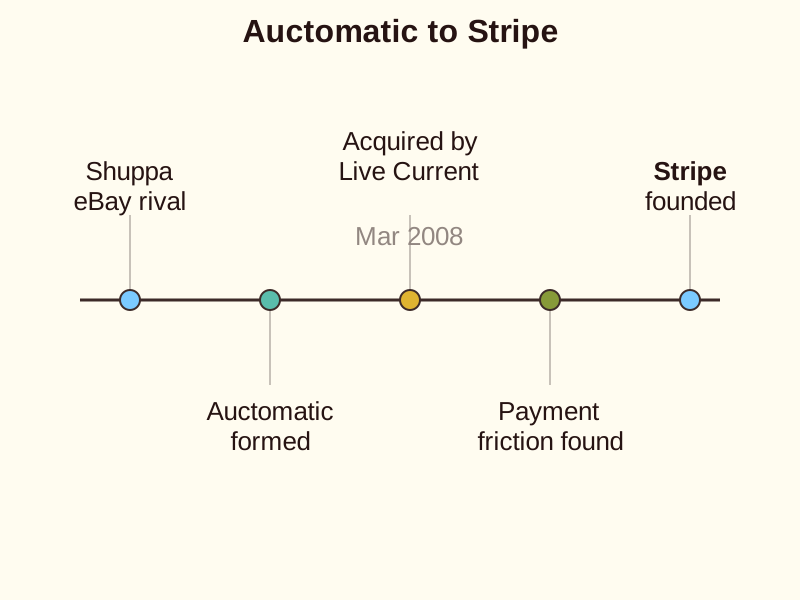
Before Stripe became a global payment giant, Patrick and John Collison built Auctomatic. This early startup focused on tools for eBay sellers.
It was not a massive success that changed the world. Instead, it served as a high-speed education in how startups actually function.
They learned about Y Combinator, fundraising, and the mechanics of online commerce. This experience built the foundation for their later work.
- Build & Launch: Build tools for eBay sellers to experience real market operations firsthand.
- Absorb Mechanics: Learn Y Combinator, fundraising, and online commerce fundamentals.
- Foundational Shift: Use the operational experience as a stepping stone for future ventures.
Earned Pattern Recognition
Auctomatic gave the brothers a front-row seat to customer friction. They saw how difficult it was for small businesses to manage online sales.
In March 2008, Live Current Media acquired the company. The deal included 2 million USD in cash and 3 million USD in shares.
While the exit was successful, the real value was the earned pattern recognition. They identified problems that only become visible when you are already building in the market.
- The Acquisition
- The Real Value
The Hidden Friction of Payments
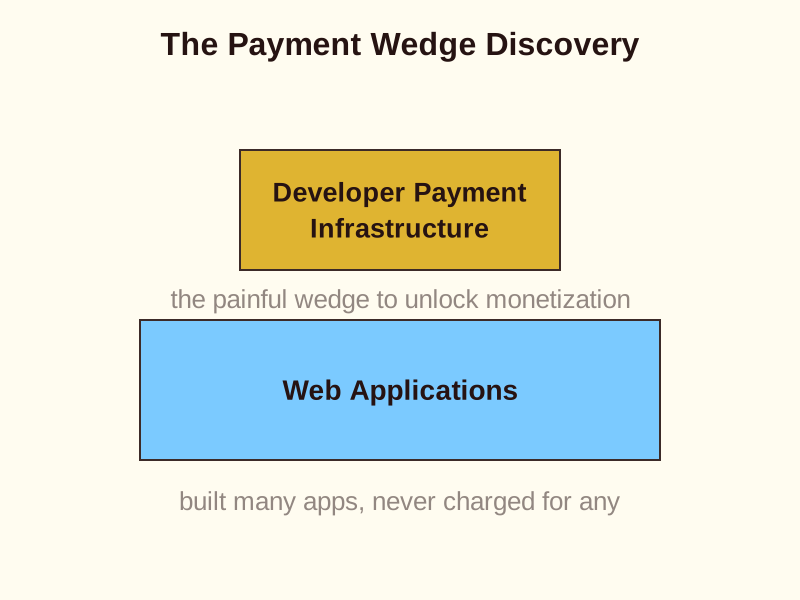
The Collisons realized a strange truth during their early projects. They had built many web applications but had never successfully charged for any of them.
Setting up payments was a nightmare for developers. This specific pain point was the developer-experience wedge they needed.
They separated the lessons of startup mechanics from the evidence of which market was actually right.
Strategic Learning Over Market Proof
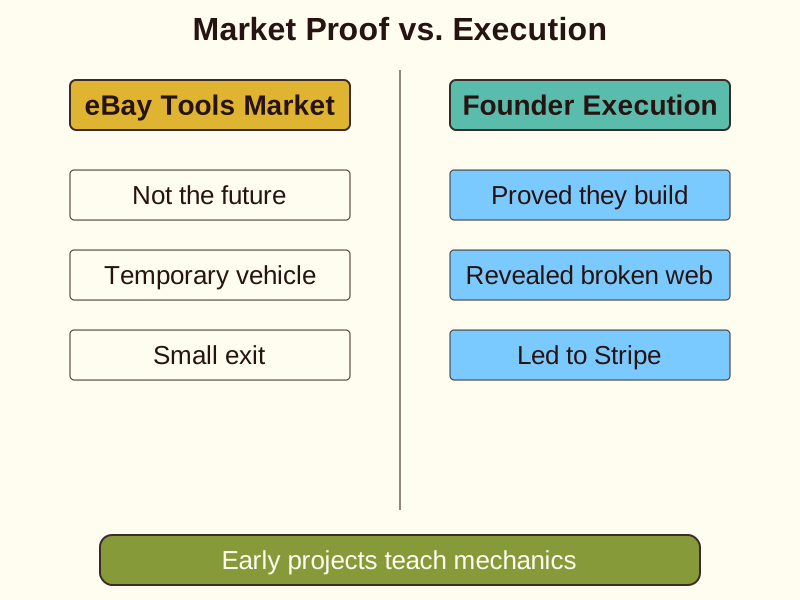
A common mistake is believing a previous exit proves a founder found the perfect market. Auctomatic did not prove the eBay tool market was the future.
It proved the founders could execute. It also revealed a deeper, unsolved problem: the infrastructure of the internet was broken.
Use your early projects to learn the mechanics. Do not mistake a small win for proof that your first idea is the final destination.
Putting It All Together
- Build & Exit: Build an early product to learn startup mechanics and fundraising.
- Isolate Friction: Separate the skill of execution from the specific product market.
- Find the Wedge: Identify a deeply frustrating infrastructure problem that customers desperately need solved.
Check yourself
A financial acquisition of an early-stage startup proves that the founders _____.
- could execute effectively in a market
- validated the perfect long-term market
Answer: could execute effectively in a market
An acquisition demonstrates execution capability and operational learning, but it does not guarantee that the original product market was the optimal long-term opportunity.
In the startup learning journey, founders first _____ to learn core mechanics, next _____ from market choices, and finally _____ to solve deeper problems.
Answer: In the startup learning journey, founders first build early products to learn core mechanics, next isolate execution lessons from market choices, and finally identify infrastructure wedges to solve deeper problems.
Founders move from building initial products to isolating practical mechanics from market proof, which allows them to target larger infrastructure pain points.
Which specific friction point did the Collison brothers experience during their early web projects that revealed the opportunity for Stripe?
- Setting up online payments was a complex nightmare for developers.
- Managing inventory across online marketplaces was too slow.
- Securing seed funding required an established corporate presence.
- Building user authentication systems required too much custom backend code.
Answer: Setting up online payments was a complex nightmare for developers.
Despite building several web applications, the founders noticed they had never successfully charged for them because setting up online payment processing was extraordinarily difficult for developers.
Keep going
This is lesson 1 of 7 in The Early Story of Stripe. Next up:
- Payments Became the Problem
- Prototype Before Certainty
- Seven Lines Hid the System
- Install the Customer Now
- Hidden Work Became the Moat
Wondering turns any topic into short lessons you can read, watch, or listen to, with practice questions and an AI tutor.