Free sample lesson · The Dream Machine
The Psychologist Who Reimagined Computers
How did a pitch-perception psychologist, not an engineer, reset what computers were for?
Lesson 1 of the Wondering course The Dream Machine
What You Will Learn
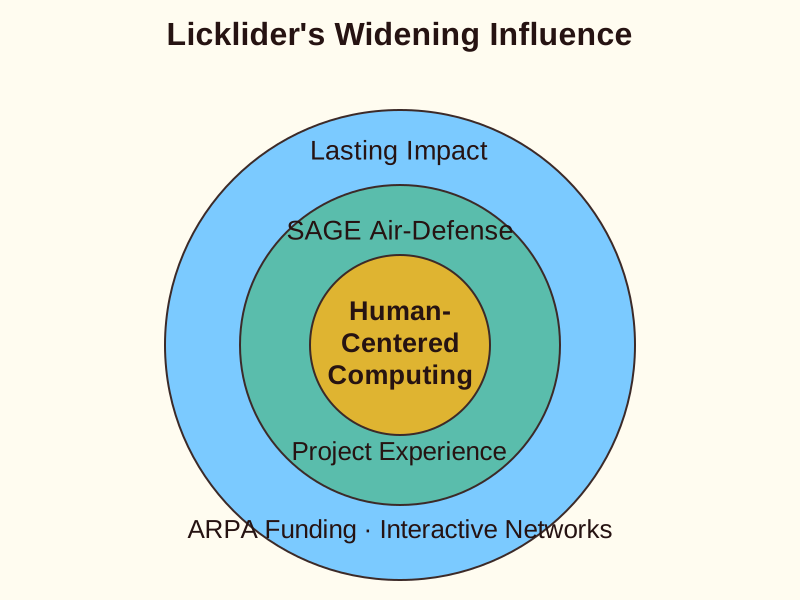
Seeing Licklider as a human-factors psychologist explains why he framed computing around people instead of hardware, the move that made the rest possible.
The Psychologist in the Lab
In the 1950s, most people viewed computers as giant, fast calculators. They were machines built for crunching numbers and solving physics equations.
J.C.R. Licklider saw them differently. He was not a hardware engineer or a programmer.
Licklider was a psychologist. He held a triple major in physics, math, and psychology from 1937. He later earned a PhD in psychoacoustics in 1942.
- Traditional View
- Licklider's View
Thinking Beyond the Hardware
Because of his background, Licklider focused on how humans process information. He did not care about raw calculating power alone.
He judged a computer by how well it served the human mind. This was a radical shift in perspective.
While others built faster circuits, Licklider asked how machines could help people think. He wanted to create a partner for the human brain.
Lessons from the SAGE Project
Licklider led the human-factors team for the SAGE air-defense project. This was a massive military effort to track aircraft.
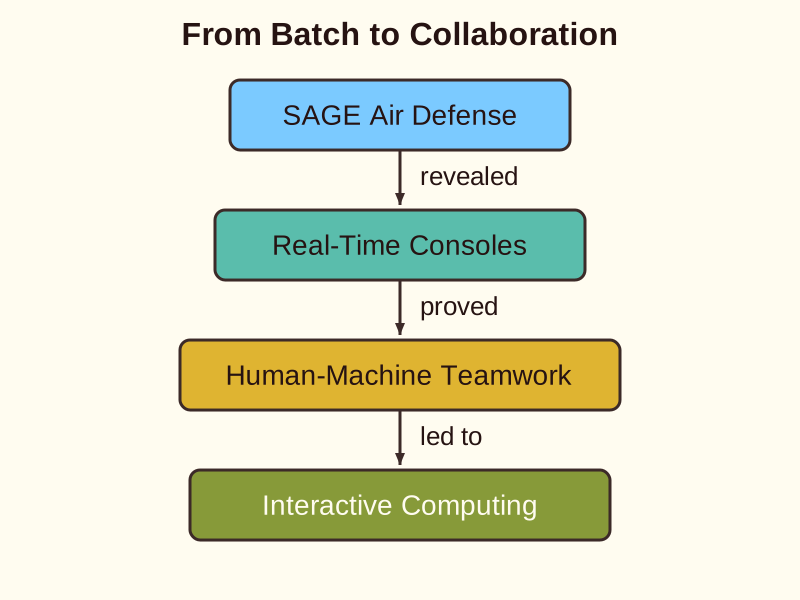
At SAGE, he saw people and machines working together at consoles in real time. It was an early glimpse of interactive computing.
This experience proved that computers could be more than batch processors. They could be tools for active, human-centered collaboration.
The Visionary Funding Power
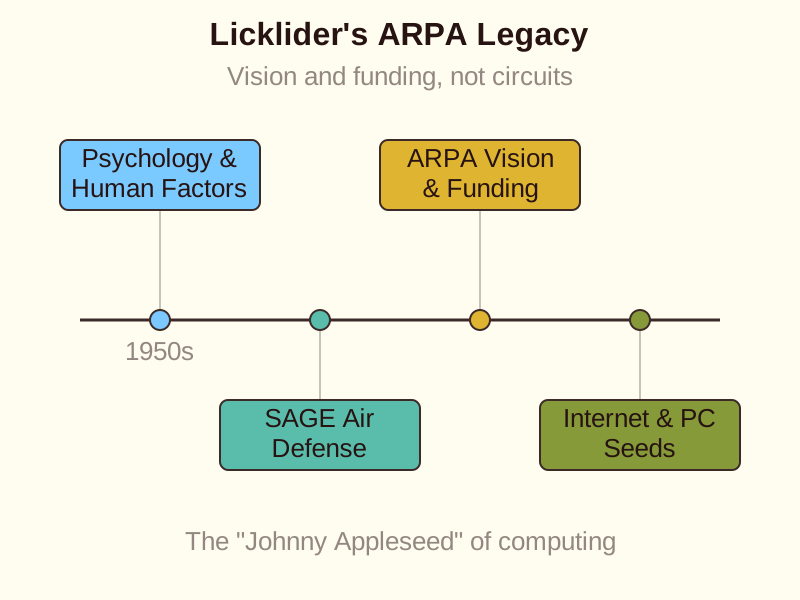
Licklider did not design circuits or write operating systems. His true leverage was vision and funding.
He became a key figure at ARPA, where he funded the research that led to the internet and personal computers.
He is often called the Johnny Appleseed of computing. He planted the ideas that allowed the modern digital world to grow.
Putting It All Together
- Shift Perspective: Look past raw technical specifications to focus on human needs.
- Prototype in Practice: Observe real-time interaction in complex operational environments.
- Fund the Future: Use strategic institutional positioning to turn visionary ideas into reality.
Check yourself
Before turning to computing, J.C.R. Licklider was primarily trained as a _____.
- psychologist
- hardware engineer
Answer: psychologist
Licklider was a psychologist and psychoacoustician, which led him to focus on human factors rather than just hardware engineering.
In the 1950s, the traditional view saw computers as _____ for crunching numbers, while Licklider viewed them as _____ for the human mind.
Answer: In the 1950s, the traditional view saw computers as calculators for crunching numbers, while Licklider viewed them as partners for the human mind.
This shift moved the focus from raw mathematical power to interactive tools that amplify human thinking.
Why did Licklider's background in psychology change how he judged computer quality?
- He focused on how well the machine served human thinking.
- He focused on making the vacuum tubes run at higher speeds.
- He focused on reducing the physical size of the hardware.
- He focused on making computers cheaper for schools to buy.
Answer: He focused on how well the machine served human thinking.
Because he studied how humans process information, he cared more about the interface and utility for the mind than the speed of the circuits.
Keep going
This is lesson 1 of 8 in The Dream Machine. Next up:
- Man-Computer Symbiosis
- The First Real-Time Machine
- Computing as a Utility
- The Freedom to Make Mistakes
- The Intergalactic Computer Network
Wondering turns any topic into short lessons you can read, watch, or listen to, with practice questions and an AI tutor.