Free sample lesson · The Black Swan: The Impact of the Highly Improbable
What Makes a Black Swan
One black swan overturned millions of white-swan sightings. What else can one sighting break?
Lesson 1 of the Wondering course The Black Swan: The Impact of the Highly Improbable
The Sighting That Broke a Rule
Could millions of observations still be wrong?
People once treated white-swan sightings as proof that all swans were white. One black swan invalidated that general claim.[[1]](https://www.nytimes.com/2007/04/22/books/chapters/0422-1st-tale.html)
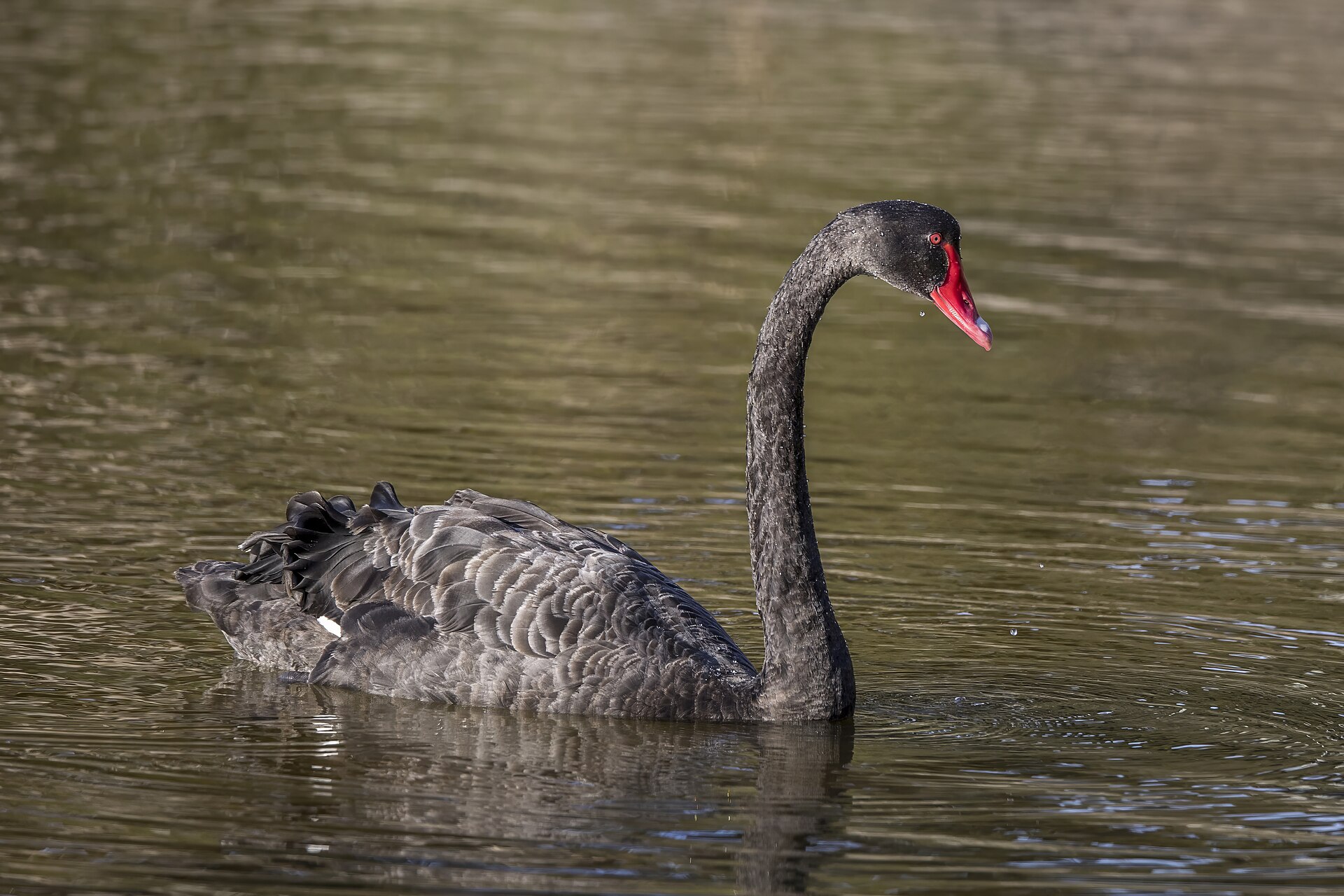
A black swan in Australia: one sighting of a bird like this was enough to overturn the old belief that all swans are white. · Photo: Charles J. Sharp, Wikimedia Commons, CC BY-SA 4.0 · CC BY-SA

The image shows why evidence is uneven: confirmations can accumulate, yet one contrary observation can overturn the rule.
- Where the phrase comes from
Three Tests, One Label
What turns a surprise into a Black Swan?
It must pass three tests: it falls outside regular expectations, produces extreme impact, and becomes explainable only afterward.[[1]](https://www.nytimes.com/2007/04/22/books/chapters/0422-1st-tale.html)
Retrospective means looking back; prospective means looking ahead. Taleb sums up the third test as "retrospective (though not prospective) predictability": the event seems predictable looking back, but was not predictable looking ahead.
Once the outcome is known, people build a convincing story around it.
- Black Swan: A surprise earns the label only by passing every test.
- Outside expectations: Falls outside regular expectations.
- Extreme impact: Produces extreme impact.
- Explained afterward: Explainable only afterward, creating retrospective predictability.
The story makes the event feel predictable in hindsight, although it was not predictable beforehand.
Surprising Does Not Mean Black Swan
A storm surprises nobody after a week of forecasts. It fails the first test because people expected it.
A once-a-decade headline typo is rare, but its impact is small. It fails the second test.
Black Swans can also be positive, including the internet or a drug discovery.[[1]](https://www.nytimes.com/2007/04/22/books/chapters/0422-1st-tale.html)[[3]](https://www.penguinrandomhouse.com/books/176226/the-black-swan-second-edition-by-nassim-nicholas-taleb/)
Taleb objected when the term became shorthand for any bad surprise.[[4]](https://www.newyorker.com/news/daily-comment/the-pandemic-isnt-a-black-swan-but-a-portent-of-a-more-fragile-global-system)
Checking a Negative Case
Why does 9/11 pass all three tests?
Test one asks whether the event fell outside regular expectations. One way to check is to look at precautions: people guard against the risks they expect, such as by locking cockpit doors.
First, Taleb argued that if the threat had been reasonably conceivable on September 10, 2001, cockpit doors would have been locked, fighter planes would have circled, and the attack would not have happened.[[1]](https://www.nytimes.com/2007/04/22/books/chapters/0422-1st-tale.html) Those precautions were missing, so 9/11 fell outside regular expectations.
Second, its impact included thousands dead, wars, and worldwide security changes.
Third, commissions and commentators explained it afterward. Those later explanations can make the attack seem easier to foresee than it was.
- Test 1: It lay outside expectations; a conceivable threat would have prompted locked cockpit doors and circling fighter planes.
- Test 2: Its impact included thousands dead, wars, and worldwide security changes.
- Test 3: Commissions and commentators explained it afterward, making it seem easier to foresee.
Checking a Positive Case
Could astonishing success count as a Black Swan? The publisher lists Google among its examples.[[3]](https://www.penguinrandomhouse.com/books/176226/the-black-swan-second-edition-by-nassim-nicholas-taleb/)
Test one passes because few expected one search start-up to succeed on that scale. Test two passes because the impact was extreme.
Test three asks whether the event became explainable only after the fact, with a story that makes it seem foreseeable.
So test three passes: the rise now reads as obvious when viewed backward, even though it was not obvious beforehand.
9/11 was a negative Black Swan, a disaster. Google is a positive one, a windfall. The impact runs in opposite directions, but both pass the same three tests: outside expectations, extreme impact, and explainable only afterward.
Challenge the Comfortable Rule
Imagine this made-up rule: the office printer always works in the morning. Many successful mornings support it, but they cannot prove the word always.
One morning failure refutes the rule immediately. That single counterexample outweighs every confirmation because the claim allowed no exceptions.
- Successful mornings
- One failed morning
Apply the same skepticism at work. Ask what observation would break a trusted rule, and avoid depending completely on a history of nothing going wrong.
Check yourself
A storm that people expected after a week of forecasts is _____.
- not a Black Swan
- a Black Swan
Answer: not a Black Swan
It is not a Black Swan because it did not fall outside regular expectations. Being surprising is not enough by itself.
A Black Swan falls outside regular _____, has extreme _____, and is explained only _____.
Answer: A Black Swan falls outside regular expectations, has extreme impact, and is explained only afterward.
All three tests are required. If even one test fails, the event does not qualify as a Black Swan.
A new search company becomes hugely successful, few people expected it, and afterward its success seems obvious because people create convincing explanations. What is it?
- A Black Swan
- A small surprise
- A fully predictable success
- A rare event with little impact
Answer: A Black Swan
It passes all three tests: it was outside expectations, had extreme impact, and became understandable mainly afterward.
Keep going
This is lesson 1 of 11 in The Black Swan: The Impact of the Highly Improbable. Next up:
- Why Stories Fool Us After the Fact
- Silent Evidence: The Unseen Cemetery
- Learning Too Precisely
- Mediocristan and Extremistan
- The Turkey Problem
Wondering turns any topic into short lessons you can read, watch, or listen to, with practice questions and an AI tutor.