Free sample lesson · The Art of Game Design
Designer Self-Knowledge
What if your greatest design tool is knowing who you are?
Lesson 1 of the Wondering course The Art of Game Design
You Are the First Lens
Every game idea passes through one filter before anyone else sees it: you.
Your experiences, passions, and insights shape which ideas excite you, which ones you drop, and how you build the ones you keep.
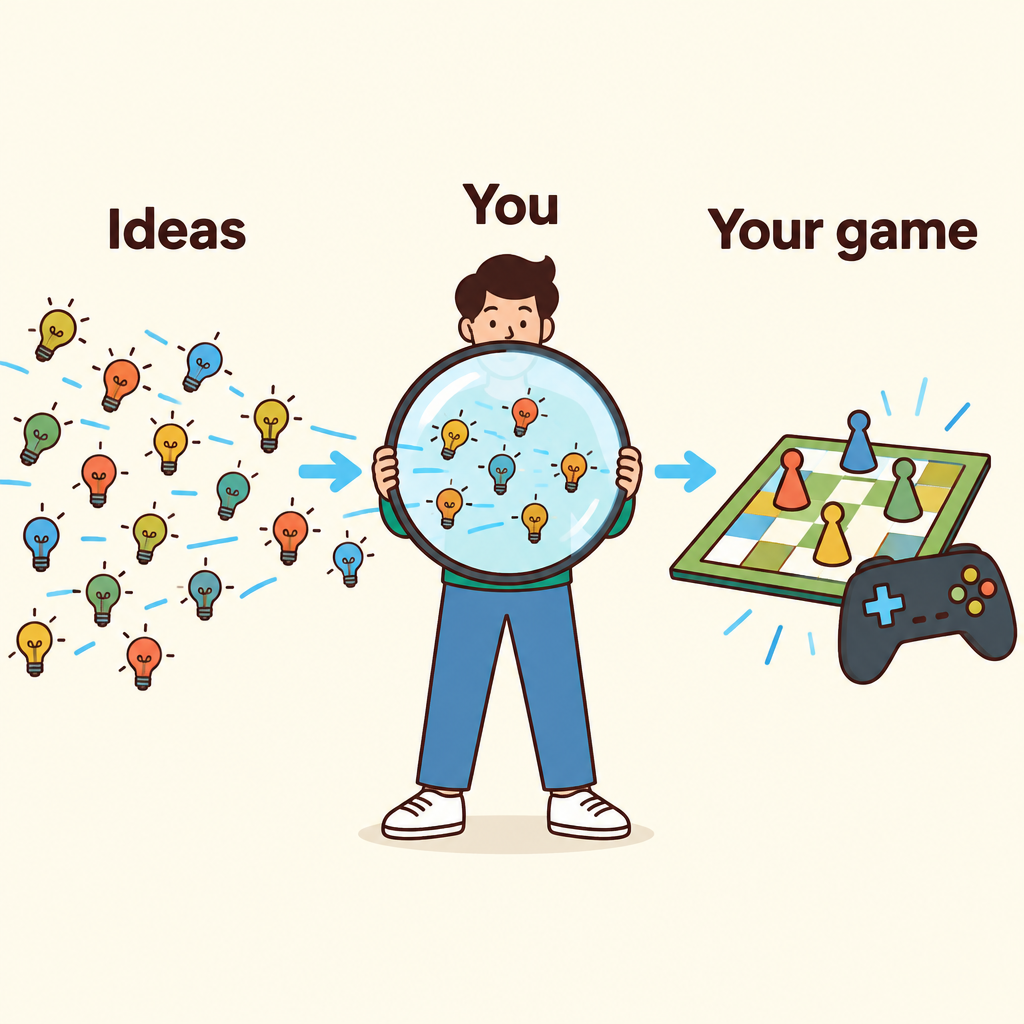
Notice how many scattered ideas enter on the left but only the shaped ones come out the other side, because the designer filters and changes everything that passes through.
That makes self-knowledge your first design tool. Good design asks for more than following formulas or imitating hits.
Your personal artistic impulse, combined with a willingness to view design through multiple lenses, decides how original your work becomes.
Strengths, Weaknesses, Interests
Knowing yourself as a designer means knowing three things.
Your strengths show where you can lean in. Your weaknesses show where you need help, practice, or a simpler plan.
Your genuine interests show which ideas you will actually care about.
Together, these three guide every decision that follows. Skip this step and you end up designing blind, guessing at choices you could have made with confidence.
Passion Fuels Persistence
Making a game is a marathon.
You build something, test it, hit a setback, revise, and try again. This cycle repeats through countless iterations.
- Build: Make a version of your idea.
- Test: See how it actually plays.
- Hit a setback: Something breaks or falls flat.
- Revise: Fix it and try again.
Skill alone rarely carries you through all of that.
Genuine passion for your concept keeps you coming back after yet another broken prototype. Self-knowledge helps you choose ideas you truly care about, so the passion is there when you need it.
Authenticity Over Imitation
Copying a successful game is tempting. It already works, so why not?
Imitation gives you something that already exists. Players have seen it, and you stay one step behind the original.
Authentic design starts from your own vision, experiences, and insights.
- Imitation
- Authentic design
The best designs emerge when you trust your unique perspective. That is where originality comes from.
Study Games Without Copying
Authenticity does not mean ignoring other games. Studying existing games is valuable.
The difference is what you take away. Copying lifts the finished result. Studying asks why something works.
When a game moves you, ask what that reveals about your own taste. Then check whether the insight fits your vision.
If it fits, express it your way. If it does not, set it aside.
- A game moves you
- Ask why it works
- Note your taste: What does this reveal about you?
- Fits your vision?
- Express it your way
- Set it aside
- Yes
- No
What Only You Can Make
Before your next project, take stock. What are your strengths? Where are you weak? What do you genuinely care about?
Pick concepts you feel passion for, because you will need it through every setback.
Study other games for insight, then trust your own perspective when you decide.
Your greatest design tool might be knowing who you are.
Check yourself
Before an idea becomes a game, it passes through the _____ as its very first filter.
- designer
- market
Answer: designer
The designer is the first lens through which every game idea passes. Your strengths, weaknesses, and interests shape an idea before players or market data ever see it.
Good design draws on self-knowledge: _____ keeps a designer going through countless setbacks, while trusting their unique _____ makes the result original rather than imitative.
Answer: Good design draws on self-knowledge: passion keeps a designer going through countless setbacks, while trusting their unique perspective makes the result original rather than imitative.
Passion supplies the persistence needed for many iterations. A unique perspective is what makes a design authentic instead of a copy.
Two designers each start a game. Maya picks a concept she genuinely loves. Leo picks a trendy concept he finds dull. After many failed prototypes, who is more likely to keep going, and why?
- Maya, because genuine passion sustains effort through setbacks
- Leo, because trendy concepts are easier to finish
- Leo, because less attachment makes failures easier to accept
- Neither, because persistence depends only on technical skill
Answer: Maya, because genuine passion sustains effort through setbacks
Making a game is a marathon of iterations and setbacks. Genuine passion for the concept is what makes that sustained effort possible. Trends and skill alone don't guarantee persistence.
Keep going
This is lesson 1 of 37 in The Art of Game Design. Next up:
- Multiple Perspectives
- Experience Over Systems
- Venue & Context
- Elemental Tetrad
- Elemental Harmony
Wondering turns any topic into short lessons you can read, watch, or listen to, with practice questions and an AI tutor.