Free sample lesson · The Art of Doing Science and Engineering
Learning to Learn
What if the most important skill isn't what you learn, but how you learn?
Lesson 1 of the Wondering course The Art of Doing Science and Engineering
Learning Is a Trainable Skill
Technical fields change fast. What you learned a few years ago may already be outdated.
The answer is learning to learn: treating your ability to learn as a skill you can build on purpose.
Richard Hamming argued that the style of thinking behind great ideas is learnable, not innate. Engineers and scientists can develop it through deliberate attention to how they think and learn.
- Innate view
- Hamming's view
Your learning ability is not fixed. You can train it.
Facts Fade, Learning Compounds
Facts have a shelf life. In a fast-moving field, today's best method can become obsolete.
Learning ability works differently. Each time you get better at learning, every future topic gets easier to pick up.
- Facts
- Can become obsolete: Today's best method may not last.
- Have a shelf life
- Learning ability
- Compounds over time: Gains build on earlier gains.
- Speeds future topics
That is why it compounds over time, like interest on savings.
Where to focus: put your effort into developing learning strategies, rather than only piling up facts.
Like Learning to Paint
Hamming compared learning to learn with learning to paint.
You can read about color and composition. Still, nobody becomes a painter from words alone.
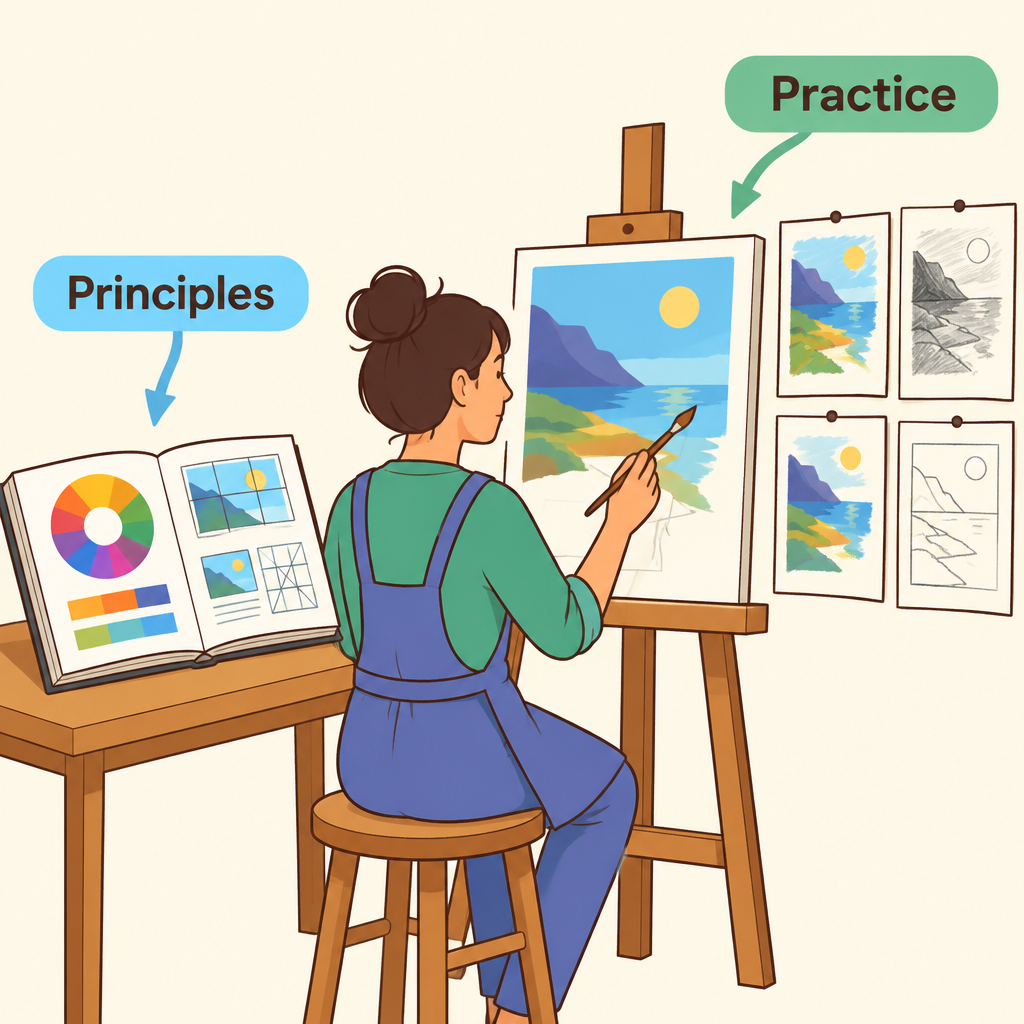
Notice that the open book of principles sits beside several rough trial sketches: the skill comes from using both together.
Painting takes principles plus practice: understand the ideas, then experiment with your own hands until they work for you.
Learning to learn is the same. This lesson gives you principles. The skill grows only when you try them in your own work.
Practice and Reflect on Purpose
Training any skill takes deliberate practice: focused effort with close attention to the result.
For learning, that means noticing how you learn, and not only what you learn.
- Try a strategy: Pick one way of learning and use it.
- Watch the result: Notice how well it worked.
- Reflect: Ask what worked and what did not.
- Adjust: Change the approach, then try again.
Try a strategy. Watch what happens. Reflect on what worked and what did not. Then adjust and try again.
Each round makes your next round of learning a little better.
Look From Many Angles
One explanation gives you one path to an idea. If that path is blocked, you are stuck.
Strong learners approach knowledge from multiple angles. For example: work through an example, explain it in your own words, and link it to another field.
- One idea: Understood from multiple angles.
- Worked example: See the idea in action.
- Your own words: Explain it plainly.
- Another field: Link it to a different domain.
Each angle adds a connection.
Together they build robust understanding that holds up and transfers across domains.
Struggle Is a Feature
Many people treat difficulty as a sign they are learning badly.
Often the opposite is true. Easy learning tends to produce shallow understanding. Smooth reading feels good, but it fades.
Struggle builds depth. Working to recall, solve, or explain forces you to build the idea yourself.
So view difficulty in learning as a feature, not a bug.
Putting It to Work
You can spot this skill in your own work. Ask yourself: am I only collecting facts, or am I improving how I learn?
To explain it to a colleague, say this: learning is a trainable skill, and it compounds over time.
Next time you learn something new, run this short routine.
- Pick a strategy: Choose a way to learn, not just facts to collect.
- Use many angles: Try an example, your own words, and another field.
- Welcome struggle: Treat difficulty as a sign you are building depth.
- Reflect and adjust: Note what worked and change your approach.
Check yourself
The ability to learn effectively is _____.
- a skill that can be trained
- a talent you are born with
Answer: a skill that can be trained
Learning to learn is a meta-skill. Like any skill, it can be systematically developed through deliberate practice and reflection. Even the style of thinking behind great ideas can be learned.
Learning to learn is compared to learning to paint. What does this comparison suggest about how the skill is developed?
- Understand the principles, then practice and experiment yourself
- Read clear explanations until the method is memorized
- Rely on natural talent, since it cannot be taught
- Copy an expert's exact routine without changes
Answer: Understand the principles, then practice and experiment yourself
Painting cannot be mastered by reading about it. Learning to learn works the same way. You need principles plus your own practice, experimentation, and reflection on how you think.
Two students study the same hard topic. One finds it easy and smooth. The other struggles but keeps working. Who is more likely to build deep understanding?
- The student who struggles
- The student who finds it easy
Answer: The student who struggles
Difficulty is a feature, not a bug. Easy learning tends to produce shallow understanding. Productive struggle builds depth.
Keep going
This is lesson 1 of 40 in The Art of Doing Science and Engineering. Next up:
- Preparation Over Memorization
- Fundamentals Over Facts
- Vision Multiplies Success
- Applying Vision Strategically
- Choosing Important Problems
Wondering turns any topic into short lessons you can read, watch, or listen to, with practice questions and an AI tutor.