Free sample lesson · The Arc PMF Framework
Start With Customer Reality
Why can identical technology demand three completely different company strategies?
Lesson 1 of the Wondering course The Arc PMF Framework
What You Will Learn
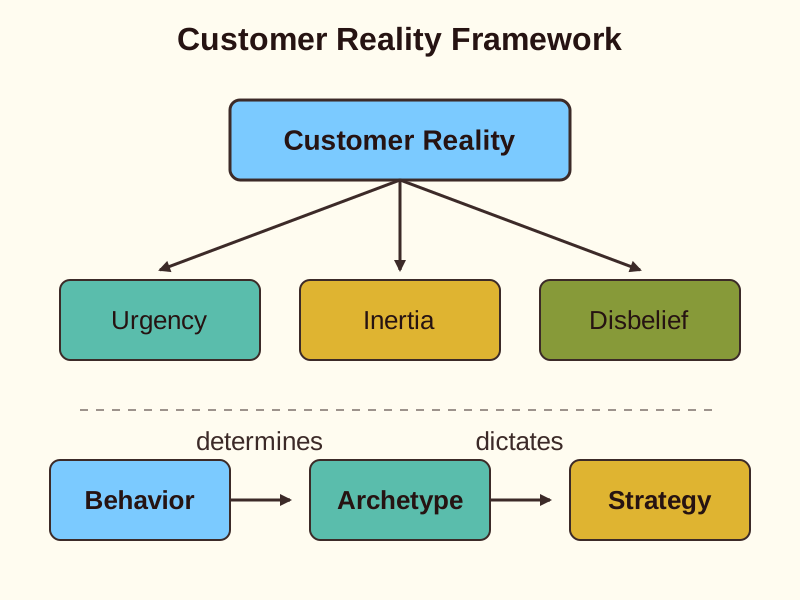
Classifying how customers experience the problem prevents you from copying an operating playbook built for a different market dynamic.
- Core idea
- Customers experience problems differently: How they perceive the problem shapes the market dynamic
- Playbooks are not portable: Copying an operating playbook from a different market dynamic backfires
Classify the customer reality before choosing a strategy.
The Customer Reality Principle
Product-market fit is not a technical category. It is defined by how your customer relates to the problem.
Founders often choose a strategy based on their pitch deck. This is a mistake. You must instead observe customer behavior to find your path.
Identical technology can require different strategies. It all depends on whether the customer feels urgency, resignation, or disbelief.
- The Mistake
- The Reality
Three Archetypes of Demand
The Hair on Fire archetype features customers with urgent needs. They are actively shopping for a solution right now.
In Hard Fact markets, customers know the pain exists. However, they accept it as a normal part of life and do not seek change.
Future Vision involves a new reality. Customers do not yet believe your solution is possible or even desirable.
Matching Strategy to Reality
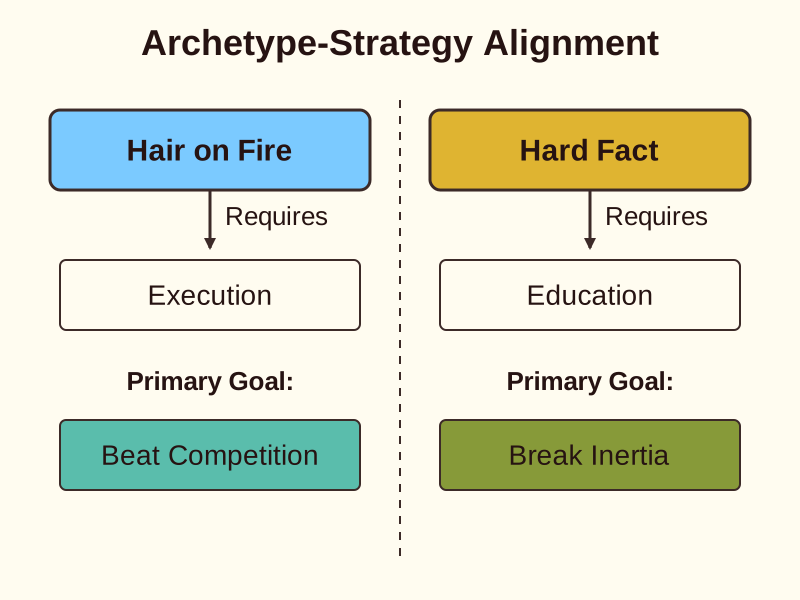
Each archetype has a unique primary obstacle. You cannot use the same playbook for all three.
Hair on Fire markets reward execution. You must beat the competition because the demand is already there.
Hard Fact markets require education. You must convince customers that their old, painful way of working is no longer necessary.
- Hair on Fire
- Hard Fact
Common Strategy Traps
Do not assume Hair on Fire is the only path to success. All three archetypes are viable if you match your operations to them.
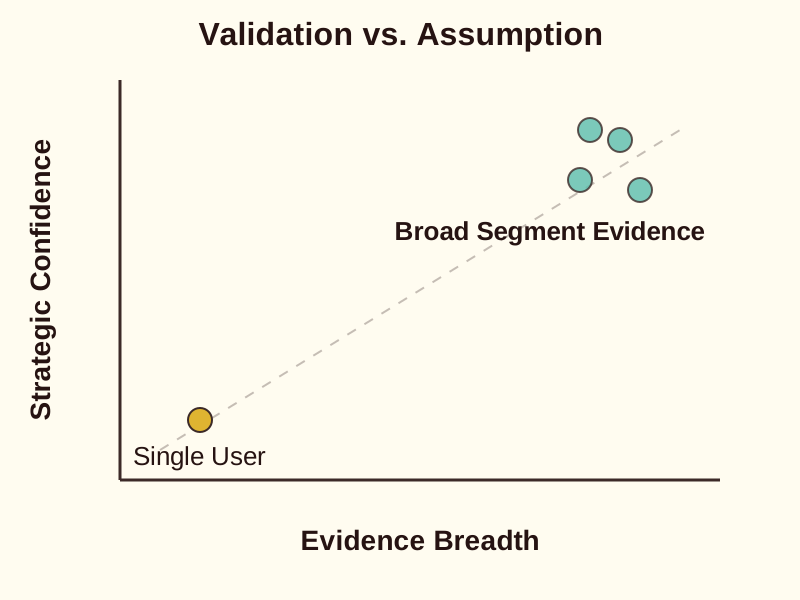
A single enthusiastic user does not prove a market archetype. You need evidence from a broader segment.
Avoid importing tactics from different paths. A strategy built for urgent demand will fail in a market defined by inertia or disbelief.
- Any path works: Do not assume Hair on Fire is the only route; all three archetypes are viable when operations match them.
- Demand evidence: One enthusiastic user does not prove an archetype; look for evidence across a broader segment.
- No imported tactics: A strategy built for urgent demand will fail in a market defined by inertia or disbelief.
How to Apply It in Real Life
- Observe Behavior: Watch if customers are actively seeking workarounds or just complaining.
- Identify Obstacle: Determine if the barrier is competition, inertia, or disbelief.
- Select Playbook: Choose execution for urgency or education for acceptance.
- Validate Segment: Ensure the behavior is consistent across a broad group, not just one fan.
Check yourself
A startup should choose its PMF archetype mainly from its pitch deck and preferred identity.
- True
- False
Answer: False
Incorrect. The archetype depends on how customers experience and respond to the problem, so founders must observe customer behavior rather than rely on their pitch deck.
Customers actively shopping for a solution fit _____; customers accepting pain as normal fit _____; customers who do not believe the new possibility fit _____.
Answer: Customers actively shopping for a solution fit Hair on Fire; customers accepting pain as normal fit Hard Fact; customers who do not believe the new possibility fit Future Vision.
Hair on Fire describes urgency, Hard Fact describes resignation, and Future Vision describes disbelief. These labels are based on customer behavior and beliefs.
A startup finds that small manufacturers complain about slow manual reporting but continue using it because they see the pain as normal. What should be the startup's primary operating priority?
- Education that challenges the accepted way of working
- Execution against competitors in an urgent buying category
- Convincing customers that the technology is physically possible
- Choosing the archetype stated in the founder's pitch deck
Answer: Education that challenges the accepted way of working
The customers are resigned to the problem rather than actively shopping for change. This is a Hard Fact market, so the startup must educate customers that the old, painful way is no longer necessary.
Keep going
This is lesson 1 of 10 in The Arc PMF Framework. Next up:
- Win the Urgent Market
- Turn Resignation Into Change
- Build Belief With Pit Stops
- Prove Your Right to Exist
- Find People Who Care
Wondering turns any topic into short lessons you can read, watch, or listen to, with practice questions and an AI tutor.