Free sample lesson · The AI Opportunity Audit
Map the Work, Not the Feature
A stakeholder asks for an AI summarizer. Which of the eleven steps needs it?
Lesson 1 of the Wondering course The AI Opportunity Audit
Map the Work, Not the Feature
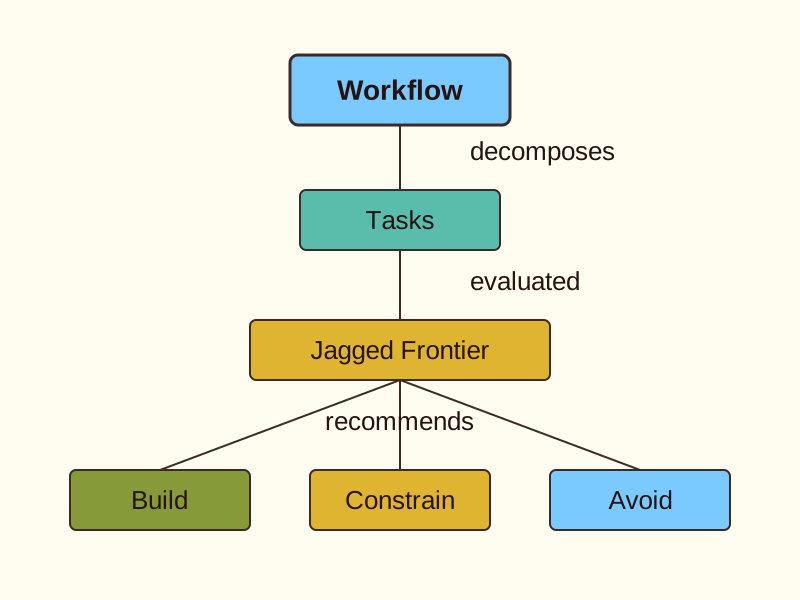
This lesson explores how task decomposition and the jagged frontier help you evaluate workflows before choosing AI solutions.
The Trap of Feature Requests
Stakeholders often ask for specific AI features, like a summarizer. These requests name a solution but hide the actual work.
A feature request is not a plan. It is a starting point for investigation.
To design effective AI, you must look past the feature. You need to map the underlying workflow first.
Decomposing the work prevents you from building AI for steps that are not actually bottlenecks.
- Feature Request
- Underlying Workflow
Decomposing the Workflow
A workflow is a series of steps. Each step has an input, an owner, a decision, and a consequence if it fails.
Consider research synthesis. It involves eleven distinct steps: recruit, schedule, record, transcribe, tag, cluster, name themes, weigh disagreement, write, review, and present.
A summarizer only touches two steps: writing and clustering. It does not help with tagging or weighing disagreement, which often consume the most time.
- Gather: Recruit, schedule, record, and transcribe sessions.
- Analyze: Tag, cluster, name themes, and weigh disagreement.
- Deliver: Write, review, and present findings.
The Jagged Technological Frontier
Model capability is not a single level. It is a jagged frontier where performance varies by task, not difficulty.
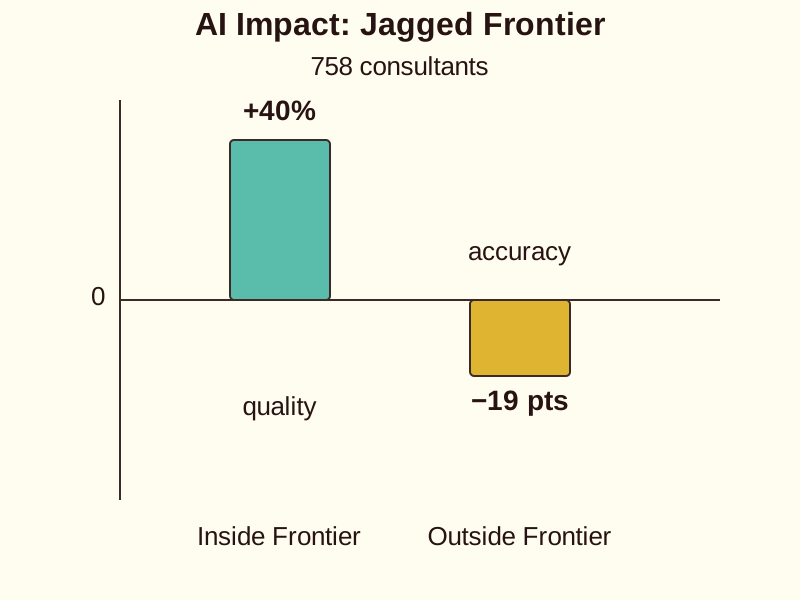
In a study of 758 consultants, AI raised quality by over 40% for tasks inside the frontier.
However, for one task outside the frontier, AI users were 19 percentage points less likely to be correct. Tasks that look equally hard to humans can fall on opposite sides of what a model does reliably.
Locating Capability Claims
You cannot assume a model will handle an easy step just because it handled a hard one. Capability claims must land on specific steps.
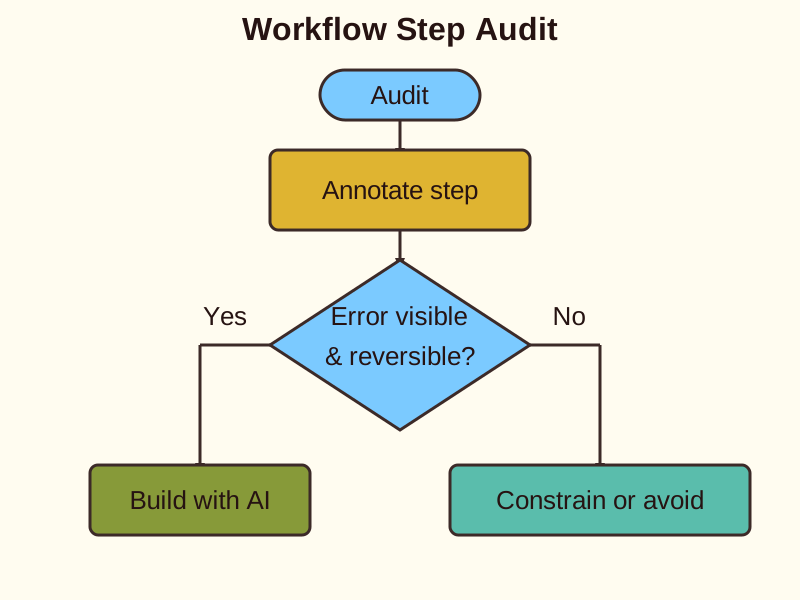
When auditing a workflow, annotate each step. Focus on whether an error is easy to notice and if it is reversible.
This evidence allows you to defend a recommendation to build, constrain, or avoid AI entirely for that specific part of the process.
Putting It All Together
- Decompose Work: Break the support process into distinct steps with inputs and owners.
- Locate on Frontier: Determine whether intent tagging falls inside or outside model capabilities.
- Defend Recommendation: Evaluate error noticeability and reversibility to decide AI deployment.
Check yourself
A stakeholder asks for an AI feature like a summarizer. Does this request map the underlying workflow or hide its steps?
- It hides its steps
- It maps the underlying workflow
Answer: It hides its steps
A feature request names a proposed solution and hides the workflow steps, inputs, owners, decisions, and failure consequences.
In the research synthesis workflow, the analysis phase moves from initial organization to deep evaluation: first you _____ information, then you _____ related notes, next you _____, and finally you _____.
Answer: In the research synthesis workflow, the analysis phase moves from initial organization to deep evaluation: first you tag information, then you cluster related notes, next you name themes, and finally you weigh disagreement.
Decomposing the analysis phase reveals four distinct sequential steps: tag, cluster, name themes, and weigh disagreement.
An AI model successfully handles a complex step in a workflow, but fails on a simpler-looking step in the same process. Why does this occur?
- Model capability varies across a jagged frontier by task type, not human perceived difficulty.
- The model experienced context window exhaustion during the simpler step.
- The workflow was decomposed into too many steps for the model to track.
- AI performance scales linearly, so the simpler step had undetected technical requirements.
Answer: Model capability varies across a jagged frontier by task type, not human perceived difficulty.
Model capability is shaped like a jagged frontier where tasks of similar apparent difficulty to humans fall on opposite sides of what a model does reliably.
Keep going
This is lesson 1 of 8 in The AI Opportunity Audit. Next up:
- Watch the Work, Don't Ask About It
- A Probe Set Beats a Demo
- Grade the Artifact, Not the Vibe
- Read Your Own Numbers
- Five Ways It Can Fail
Wondering turns any topic into short lessons you can read, watch, or listen to, with practice questions and an AI tutor.