Free sample lesson · Temporal vs. Airflow: Choosing the Right Workflow Orchestrator
The DAG Scheduler Model
Lesson 1 of the Wondering course Temporal vs. Airflow: Choosing the Right Workflow Orchestrator
Workflows as Graphs
Airflow does not treat a pipeline as a script that runs top to bottom.
It treats it as a Directed Acyclic Graph, or DAG. Tasks are nodes. Dependencies are arrows between them.
Directed means each arrow points one way. Acyclic means no arrow ever loops back.
That second rule matters: a cycle would leave the scheduler waiting forever.
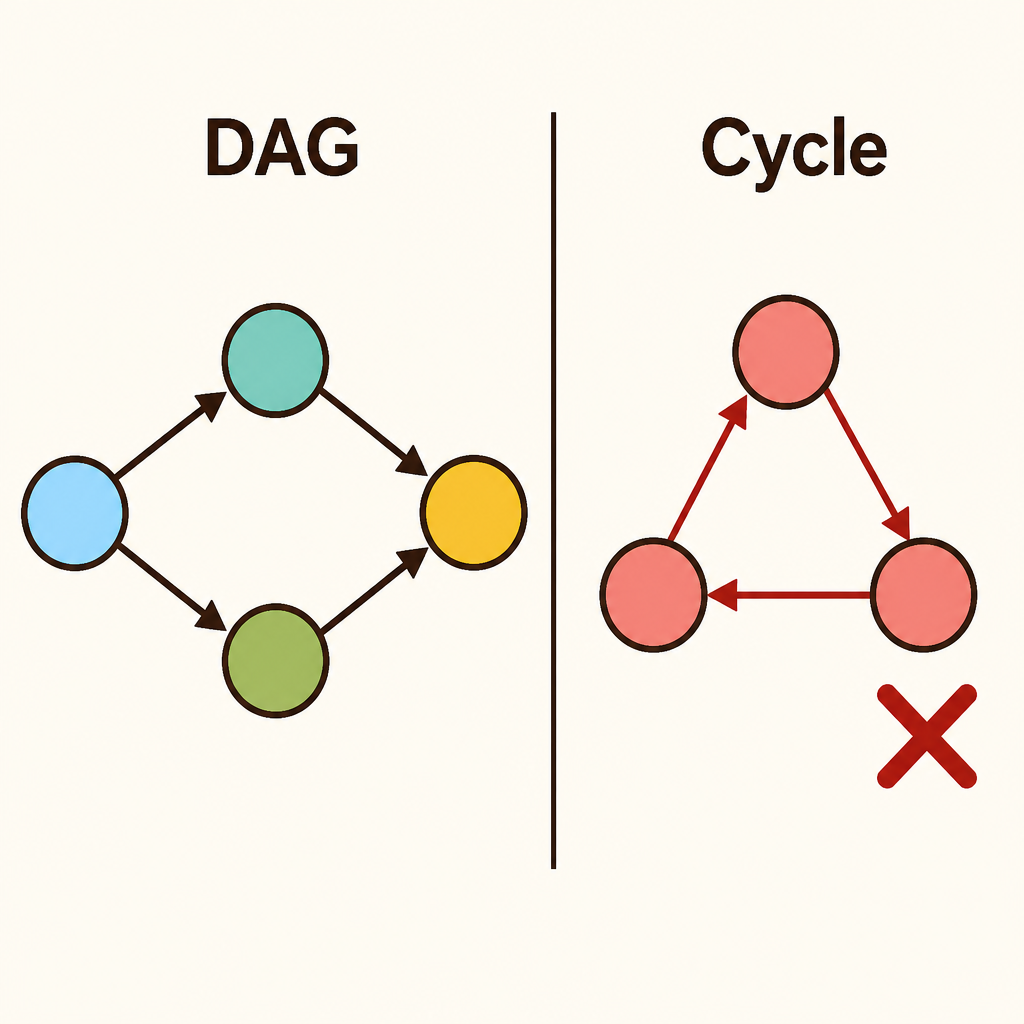
Notice that every arrow in the valid graph moves forward, while the rejected version loops back on itself and could never finish.
Defined in Python
A DAG is not written in a configuration file. It is written in Python code.
This means pipelines can use loops, functions, and conditionals to build tasks dynamically.
Your Python file is a definition, not a run. Airflow reads it to learn the shape of the graph.
The actual execution happens later, and it is the scheduler that decides when.
- Python file
- Scheduler run
How the Scheduler Dispatches
The scheduler is the part of Airflow that keeps asking one question: what is ready to run right now?
It parses the DAG files, checks each task against its dependencies, and looks at what has already finished.
If every upstream task has succeeded, the task becomes eligible and is queued for a worker.
If not, it waits and the scheduler checks again on its next pass.
- Parse DAG files: The scheduler reads the graph definitions.
- Check dependencies: It compares each task against what has already finished.
- Upstream succeeded?
- Queue for worker: The task becomes eligible and is handed to a worker.
- Wait: The task stays pending until the next pass.
- next pass
The Metadata Database
Airflow needs somewhere to remember what happened. That place is the metadata database.
It normally runs on Postgres or MySQL.
Every task state lives there: whether a task is queued, running, succeeded, or failed.
The scheduler reads that stored state to decide the next move, so the database is the shared memory of the whole system.
The Life of a Task
A single task moves through a sequence of recorded states.
It starts as scheduled once its dependencies are met, then becomes queued when handed to a worker.
It turns running while the work happens, and ends as succeeded or failed.
Each change is written back to the metadata database, so a restarted scheduler picks up exactly where things stood.
- Scheduled: The task's dependencies are met and it is eligible.
- Queued: The task is handed to a worker.
- Running: The work is actually happening.
- Succeeded or failed: The final outcome is written back to the metadata database.
Three Parts, One System
Airflow's model rests on three pieces that depend on each other.
The DAG in Python describes the shape. The scheduler decides timing. The metadata database holds the truth about state.
Remove any one and the model breaks: no graph means no dependencies, no scheduler means nothing dispatches, no database means no memory.
- DAG in Python: Describes the shape of tasks and dependencies.
- Scheduler: Decides which tasks are ready to run.
- Metadata database: Holds the truth about task state.
- Worker: Runs the task once it is queued.
Why the Rules Hold
The acyclic rule is not a stylistic preference. It is what makes scheduling decidable at all.
Because arrows never loop, there is always a task with no unfinished upstream work, so progress is guaranteed.
Sit with that for a moment before you write your next pipeline.
Check yourself
A workflow graph contains no dependency loop that returns to an earlier task. Is this graph acyclic?
- Acyclic
- Cyclic
Answer: Acyclic
Correct. A DAG must be acyclic, so its dependency arrows cannot form a loop. A cycle could leave the scheduler waiting indefinitely.
A task becomes _____ after its dependencies are met, then _____ for a worker, _____ during execution, and finally _____.
Answer: A task becomes scheduled after its dependencies are met, then queued for a worker, running during execution, and finally succeeded or failed.
The task lifecycle begins when dependencies are met and the task is scheduled. It is then queued for a worker, runs while work is performed, and ends in success or failure.
A task has two upstream tasks: one succeeded and one failed. What should the scheduler do with the downstream task?
- The scheduler leaves the task waiting because an upstream task failed
- The scheduler queues the task because only running upstream tasks matter
- The scheduler runs the task immediately because Python defines it
- The scheduler marks the task succeeded because the database stores it
Answer: The scheduler leaves the task waiting because an upstream task failed
The scheduler checks dependencies and stored task states. A task is eligible only when every upstream task has succeeded; it is then queued for a worker. A task with a failed upstream dependency is not eligible under the stated model.
Keep going
This is lesson 1 of 9 in Temporal vs. Airflow: Choosing the Right Workflow Orchestrator. Next up:
- Failure Handling in Airflow
- Airflow's Strengths: Providers and Scheduling
- Durable Execution: The Core Idea
- Workflows as Code
- Time and Signals in Temporal
Wondering turns any topic into short lessons you can read, watch, or listen to, with practice questions and an AI tutor.